Building team spirit and choosing a captain in football
How team cohesion develops, what damages it, when a permanent captain makes sense, how to choose one and why good teams have several leaders.
What is team spirit?
A collection of good players is not yet a good team. Team spirit means the players pursue shared goals, accept each other and sometimes put their own interests behind the team's. They help each other when things aren't going well and stick to shared rules.
Cohesion and performance are linked. A 2002 meta-analysis by Carron and colleagues pooled 46 studies from many sports. It found a moderate to large relationship between cohesion and performance, in both directions: cohesion helps success, and success strengthens cohesion. So team spirit is about more than just the mood.
Where team spirit comes from
The German textbook authors Bisanz and Gerisch name several building blocks:
- Shared goals: the team agrees on goals that are realistic, concrete and stated positively. Goals set by the coach alone carry less weight.
- Rules that apply to everyone: how to set them together is explained in Team rules in football.
- Clear roles: everyone knows their job, on the pitch and off it.
- Mutual acceptance: different characters and ability levels are accepted.
- Taking responsibility: players get tasks, not just instructions.
How to build team spirit day to day
Team spirit grows mainly in normal training, not on a one-off trip.
- Rituals: greet and say goodbye to every player by name, a shared huddle before and after training or a match, a team chant. Rituals give structure and make the group visible.
- Mix the teams in training: put teams together on purpose in games, so the same friends don't always play together. Tasks that can only be solved together bring together players who otherwise have little to do with each other.
- Share responsibility: every player leads the warm-up once per half season. With younger players, the children can choose the warm-up game. Others look after balls, bibs or the team kitty.
- Notice the quiet ones: every team has players who never stand out and never ask for anything. They are the easiest to lose. Pick two names every week and have a short conversation with each about something specific.
- Bring in new players: give newcomers a buddy from the team, explain the rules and rituals and make sure they aren't left on the fringes in their first weeks.
- Time together off the pitch: a barbecue after the last session, a tournament, a team trip. That strengthens the bond. Adventure activities such as a ropes course or rafting produce a quick "aha" moment. But you shouldn't expect deep effects from a single event, say Bisanz and Gerisch.
What damages cohesion
Problems usually show early. Typical disruptions are:
- Perceived unfairness: different rules for some, playing time handed out by sympathy.
- Cliques that exclude others. Friendships within the team are normal. It only becomes a problem when groups work against each other.
- Criticism in front of others: criticising team-mates in front of spectators or on social media is off limits. Criticism belongs in private, factual and about the behaviour.
- Selfishness, for example when someone doesn't chase back after losing the ball and leaves the running to the others.
- Smouldering conflicts: not every argument needs the coach. But if a conflict drags on for weeks, address it before it splits the team.
When to appoint a captain?
We didn't find a fixed age rule for this in the football associations' materials. From coaching practice, this has proven itself:
- Children's football (up to about U11): no permanent captain. The armband moves to a different child every match. That way every child feels valued and proudly leads the team out once. In the same spirit, penalties and free kicks shouldn't always be taken by the same players.
- From about U12/U13: a permanent captain or a small leadership group of two or three players is possible. Many coaches still change the captain at the halfway point of the season at this age, so several players get to know the role.
- From about U15 and in adult football: a permanent captain for the season, plus one or two vice-captains and ideally a leadership group.
Important for matches in Germany: since 2024/25 the captain rule has applied in all leagues, including youth football. Only the captain may approach the referee to have an important decision explained, the others keep their distance. According to the DFB, the captain is also responsible for making sure team-mates respect the referee. If the goalkeeper is captain, an outfield player is named to the referee before the match who may approach them instead.
How do I choose the captain?
There are three ways:
- The coach appoints the captain. It's quick, but the team doesn't necessarily stand behind the decision.
- The team votes. The captain has the team's backing, but the vote can turn into a popularity contest.
- A mix: the team votes and the coach confirms, or proposes candidates beforehand. For youth and adult teams this is often the best way.
Before the vote, say what makes a good captain: a role model in effort and behaviour, someone who speaks for the team, sticks to the rules, looks out for others and stays calm when the team is behind. The best player is not automatically the best captain.
Good teams have several leaders
The research group led by Katrien Fransen at KU Leuven studied who really leads in teams. Their finding: the captain is overrated as a leader. Usually other players lead too, on the pitch and off it. The researchers distinguish four roles:
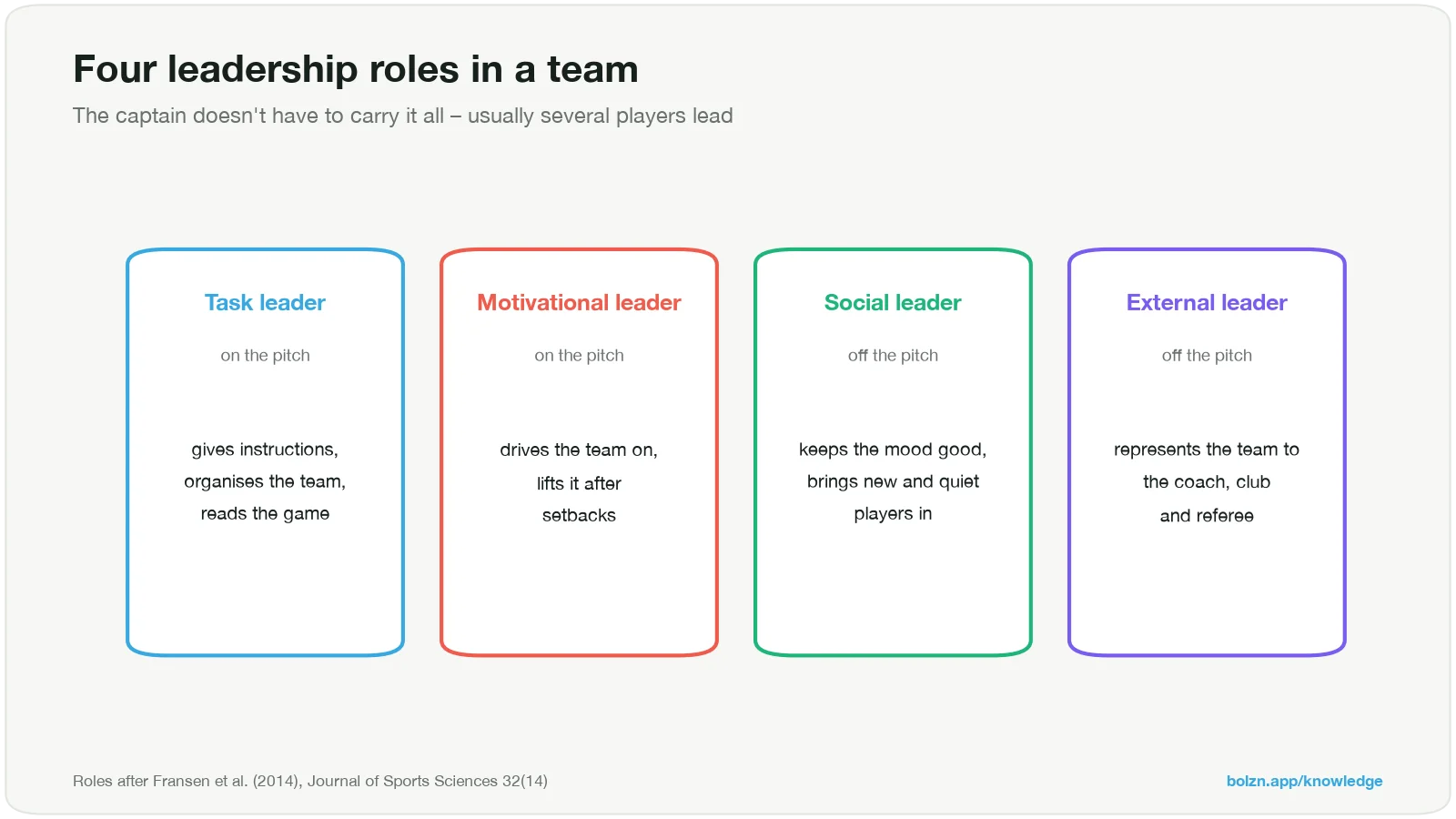
- Task leader: gives instructions on the pitch and organises the team.
- Motivational leader: drives the team on during the game and lifts it after setbacks.
- Social leader: keeps the mood good off the pitch and brings everyone into the team.
- External leader: represents the team to the coach, the club and the referee.
One player rarely fills all four roles. For you as a coach, that means: look at who already takes on which role in your team, and strengthen those players deliberately. A leadership group with the captain and two or three other players spreads the responsibility across several shoulders. Involve the group in important decisions, such as rules or team trips. Decisions about the line-up and training stay with the coach.
For children: responsibility can be learned. Not everyone is a born leader, and that's fine. Players who get small tasks and are trusted with something take on more responsibility over time by themselves.
Sources
- Carron, A. V., Colman, M. M., Wheeler, J. & Stevens, D. (2002). Cohesion and performance in sport: a meta analysis. Journal of Sport & Exercise Psychology, 24(2), 168–188.
- Fransen, K., Vanbeselaere, N., De Cuyper, B., Vande Broek, G. & Boen, F. (2014). The myth of the team captain as principal leader: extending the athlete leadership classification within sport teams. Journal of Sports Sciences, 32(14), 1389–1397.
- Bisanz, G. & Gerisch, G.: Fußball – Kondition, Technik, Taktik und Coaching. Meyer & Meyer (chapters on team building and team spirit, building a leadership structure).
- Age-appropriate football training in childhood and adolescence, final thesis for the Austrian FA coaching course (chapter on responsibility and the captain's armband in children's football).
- German Football Association (2024): FAQ on the introduction of the captain rule and captain rule information page, dfb.de.
- Practical guide for youth coaches: culture, discipline and the dressing room.