Parents on the touchline: what helps kids in youth football
Cheer, don't coach, the ride home, pressure and fun: what kids tell researchers they want from parents at football, and how to handle conflict.
What should parents do on the touchline?
The short answer: be there, cheer, and leave the rest to the kids and the coach. Children love it when their parents watch. But they don't want instructions from the side, rows with the referee or a match analysis on the way home. What they want is praise for effort and attitude, calm body language and the feeling that the result doesn't change how their parents see them.
That isn't just gut feeling. Several studies have asked children and teenagers directly what helps them, and the answers are remarkably consistent.
What kids want from their parents
Sport psychologist Camilla Knight and colleagues asked young athletes. In focus groups, 42 high-level Canadian tennis players aged about 13 said (Knight, Boden & Holt, 2010): parents should not give technical or tactical advice. They should praise effort and attitude, help with practical things (food, kit, lifts) and make sure their body language matches their words. Shouting "well done" while clutching your head sends two messages.
A second study with 36 girls from team sports (Knight, Neely & Holt, 2011) found that the wishes change with timing: practical preparation before the game, support and encouragement during it, and feedback that suits the child afterwards.
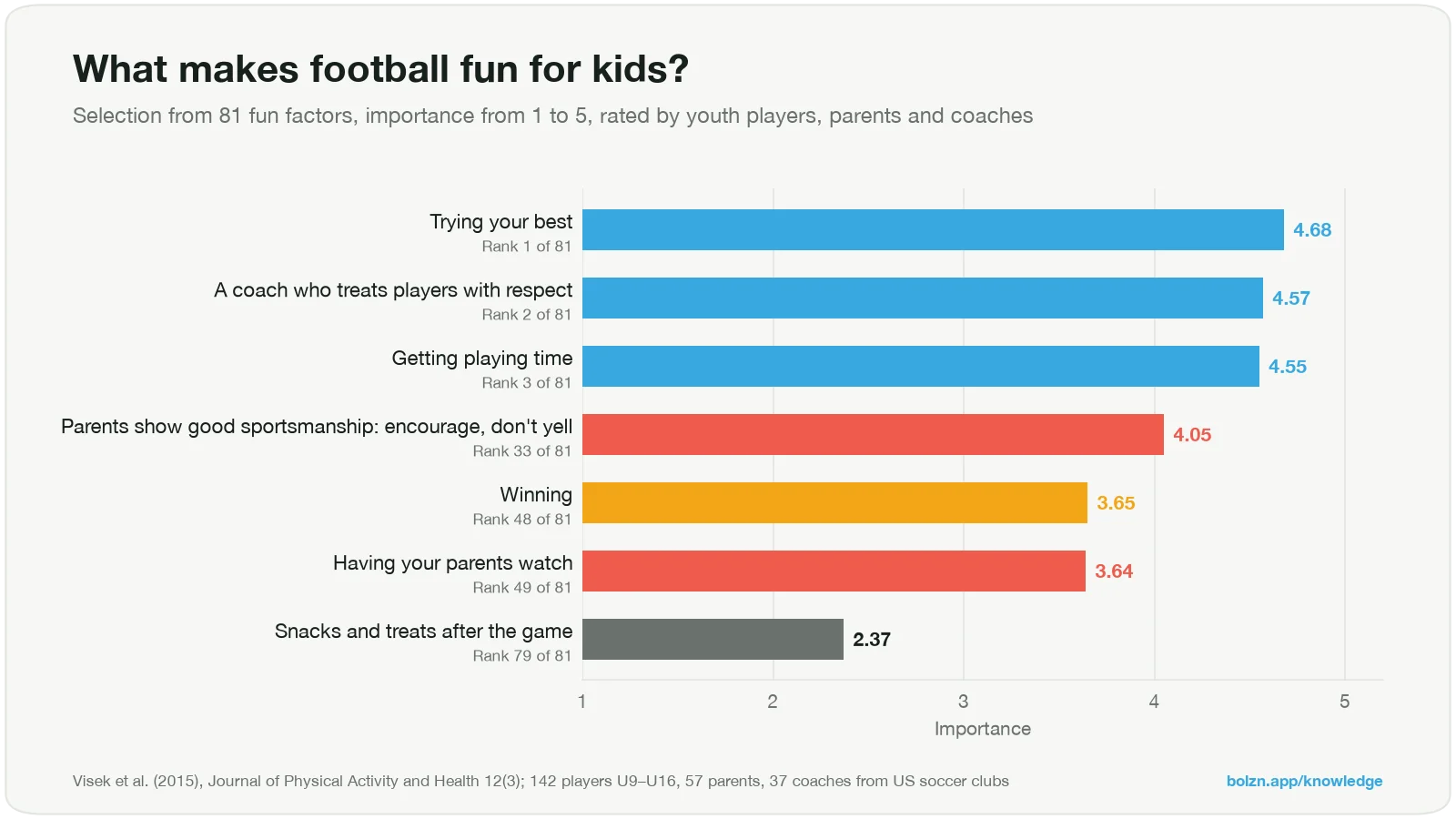
What makes football fun in the first place was studied by Amanda Visek and her team in the US (Visek et al., 2015). 142 soccer players from U9 to U16, 57 parents and 37 coaches came up with 81 things that make the game fun and rated each from 1 to 5. Trying your best came first, a coach who treats players with respect second, getting playing time third. Winning only made 48th. "Parents show good sportsmanship: encouraging, not yelling" scored 4.05, well ahead of winning.
Cheer, don't coach
The most common touchline problem isn't abuse. It's well-meant shouting: "Shoot!", "Pass it!", "Get back!". The child then has two voices in their head, yours and the coach's, and they often say different things. And the child is supposed to be learning to make their own decisions. In German children's football that's even a rule: in the Fair Play League there's no referee, the coaches hold back and parents keep their distance. More in Funino and the Fair Play League.
| Helps | Hurts |
|---|---|
| "Great, keep going!" | "Just shoot!" |
| "Great effort!" | "Concentrate!" |
| Applause for both teams | Cheering when the other team makes a mistake |
| After a mistake: "Head up, next ball!" | Sighing, head-shaking, throwing your arms up |
| Staying calm when your child is on the bench | Asking loudly why they're not playing |
The German FA (DFB) gives parents a simple tip in its fair play flyer: say what should happen, not what shouldn't. So "Listen to your coach!" rather than "Stop chatting!".
Referees, opponents and coaches
- Referees: in youth football they're often teenagers themselves. Every decision you criticise out loud teaches your child that this is normal. The FA in England has parents sign a Respect code of conduct: always respect the referee and coaches, and stay behind the touchline. Breaking it can mean a warning, being asked to leave, or losing club membership.
- Opponents: good play by both teams deserves applause. Your own child's fouls don't deserve praise.
- Coaches: the coach decides the line-up, positions and substitutions. If you disagree, talk to them, but not on the touchline and not at half-time.
The ride home
For many kids the drive home after a match is the worst part of the weekend. Australian researchers Samuel Elliott and Murray Drummond talked to 86 parents and children in junior Australian football (2017). They found that many parents run a kind of debrief of their child's performance after the game, and depending on how they do it, it either strengthens or undermines the child's enjoyment.
A study from Canada actually filmed these rides (Tamminen et al., 2022): 98 videos from 28 parent-child pairs, the children aged 11 to 16. Sport took up only 13 percent of the time; 59 percent was silence. Parents praised their child's performance more than the child did. But they mostly asked closed questions, and sometimes kept talking before the child could answer.
How to make the ride home better:
- Let your child start. If they want to talk about the game, they will.
- Open questions, not verdicts: "What was fun today?" rather than "Why didn't you shoot?"
- Let them finish. Even if there's a pause.
- Analysis is the coach's job. If your child wants to talk about a mistake, listen rather than correct.
- US coaches Bruce Brown and Rob Miller recommend parents say one sentence after a game: "I love to watch you play."
Pressure, fun and dropping out
When kids quit football there's rarely just one reason. A systematic review of 43 studies (Crane & Temple, 2015) found five main areas: lack of enjoyment, feeling not good enough, social pressure, other priorities, and physical reasons such as growth or injury. Pressure from outside is part of it, including pressure from parents.
A study of 723 young athletes from basketball, handball, football and volleyball and one parent each (Sánchez-Miguel et al., 2013) points the same way: kids who felt supported by their parents enjoyed their sport more. Kids who felt pressure enjoyed it less and were less motivated. That's an association from a survey, not proof of cause and effect, but it fits everything children say themselves.
An honest self-check
The DFB's fair play flyer asks parents ten questions. The more often you answer no, the better. Some of them:
- Are you often unhappy with your child's performance?
- Does it annoy you when your child is on the bench while "weaker" kids play?
- Do you get angry when your child doesn't follow your football advice?
- Do you tell your child after the game everything they did wrong?
What makes a good football parent?
In 2015 sport psychologists Chris Harwood and Camilla Knight summed up what "expertise" as a sport parent means. Good sport parents
- choose suitable opportunities and give the right kind of support,
- use a supportive parenting style that leaves room for the child's own decisions,
- manage their own emotions during competition,
- build good relationships with coaches, other parents and the club,
- handle the organisation that comes with the sport,
- adapt their role as the child gets older.
Point 6 matters: a five-year-old needs you as driver, comforter and fan. A 15-year-old mostly needs someone for whom football isn't the only topic.
What to do when there's conflict
With the coach: 1. Not on the touchline, not at half-time, not straight after the game. Sleep on it. 2. Ask for a one-to-one chat, through the channel the coach gave you. 3. Ask instead of accusing: "What does my child need to get more minutes?" 4. If that doesn't help, the club's youth coordinator is the next step.
When other parents lose it: don't join in, keep your distance, tell the coach or youth coordinator. The DFB advises clubs to react clearly and promptly when parents become abusive on the touchline. That's the club's job, not yours.
When it's something more serious: if your child tells you about situations that worry you, such as verbal abuse, boundaries being crossed or private messages from an adult, contact your club's welfare officer. Who that is should have been explained at the parents' meeting; if not, ask the youth coordinator.
When you can't be there
You don't have to be at every game. In Visek's study, "having your parents watch" sat in the middle of the fun factors, behind many things to do with the game itself. In the bolzn app the coach can run a live ticker that parents can follow in the browser without the app, and ride sharing helps your child find a lift. Afterwards, the question that counts is "How was it?", not "What was the score?".
Sources
- Knight, C. J., Boden, C. M. & Holt, N. L. (2010). Junior tennis players' preferences for parental behaviors. Journal of Applied Sport Psychology, 22(4), 377–391.
- Knight, C. J., Neely, K. C. & Holt, N. L. (2011). Parental behaviors in team sports: How do female athletes want parents to behave? Journal of Applied Sport Psychology, 23(1), 76–92.
- Visek, A. J. et al. (2015). The fun integration theory: Toward sustaining children and adolescents sport participation. Journal of Physical Activity and Health, 12(3), 424–433 (Table 2).
- Elliott, S. K. & Drummond, M. J. N. (2017). Parents in youth sport: What happens after the game? Sport, Education and Society, 22(3), 391–406.
- Tamminen, K. A., Bissett, J. E., Azimi, S. & Kim, J. (2022). Parent and child car-ride interactions before and after sport competitions and practices. Psychology of Sport and Exercise, 58, 102095.
- Crane, J. & Temple, V. (2015). A systematic review of dropout from organized sport among children and youth. European Physical Education Review, 21(1), 114–131.
- Sánchez-Miguel, P. A. et al. (2013). The importance of parents' behavior in their children's enjoyment and amotivation in sports. Journal of Human Kinetics, 36, 169–177.
- Harwood, C. G. & Knight, C. J. (2015). Parenting in youth sport: A position paper on parenting expertise. Psychology of Sport and Exercise, 16, 24–35.
- DFB (2026). Fair bleiben, liebe Eltern! (parents' flyer) and Verantwortung leben: Kinder- und Jugendschutz im Vereinsfußball, pp. 62–65.
- The FA. Respect Code of Conduct: Spectators and Parents/Carers.