Parents' meeting in youth football: agenda, topics, template
When to hold a pre-season parents' meeting in youth football, what goes on the agenda and how to answer the hard questions about playing time and line-ups.
Why hold a parents' meeting before the season?
Most trouble with parents doesn't come from bad intentions. It comes from expectations nobody said out loud. One mum thinks her son will play every minute. One dad thinks the coach picks the strongest side. The coach thinks everyone knows that cry-offs have to come in by Thursday. A parents' meeting at the start of the season puts these expectations on the table before they collide on the touchline.
In short: one evening, about 60 minutes, shortly before the first match. The agenda covers your aims, your rules on playing time and line-ups, dates, lifts and costs, how to reach you, what you expect from parents on the touchline and who in the club deals with safeguarding. Questions come at the end. Afterwards, send everyone a one-page summary.
Associations and clubs recommend the same. The Bertelsmann Stiftung's checklist for German youth football officials lists a parents' evening at the start of the season, held together with the youth coaches. The German FA (DFB) advises in its 2026 safeguarding brochure to use that evening to present the club's safeguarding policy and contact people. Some clubs make it compulsory for their coaches. The Bambini coaching folder of FCK Frohnau in Berlin, for example, requires two meetings a year, before the season and before the second half of the season, both with support from the youth department.
When, and for how long?
- Timing: one or two weeks before the first match, once the squad is settled. A second, shorter meeting before the second half of the season is worth it if something has changed (new league, new coaches, lots of new kids).
- Length: about 60 minutes. Few people concentrate longer, and parents coming from work want to be home by half past eight.
- Place: the clubhouse or a changing room, not the touchline. People who sit down listen.
- Children: with the youngest age groups it's practical to meet straight after training while an assistant coach keeps the kids playing. From about U13 you can bring the players in for part of it, for example to agree the team rules or to introduce the captain and team council (see Team spirit and choosing a captain).
- Short version: if a full evening isn't possible, 20 minutes after a training session will do, as described in Team rules in football. But then send a written summary.
The quickest way to find a date is a poll with two or three options. Then send the invitation with a short agenda, so parents know it's about more than the barbecue rota.
Parents' meeting agenda: what to cover
| Topic | What you say | Why it matters |
|---|---|---|
| Introductions | Who you are, who's on the coaching team, that you're volunteers | Parents often only know your name |
| Aims and philosophy | What the kids should learn this season. Whether it's about development or league position | The basis for every later discussion |
| Playing time and line-ups | Your rule on minutes and positions, openly and specifically | The most common source of conflict |
| Training and dates | Training times, match days, tournaments, holidays, deadline for cry-offs | Saves you questions every week |
| Lifts and jobs | Car pooling, kit washing, cakes for home games, helpers on match day | Children's football barely works without parents |
| Costs | Fees, extra payments for tournaments or camps, what the team kitty is for | Money is touchy; transparency takes the heat out |
| Communication | One channel, set times, no talks on the touchline or at half-time | Protects you and the kids |
| Touchline rules | Cheer, don't coach. Distance, respect for referee and opponents | Parents often don't realise the effect they have |
| Safeguarding | Who the club's welfare officer is, how to reach them, rules on photos and messages | Parents need to know where to turn |
Playing time and line-ups: be specific
This is where a quiet season is won or lost. "Everyone gets to play" isn't enough. Say what you actually do:
- Children's football (up to U11): everyone plays, roughly equal minutes over the season, in several positions. In Germany's 3v3 festival format the kids rotate anyway, and the DFB aims for at least 75 percent playing time per child. More in Funino and the Fair Play League.
- A fixed minimum: some clubs set one. In the coaching handbook of Swiss club FC Glarus, for example, every U9 player is on the pitch for at least half of every game (exceptions only in semi-finals and finals), and every child who wants to go in goal gets at least one game there each match day.
- From U13 upwards: if performance, training attendance or attitude affect playing time, say so openly, and tell players how they can earn more minutes. The differences between grassroots and elite pathways are explained in Grassroots and elite youth football.
Safeguarding: brief, but don't skip it
Five minutes is enough. Among other things, the DFB's brochure Verantwortung leben (2026) recommends:
- The club's safeguarding contact people are named and visible to parents, with a way to reach them.
- Communication goes through official club channels: the team group, club e-mail or the club's platform, not private one-to-one messages from adults to children.
- Photos and videos only with consent. Nothing is published without the parents' written permission, and never in changing rooms or showers.
- Coaches and helpers who work with children regularly provide an enhanced criminal record check (in Germany the erweitertes Führungszeugnis).
You don't have to be the expert. It's enough to say there's a policy and who is responsible.
Running order: a parents' meeting in 60 minutes
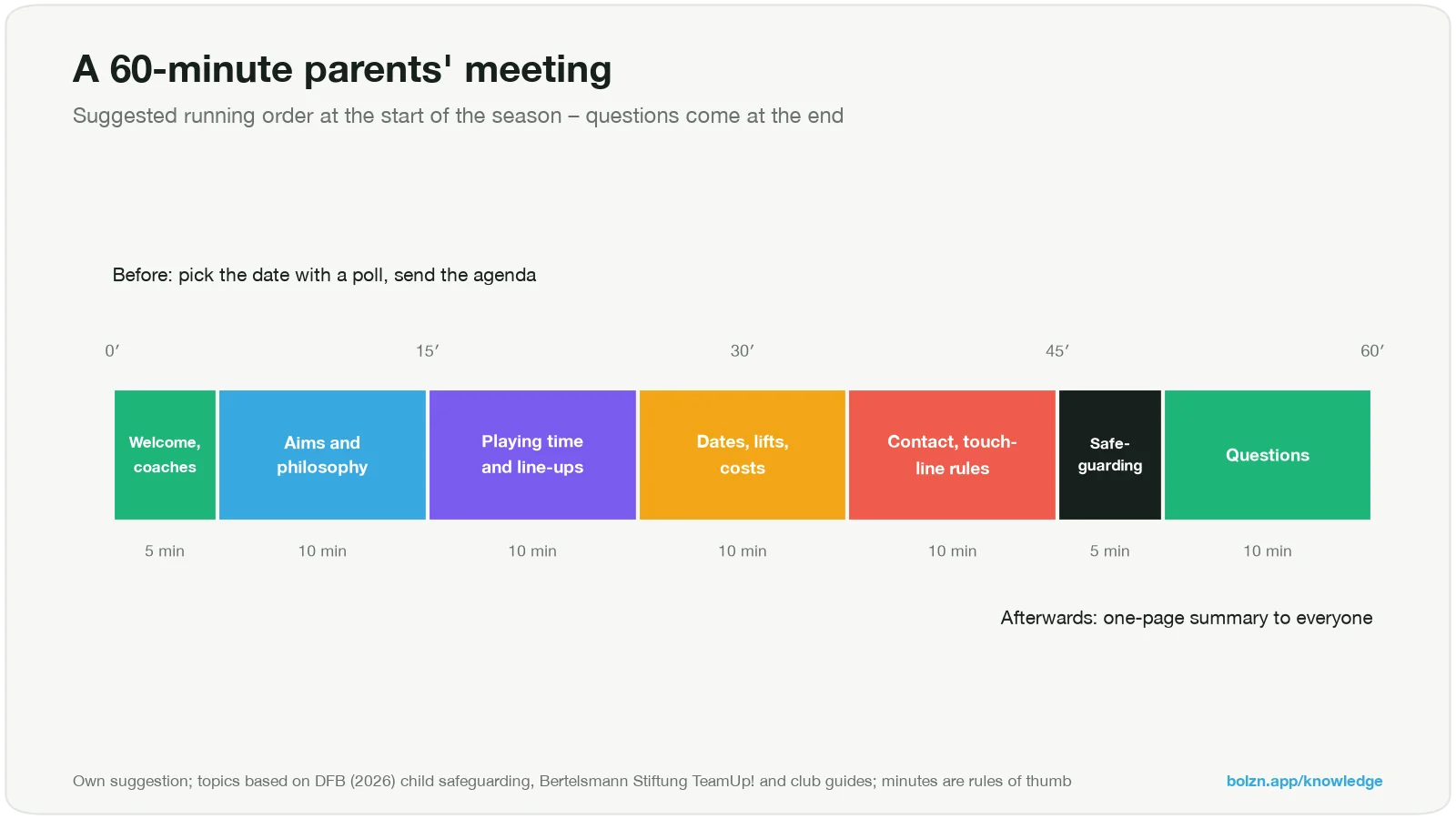
This order works well. The minutes are rules of thumb:
| Minute | Block | Tip |
|---|---|---|
| 0–5 | Welcome, coaching team introduces itself | Name badges for parents help you all year |
| 5–15 | Aims and philosophy | One example from training says more than a mission statement |
| 15–25 | Playing time and line-ups | State the rule, don't justify it |
| 25–35 | Dates, lifts, costs | Pass the sign-up sheet round right away |
| 35–45 | Communication and touchline rules | Three rules beat ten |
| 45–50 | Safeguarding | Invite the welfare officer if you can |
| 50–60 | Questions | Questions about one child: "Let's talk about that one to one" |
Questions belong at the end. Ask for questions at the start and you'll spend an hour on last weekend's tournament.
Checklist: before, during, after
Before - Agree the date, send the invitation with the agenda - Ask the youth coordinator or welfare officer to come along - Put the fixture list, costs and contact details on one page each - Prepare a sign-up sheet for lifts, kit washing and match-day helpers
On the evening - Attendance list, so you know who to update afterwards - Stay calm if it gets heated. No child is discussed in front of everyone - Let volunteers sign up for jobs on the spot
Afterwards - A one-page summary to everyone, including those who didn't come - Settle any individual questions within a week
Not every parent will come. The DFB advises accepting that and making the information available anyway: at pick-up, on a notice board or online.
Hard questions and good answers
"Why does my child play less than the others?" Don't say "That's not true." Say: "Let's look at it calmly after training." If you note down minutes, you'll have numbers instead of impressions.
"Why is there no league table? How will they learn to win?" In children's football every game is still won or lost, the results just aren't added up over the season. The full answer is in Funino and the Fair Play League.
"My child is too good for this team." Explain how your club handles strong players: training with an older group, regional development centres, trials. Don't promise anything you can't decide.
"Why is my son always in defence?" Because kids should learn every position, and because you rotate. If you don't rotate, it's a fair question.
"I don't agree with your decision." That's allowed. Offer a conversation, just not on the touchline and not straight after the match. For parents who want a say in everything, the DFB suggests: value their commitment, but make it clear that decisions about training are made by the coaches.
When parents cross the line
A parents' meeting prevents a lot, but not everything. If parents shout from the touchline, insult children or pile on pressure, the DFB recommends reacting clearly and promptly, but respectfully. Talk first; there's often stress or worry behind it. If it happens again, consequences follow, carried by the club, not by you alone. A parents' code of conduct handed out at the start of the season helps, for example:
- I support my child without putting pressure on them.
- I respect the decisions of coaches and referees.
- I raise concerns directly with the coach or the welfare officer.
- I'm aware that I'm a role model.
In England, The FA's Respect code for spectators and parents does the same job. What actually helps on the touchline is something you can pass on to parents with Parents on the touchline.
After the season
A short review at the end of the season closes the loop: what went well, what should change? That can be five minutes at the end-of-season party or an anonymous poll with three questions. The Bertelsmann Stiftung lists this debrief as a step at the end of the season. Ask, and you hear about problems before they turn into complaints.
Organising the parents' meeting with bolzn
The bolzn app has tools that fit. Use a poll to agree the date, anonymously if you like. You can cap the sign-ups per option, for example at three drivers for the away tournament. In bring lists everyone signs up for cakes or drinks themselves. For training and matches players and parents reply yes or no, with a deadline, and ride sharing lets them ask for a lift. The team kitty shows the team who has paid. That way, some questions at the meeting answer themselves: "It's in the app."
Sources
- DFB (2026). Verantwortung leben: Kinder- und Jugendschutz im Vereinsfußball (child and youth safeguarding in club football), pp. 14 f. (communication, photos), pp. 34 f. (criminal record checks), pp. 62–65 (working with parents, sample code, challenges).
- DFB (2026). Fair bleiben, liebe Eltern! (parents' flyer for the Fair Play Days).
- Bertelsmann Stiftung (2020). TeamUp! Wertebildung im Verein verankern: Checkliste für Verantwortliche zur wertebildenden Jugendarbeit im Verein.
- DFB (2024). Kinderfußball: Leitfaden für die Implementierung neuer Wettbewerbsformen in den Altersklassen U6–U11.
- FC Glarus (2020). Trainerhandbuch G- und F-Junioren, Saison 2020/2021, p. 33.
- FCK Frohnau. Trainermappe Bambini (section on working with parents).
- The FA. Respect Code of Conduct: Spectators and Parents/Carers.
- Amar, S., interviewed by web.de (2024): Zoff zwischen Eltern und Jugendtrainern.