Funino rules, pitch size and Germany's Fair Play League
Funino rules, pitch and goal sizes, Germany's new U7–U11 formats and the three Fair Play League rules – plus what parents should do on the touchline.
What is Funino?
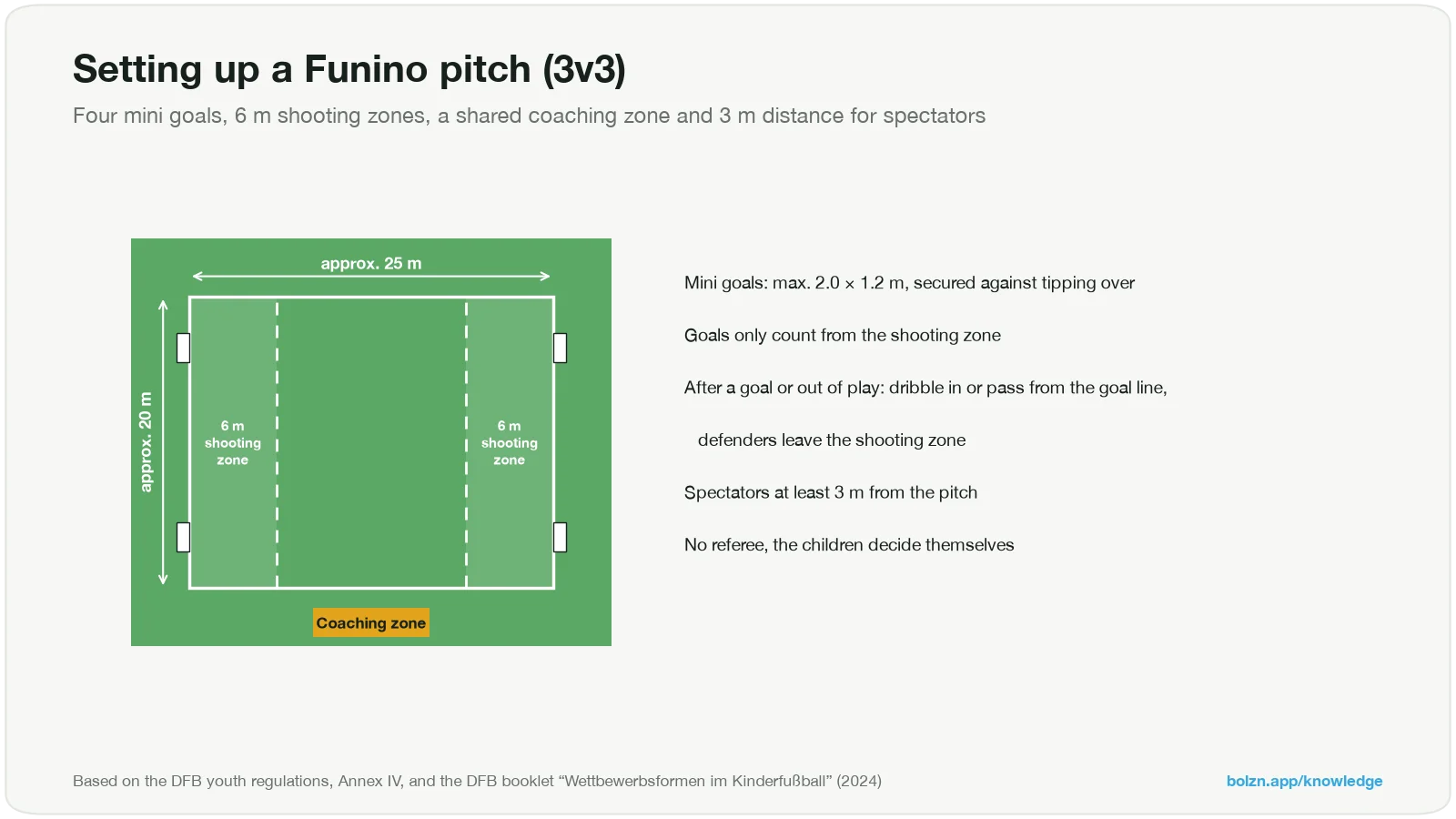
Funino is 3v3 football on four mini goals, with no goalkeepers. Each team defends two goals on its own end line and attacks the two goals of the other team. Goals only count when the shot is taken from a shooting zone, usually 6 metres deep in front of the end line. After every goal both teams rotate one player. The game was created by Horst Wein (1941–2016), a former German national hockey coach who built his own coaching model for children's football from the 1980s onwards.
In Germany, 3v3 on four mini goals has been the standard competition format for the U7s and U9s since the 2024/25 season. The German FA (DFB) doesn't call it "Funino" but talks about the new competition formats in children's football. They come with the rules of the Fair Play League (Fair-Play-Liga): no referee, one shared coaching zone for both coaches, and parents at a distance.
Funino rules at a glance
The rules below follow the DFB guide to the competition formats (2024). The regional associations differ in the details, more on that below.
- Players: 3v3 without goalkeepers, plus up to two rotation players per team.
- Goals only count from the shooting zone. A shot from further out may hit the net, but the goal doesn't stand.
- Rotate after every goal: both teams swap one player, no matter who scored, in a fixed order. The swap happens at the halfway line while play goes on. If hardly any goals are scored, rotate in between as well.
- No kick-off, no throw-ins, no offside, no penalties.
- After a goal or a goal kick situation the team dribbles or passes the ball in from its own end line. The opponents have to leave the shooting zone.
- Ball out over the touchline: dribble or pass it in. A goal can't be scored directly from a restart, someone has to touch the ball first.
- Corner: from the touchline level with the shooting zone, as a dribble or a pass.
- Distance at restarts: at least 3 metres.
- Foul: free kick, again as a dribble or pass. A player who keeps standing in front of a mini goal gets a warning, then the other team gets a penalty attack.
- Three-goal rule (optional): a team that is three goals down may put an extra player on until the gap shrinks.
- Handshake before and after every game.
For the U7s there is also 2v2. Goals count from the halfway line, there is no shooting zone.
Funino pitch size and goals
| Format | Pitch (DFB) | Goals | Shooting zone |
|---|---|---|---|
| 2v2 (U7) | approx. 16 × 20 m | 4 mini goals, max. 2.0 × 1.2 m | from halfway line |
| 3v3 (U7 and U9) | approx. 25 × 20 m | 4 mini goals, max. 2.0 × 1.2 m | 6 m |
| 4v4 / 5v5 on mini goals (U9 and U11) | approx. 40 × 25 m | 4 mini goals, max. 2.0 × 1.2 m | 6 m |
| 5v5 with goalkeeper (U9 and U11) | approx. 40 × 25 m | 2 youth goals 5 × 2 m, lowered to 1.65 m for U9 | from halfway line |
| 7v7 (U11) | approx. 55 × 35 m | 2 youth goals 5 × 2 m | none, score from anywhere |
The DFB guide places the mini goals about 2 metres in from the touchline. Youth goals must be secured so they can't tip over. If you have no mini goals, cone or pole goals work too.
These are approximate sizes, and the associations read them differently. For 3v3, the DFB's own FAQ from 2022 gives 26 to 28 × 20 to 22 metres, Lower Saxony (NFV) about 26 × 20 metres and Bavaria (BFV) about 20 × 30 metres. For mini goals, the Rhineland association recommends 1.20 × 0.75 metres and the NFV about 1.20 × 0.80 metres, while the DFB maximum is 2.0 × 1.2 metres. All pitch sizes from U7 to U19 are in Youth football pitch sizes.
Which format for which age group?
According to the DFB guide (2024):
| Age group | Formats | Playing time at a festival | Ball |
|---|---|---|---|
| U6/U7 (Bambini) | 2v2 or 3v3 on 4 mini goals | up to 7 rounds of max. 5 min (2v2) or 7 min (3v3) | size 3, 290 g |
| U8/U9 | 3v3 on 4 mini goals, 4v4 or 5v5 | up to 7 × 10 min (3v3), 6 × 10–12 min (4v4, 5v5) | size 3, 290 g |
| U10/U11 | 4v4, 5v5 or 7v7 | 6 × 10–12 min, 7v7 4 × 15 or 2 × 25 min | size 4, 350 g |
There is a 3-minute break between rounds. For U9s the DFB clearly recommends focusing on 3v3, because that's where children get the ball most often. From U10, goalkeepers play regularly. In 4v4 and 5v5, players don't rotate after each goal but every 3 minutes on a shared whistle. In 7v7 the rotation players play 2v2 or 3v3 on a side pitch in the meantime.
Which birth years belong to which age group in 2026/27 is explained in Youth football age groups.
Is Funino compulsory in Germany?
Essentially yes. In March 2022 the DFB's general assembly decided to make the new formats compulsory across Germany from the 2024/25 season. According to the DFB, the associations no longer schedule old-style games for U7 to U11 since then. But each regional association runs its own version, and the differences are bigger than many people think:
- Bavaria (BFV) calls the formats "Minifußball" (Fußball2 to Fußball7) and caps playing time per day: 80 minutes for U7 and U9, 100 minutes for U11. Players rotate after each goal, after 3 minutes at the latest.
- Lower Saxony (NFV) also plays 3+1 v 3+1 on two youth goals for U9 and 4+1 v 4+1 for U11. A 7v7 league for U11 is only possible on request, and only up to the 2026/27 season. Players rotate after 2 minutes at the latest.
- Middle Rhine (FVM, Rhein-Erft district 2026/27) has U11s play 4v4 on mini goals on about 30 × 25 metres.
- Württemberg (WFV) plays a mixed pitch with 4v4 and 3v3 for U9s. For U11s, result lists, tables and referees are allowed again.
What counts for your games is always the rules of your regional association or district.
The Fair Play League: three rules
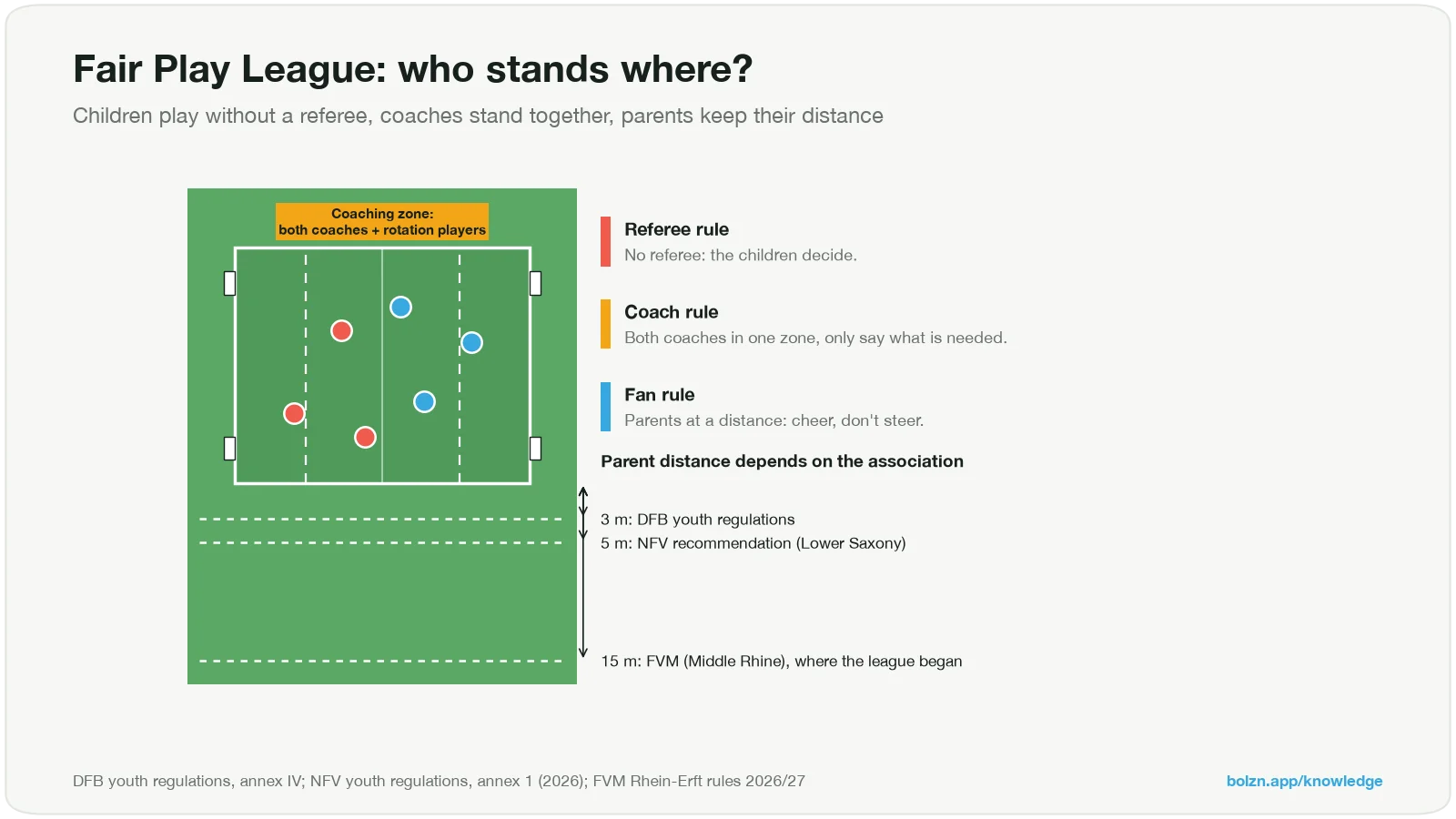
The Fair Play League is older than the reform. Youth coach Ralf Klohr started it in 2007 in the Aachen district, prompted by a newspaper report about a U9 game that had to be abandoned because parents got into a fight. In the first season 11 U11 teams, 12 U9 teams and almost all U7 teams in the district took part. The DFB later wrote its principles into its youth regulations. They apply to U9 and younger, and to U11 where the regional association decides so:
- Referee rule: there is no referee. The children decide themselves whether the ball was out, whether it was a foul or a goal.
- Coach rule: both coaches stand together in one coaching zone, usually level with the halfway line. They only give the instructions that are really needed and step in only when the children can't agree.
- Fan rule: parents and spectators keep their distance from the pitch and don't step onto the main pitch.
There is no single number for that distance. The DFB youth regulations require at least 3 metres. The NFV recommends 5 metres or a zone outside the main pitch, the WFV puts parents behind the barrier of the full-size pitch. In the Middle Rhine association, where the Fair Play League began, it's 15 metres. The overview table in the DFB guide also still says 15 metres, while the text of the same guide says 3 metres. Follow what your district says.
How does a festival work?
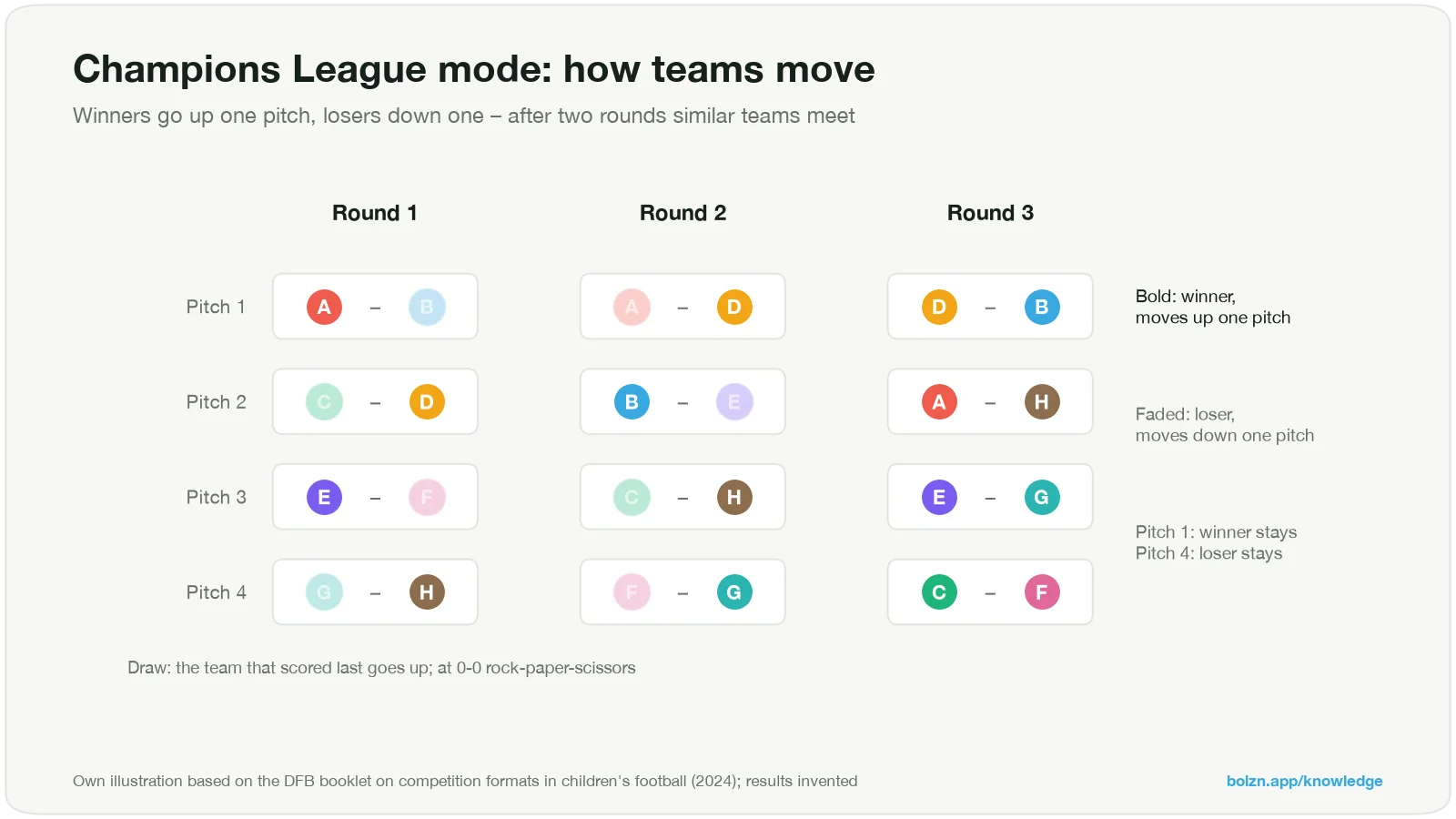
Instead of one game with a referee and a league table, several clubs meet for a festival with several pitches side by side. It's played in Champions League mode:
- Make teams: each club forms as many teams of three as possible, with rotation players where needed. The DFB's examples: 13 children make four teams (3 + 3 + 3 + 4), 16 children four or five teams. Once a team has two rotation players, it's better to set up another pitch. The goal is for every child to play at least 75 percent of the time.
- Number the pitches and assign the teams. Ideally the coaches talk briefly beforehand and assign teams by strength.
- After every round: the winner moves up one pitch, the loser moves down one. On the top pitch the winner stays, on the bottom pitch the loser stays.
- Draws: the team that scored last goes up. At 0-0, rock-paper-scissors decides.
After two or three rounds, similar teams usually play each other. That's the whole point: fewer 10-0 games, more close games for everyone.
Equipment for a festival with six pitches: 24 mini goals (or poles), cones in two colours for the pitch lines and shooting zones, bibs, two or three balls per pitch, a watch or whistle for a shared start, and a list of pitch numbers. How many pitches fit on a full-size pitch is shown in Youth football pitch sizes.
What should parents do on the touchline?
- Cheer, don't steer. "Well done!" helps. "Shoot!" or "Pass it!" confuses, because the child is supposed to decide.
- Keep your distance, even when your own child is on a break.
- No refereeing from outside. The children sort out throw-ins and fouls themselves. It works better than adults expect.
- Don't ask about the score afterwards, ask what was fun. On an afternoon with seven games every child has won and lost.
- Help instead of watching: look after a pitch, fetch balls, set up goals. Festivals hardly work without parents helping.
No league table: how do children learn to win?
This is the question parents ask most, and the answer is: they win and lose even more often. Every single game is won or lost, and the winner moves up. The results just aren't collected over a season. So a child has several wins and defeats in one afternoon instead of one game a week. And a team that loses a lot ends up on the lower pitches against similar opponents, where it wins again.
Other common objections:
- "That's not proper football." Two teams, one ball, goals. Just more goals and fewer players. An analysis of 39 children's games (Lex, Simon & Schwab, 2022) found significantly more of every action measured, passes, dribbles, shots and goals, in 3v3 than in 7v7 and 6v6. Why weaker children in particular benefit is explained in Small-sided games in children's football.
- "Without a referee there will be arguments." That's exactly what the children are meant to learn: how to agree. The coaches step in when it doesn't work.
- "Where do goalkeepers learn?" U7s and U9s mostly play without a keeper. From U10, goalkeepers play regularly, according to the DFB, and that's when specific goalkeeper training makes sense. Before that, every child can go in goal in training.
- "My child is too good for 3v3." Good players quickly move up to the top pitch and meet strong opponents there. In 3v3 they also get more duels and shots than in any bigger format.
Funino variations for training
Funino works in training too, not just on match days. Proven variations, as described for example by FC St. Pauli and the Bavarian association:
- Diagonal goals: each team attacks one goal on each side.
- Reversed goals: the mini goals stand on the shooting zone line facing the end line. Play goes on behind the goals, like in ice hockey.
- Dribble goals: two cone goals you have to dribble through instead of shooting into.
- Different balls: tennis ball, futsal ball, light ball. Each ball needs a different technique.
- 4v4 or 5v5 on four mini goals for older children.
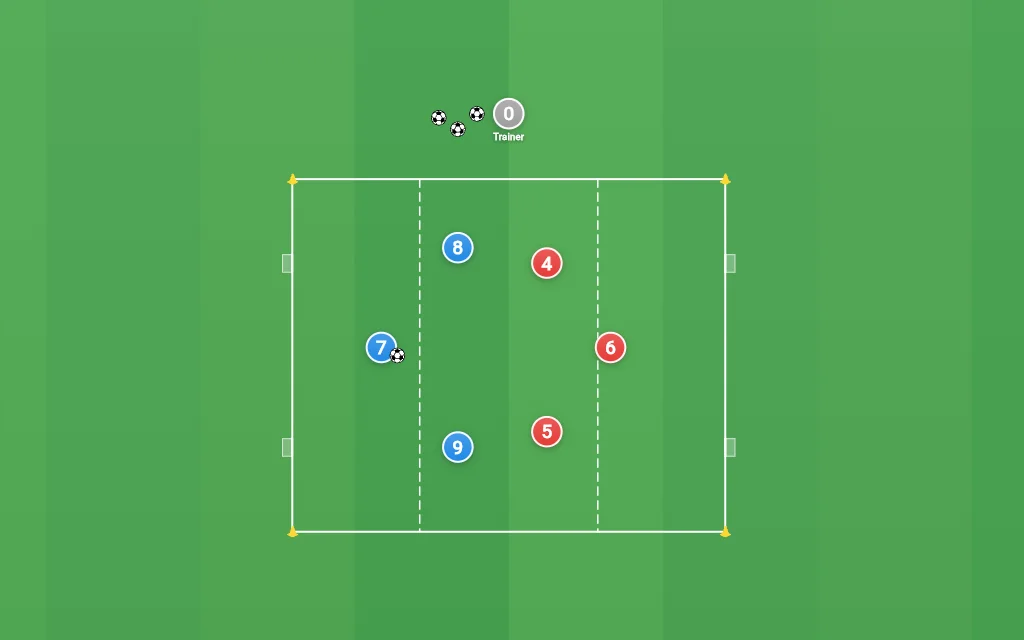
From the bolzn drill library: 3v3 on a Funino pitch with 4 mini goals.
To end a session, try a mini tournament on three pitches with promotion and relegation, so the children know the format before their first festival. Funino games and tournament formats for all children's age groups are in the bolzn football drills, and with training planning you turn them into a session.
Sources
- DFB (2024). Kinderfußball: Leitfaden für die Implementierung neuer Wettbewerbsformen in den Altersklassen U6–U11 (guide), pp. 3–5, 8–24, 26–33.
- DFB (2022). FAQ zu den neuen Spielformen im Kinderfußball, 31 May 2022.
- DFB. Jugendordnung (youth regulations), annex IV, III. child-friendly football (Fair Play League principles).
- Bavarian FA (BFV) (2026). Richtlinie für den Minifußball, 17 April 2026.
- Lower Saxony FA (NFV) (2026). Jugendordnung, Anhang 1, July 2026.
- Middle Rhine FA (FVM), Rhein-Erft district (2026). Durchführungsbestimmungen Kinderfußball 2026/27.
- Württemberg FA (WFV) (2026). wfv-Kinderfußball-Leitfaden 2026/27.
- Rhineland FA (FVR) (2024). Kinder- und Juniorenfußball im Rheinland, August 2024; Fair-Play-Liga (information sheet, 2019).
- Höfel, D. (2018). Zur Fair-Play-Liga im Fußball als Vermittler einer Handlungs- und Verhaltensweise nach den Maßstäben einer sportlichen Fairness. Master's thesis, Goethe University Frankfurt, ch. 3.2.
- Lex, H., Simon, M. & Schwab, S. (2022). Insights into the application of soccer-specific actions in established and new game forms of youth soccer. German Journal of Exercise and Sport Research, 52, 168–172.
- FC St. Pauli Rabauken: FUNiño variants.