Heel spur: what is really behind the heel pain
Heel spur or plantar fasciitis? Why the spur is usually not to blame, what helps against heel pain and how footballers can keep playing.
What is a heel spur?
A heel spur is a small bony outgrowth on the heel bone that can be seen on an X-ray. When someone complains of pain under the heel, people are quick to say: "That's a heel spur." Yet in most cases the spur is not the cause. The cause is an overloaded band of tendon-like tissue under the sole of the foot, the plantar fascia. Doctors then speak of plantar fasciitis.
The good news: the heel pain can be treated well without surgery, and you can do much of it yourself. The bad news: it often takes patience, sometimes months to more than a year.
This article is aimed at adults. In children and adolescents, heel pain is almost never a heel spur but usually an irritation of the growth plate: see Heel pain in children.
Is the spur to blame for the pain?
Mostly not. Many people have a heel spur without ever feeling any pain:
- In one study about one in three people without heel pain had a spur.
- Among people over 62, more than half have a spur.
- Whether a spur is there or not makes no difference to how quickly the symptoms go away.
The spur is more of a side effect of the same load that also irritates the plantar fascia. That is why it neither has to "go" nor does "calcium have to be broken down". After successful treatment it can usually still be seen on the X-ray, and the pain is gone all the same.
How do I recognise plantar fasciitis?
Typical signs:
- pain on the inner underside of the heel, sometimes extending into the sole of the foot,
- worst with the first steps in the morning or after sitting for a long time,
- gets better once you have walked a little, comes back after standing or walking for a long time,
- often after an increase in load: start of the season, more running, artificial turf, new shoes.
The doctor usually makes the diagnosis by examination. An X-ray is generally not necessary, except to rule out other causes.
Who gets heel pain?
It most often affects people between 40 and 60, so exactly the age group in veterans' teams (Ü-Mannschaften), and many coaches. Risk factors are:
- a stiff calf, meaning little mobility in the ankle (the strongest known factor),
- being overweight, especially in people who do little sport,
- a lot of standing or walking on hard ground, including at work,
- running: in runners, plantar fasciitis is one of the most common injuries.
What helps against heel pain?
No single treatment is clearly superior to all the others. A stepped plan that starts with simple measures has proved its worth:
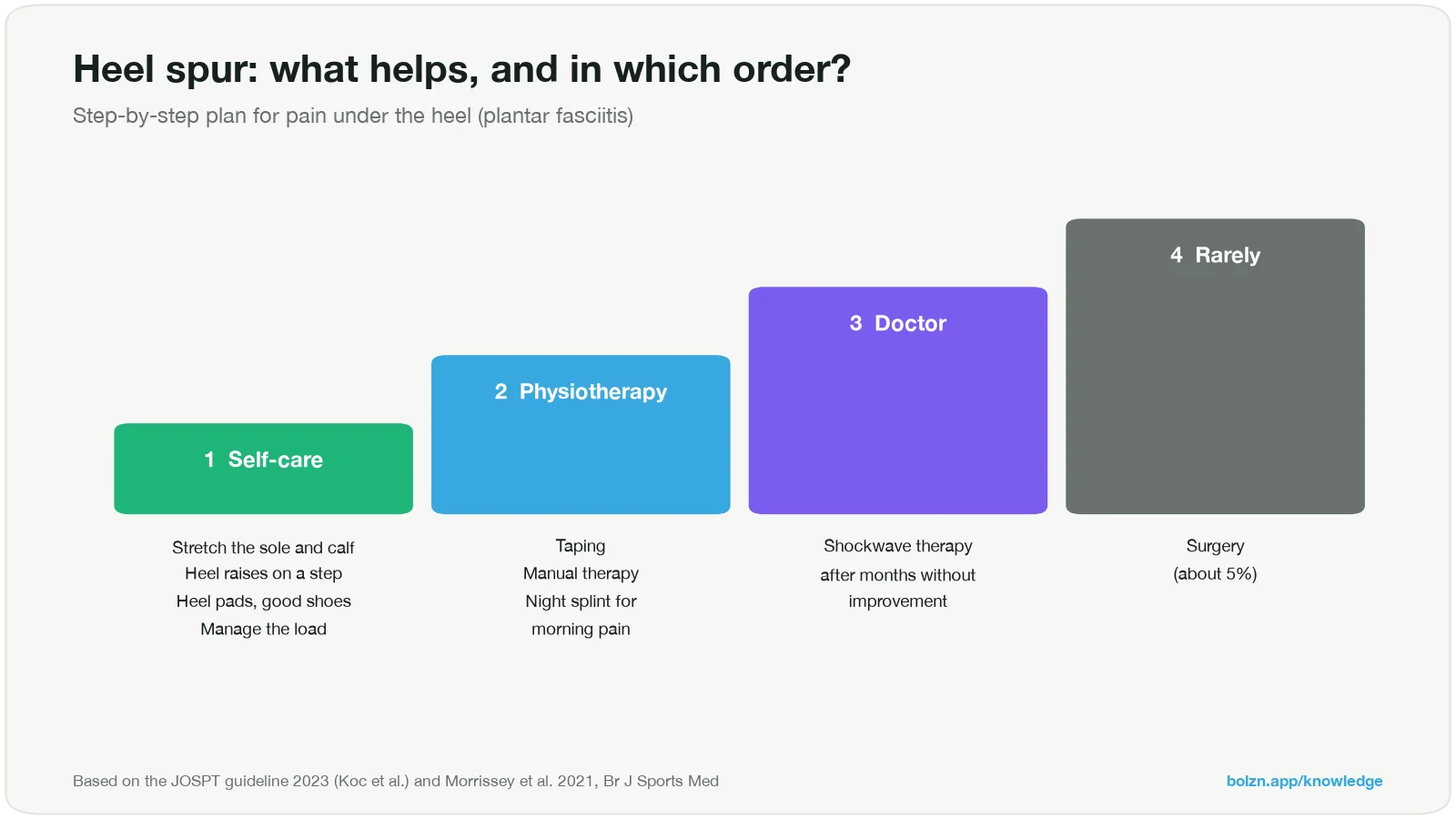
Step 1: what you can do yourself
- Stretching the sole of the foot and the calf: in the morning before getting up, pull the toes towards the shin with your hand and hold. In addition stretch the calf against a wall, with the knee straight and with the knee bent. This helps above all against first-step pain.
- Strengthening: single-leg heel raises on a step, with a rolled-up towel under the toes. Up slowly, hold briefly, down slowly, about every other day. In one study this helped faster than stretching alone.
- Heel cushion and footwear: a soft heel cushion and well-cushioned shoes take off load. Do not walk barefoot on hard ground for long. Expensive custom insoles, however, were no better than sham insoles in one study.
- Manage the load: fewer sprints and jumps, no studs on hard ground, cycling or swimming to compensate.
- Weight: if you are overweight, every kilo less helps in the long run.
Step 2: physiotherapy
Taping, manual therapy and, with severe pain in the morning, a night splint that keeps the foot gently stretched overnight. These measures are recommended by the current guideline for physiotherapists.
Step 3: doctor
If nothing improves after a few months, shockwave therapy is an effective option. Caution is called for with a cortisone injection: it only helps briefly and in the worst case can lead to a rupture of the plantar fascia.
Step 4: surgery
Only in rare cases, in about 5 out of 100 people affected.
Can I play football with a heel spur?
There is no general ban. What matters is adjusting the load: mild pain while playing is fine as long as it is no worse the next morning than before. If the first-step pain gets stronger from week to week, the load is too high. Then temporarily do fewer sprints and jumps, shorter sessions and more alternative exercise. What a training week with enough recovery looks like is covered in the article Planning a training week.
When should I see a doctor?
With typical first-step pain you can begin with step 1 yourself at first. If nothing improves after about two weeks, have yourself examined by your GP or an orthopaedic specialist. See a doctor immediately with:
- numbness, tingling or burning in the sole of the foot,
- pain when the heel is squeezed from the sides (a sign of a stress fracture),
- swelling, redness, symptoms in both feet together with back or joint pain,
- pain at night or fever,
- a sudden pop with bruising on the sole of the foot,
- diabetes.
Heel spur at the top or at the bottom?
Besides the lower heel spur there is also an upper (posterior) heel spur where the Achilles tendon attaches, and Haglund's deformity, a bony prominence at the back of the heel bone. These cause pain at the back of the heel, often from pressure of the shoe's heel counter, and are treated differently.
Sources
- Koc, T. A. et al. (2023). Heel pain – plantar fasciitis: revision 2023. Journal of Orthopaedic & Sports Physical Therapy, 53(12), CPG1–CPG39.
- Morrissey, D. et al. (2021). Management of plantar heel pain: a best practice guide informed by a systematic review, expert clinical reasoning and patient values. British Journal of Sports Medicine.
- Rathleff, M. S. et al. (2015). High-load strength training improves outcome in patients with plantar fasciitis. Scandinavian Journal of Medicine & Science in Sports.
- Rasenberg, N. et al. (2021). Custom insoles versus sham and GP-led usual care in patients with plantar heel pain (STAP study). British Journal of Sports Medicine.
- Babatunde, O. O. et al. (2019). Comparative effectiveness of treatment options for plantar heel pain: a systematic review with network meta-analysis. British Journal of Sports Medicine.
- David, J. A. et al. (2017). Injected corticosteroids for treating plantar heel pain in adults. Cochrane Database of Systematic Reviews.
- Menz, H. B. et al. (2008). Plantar calcaneal spurs in older people: longitudinal traction or vertical compression? Journal of Foot and Ankle Research.
- Johal, K. S. & Milner, S. A. (2012). Plantar fasciitis and the calcaneal spur: fact or fiction? Foot and Ankle Surgery.
- Hansen, L. et al. (2018). Long-term prognosis of plantar fasciitis: a 5- to 15-year follow-up study of 174 patients. Orthopaedic Journal of Sports Medicine.
- Riddle, D. L. et al. (2003). Risk factors for plantar fasciitis: a matched case-control study. Journal of Bone and Joint Surgery.
- German Federal Ministry of Health (Bundesministerium für Gesundheit): gesund.bund.de, "Fersensporn".