Planning a football training week: load and recovery
Here is how to plan the training week between two matches: when to recover, when to train hard, when to sprint – with weekly plans for two and three sessions.
How do I plan the training week between two matches?
The rule of thumb is: recover after the match, load in midweek, ease off before the match. The day after the match, and usually the second day too, belong to recovery. The most intense session, with large-sided games, lots of running and duels, comes three to four days before the next match. The last session before the match is short, fast and light, with set pieces and finishing.
This rhythm follows from a simple observation: after a match, muscles and energy stores need two to three days before they can take full load again (see Recovery after a match). If you train hard too early, you load a tired body. If you train hard too late, you carry the fatigue into the match.
Matchday plus and minus: the language of weekly planning
Professionals and coaching courses count the days from the match:
- MD (matchday) is the day of the match.
- MD+1, MD+2 are the first and second day after the match.
- MD-1, MD-2 are the day before the match and the day before that.
With a match on Sunday, Monday is therefore MD+1, Tuesday is MD+2 and at the same time MD-5, Thursday is MD-3 and Saturday is MD-1. This way of counting helps because it works regardless of the day of the week. If you play on Saturdays or Fridays, everything simply shifts.
How professionals plan the week
A similar pattern has become established among professional teams with one match a week. A survey of 100 practitioners from elite football (Buchheit & Hader) shows it clearly:
| Day | Typical load in professional football |
|---|---|
| MD+1 | recovery or off; substitutes do top-up training |
| MD+2 | off |
| MD-4 | high: strength, small-sided games |
| MD-3 | high: large-sided games, lots of running |
| MD-2 | medium: speed, tactics |
| MD-1 | low: short activation, set pieces |
An analysis of 18 elite teams over several years (Buchheit et al. 2023) also found that in weeks with a day off two days after the match there were markedly fewer non-contact injuries. This is an association, not proof. But it fits with everything that is known about recovery.
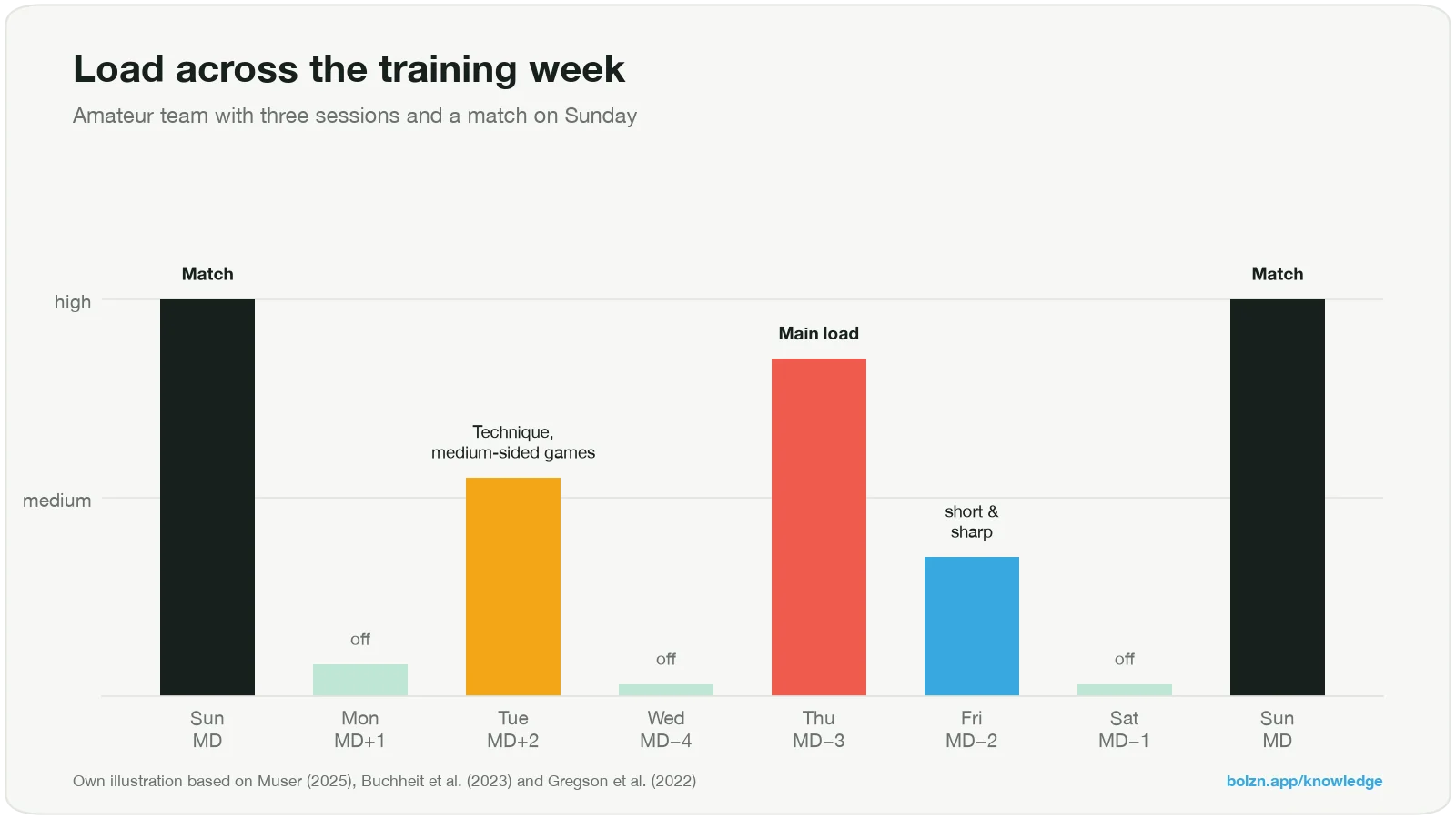
Training week with three sessions (match on Sunday)
In amateur football most teams train two or three times a week, usually in the evening. A tried-and-tested pattern for three sessions:
| Day | Content | Load |
|---|---|---|
| Sunday | Match | high |
| Monday | off, light movement (walking, cycling) | very low |
| Tuesday | Technique, small-sided games at medium intensity, substitutes with an extra task | medium |
| Wednesday | off | – |
| Thursday | Main load: small-sided games, duels, endurance, sprints | high |
| Friday | short and fast: accelerations, tactics, set pieces, finishing | low to medium |
| Saturday | off | – |
Important points:
- Tuesday is not a flat-out day yet. Two days after the match many players have not yet recovered. Technique, passing drills and games at medium intensity work well.
- Thursday is the load day. Intense small-sided games and long sprints fit here. That leaves three days of recovery until Sunday.
- Friday is short. 60 minutes are enough. Fast, short actions with full rests activate the players without tiring them.
Training week with two sessions
With two sessions, Tuesday and Thursday are the obvious choice:
- Tuesday: technique and tactics, small-sided games at medium intensity, substitutes with an extra load.
- Thursday: main load with intense small-sided games and sprints, set pieces to finish.
If the second session is not until Friday, it should not be the hardest of the week. Then you swap the content: more intense on Tuesdays, short and fast on Fridays.
Endurance, speed and strength during the week
Endurance through small-sided games
In football, endurance is best trained with the ball. The smaller the area per player, the more intense the load:
| Game format | Area per player | Duration per bout | Load |
|---|---|---|---|
| 8v8 to 11v11 | 250–350 m² | 8–10 min | high, more basic endurance |
| 3v3 to 4v4 | 100–150 m² | 1–4 min | very high |
| 1v1 to 2v2 | 50–80 m² | 30–60 s | maximal, long rests needed |
The ideal is one large-sided and one small-sided game a week. Both belong on the load day or the day before, not on the Friday before the match. You will find suitable small-sided games in the bolzn football drills.
Speed
Sprints require a rested body and full rests. Put them at the start of a session, straight after the warm-up. Long straight sprints belong on the load day. Short accelerations with changes of direction also fit shortly before the match.
A tip from research: players who regularly get close to their top speed injure their hamstrings less often. A few sprints over 30 to 40 metres at full speed once or twice a week are therefore not only training but also prevention.
Strength
Strength training for the legs fits best on the load day or the day before. Having little time is no reason to leave it out: ten to fifteen minutes in the warm-up, two to three times a week, already achieve a lot. Strengthening work for the core and upper body can also be done shortly after the match.
Players with little playing time
Substitutes and players who only played a few minutes are missing the load of the match after the weekend. If they train just as lightly during the week as the regular starters, they lose fitness. Plan an extra task for them in the first session of the week, for example a small-sided game and a few sprints, while the others are already cooling down.
Two matches a week and midweek fixtures
If your team plays twice a week, there is hardly any room for load. Training then consists only of recovery, tactics and short activation. The matches themselves are load enough. Important: with two matches a week the risk of injury rises markedly, and recovery (sleep, food, fluids) then becomes even more important.
Measuring load the simple way
You do not need heart rate monitors to manage the week. After every session, have the players rate how hard it was on a scale from 0 (not strenuous at all) to 10 (maximal). Multiplied by the minutes, this gives the training load. If the value on Friday is suddenly higher than on Thursday, something is wrong with the planning. How to ask about fatigue and wellbeing as well is covered in the article Spotting overtraining.
You can set up your weekly plan directly in the bolzn training planner.
Common mistakes
- Punishment after a defeat: a running session on Tuesday after a poor match hits a body that is still tired.
- Friday as the hardest session because that is when everyone is there.
- Sprints at the end of the session, when the players are already tired.
- The same amount every week: after a few hard weeks, a lighter week does good. This also applies as the end of the first half of the season approaches.
- Trying to plan supercompensation down to the hour: the rhythm of the week matters more than exact rest times.
Sources
- Buchheit, M., Settembre, M., Hader, K. & McHugh, D. (2023). Planning the microcycle in elite football: to rest or not to rest? International Journal of Sports Physiology and Performance, 18(3), 293–299.
- Muser, B. (2025). Periodisierung des Athletiktrainings im Wochenverlauf. Presentation, VBG-Präventionssymposium Fußball, Hamburg.
- Gregson, W., Howatson, G. & Thorpe, R. (2022). A periodised recovery strategy framework for the elite football player. Aspetar Sports Medicine Journal, 11.
- Laursen, P. & Buchheit, M. (2019). Science and Application of High-Intensity Interval Training. Champaign: Human Kinetics.
- Malone, S. et al. (2017). High chronic training loads and exposure to bouts of maximal velocity running reduce injury risk in elite Gaelic football. Journal of Science and Medicine in Sport, 20(3), 250–254.
- Foster, C. et al. (2001). A new approach to monitoring exercise training. Journal of Strength and Conditioning Research, 15(1), 109–115.
- Dupont, G. et al. (2010). Effect of 2 soccer matches in a week on physical performance and injury rate. American Journal of Sports Medicine, 38(9), 1752–1758.