Heel pain in children: Sever's disease in football
Why growing children get heel pain, whether it is harmless, whether they can keep playing football and what helps against the pain.
Why does my child have heel pain?
If a child between 8 and 14 complains of pain at the back of the heel after training, the cause is usually an irritation of the growth plate in the heel bone. Doctors call this Sever's disease or calcaneal apophysitis. That sounds dramatic, but it is a harmless overuse problem that goes away by itself once growth is complete. No lasting damage is to be expected.
In most cases a complete break from football is not necessary. What matters is adjusting the load to the pain for a while. Here we explain how to do that and when you should see a doctor after all.
This article is no substitute for a medical examination. It is meant to help parents and coaches make sense of the symptoms.
What happens in Sever's disease?
In children the heel bone has not yet fully turned to bone. At its back end sits a growth plate made of cartilage. This is exactly where the Achilles tendon attaches, the strongest tendon in the body. With every sprint, jump, sudden stop and change of direction it pulls on this still soft spot.
During a growth spurt something else comes on top: the bones grow faster than muscles and tendons can adapt. The calf becomes relatively "too short" as a result, and the pull on the heel increases. If a lot of training is added to that, it irritates the growth plate.
Important for parents: it is not a tendon inflammation. The Achilles tendon itself is almost never the problem in children, unlike in adults who complain of Achilles tendon pain.
Who is affected?
- Age: mostly between 8 and 14, so exactly the U11, U13 and U15 age groups (E-, D- and C-Jugend).
- Boys are affected more often than girls (in one review about 7 out of 10 cases).
- Both heels: in almost half of the children both sides hurt.
- Stop-and-go sports: football, handball, basketball and indoor sports. Children who sprint and jump a lot are affected more often.
- Growth spurt: many affected children have just become taller and heavier.
In general practice about 4 in 1,000 children per year present with Sever's disease. Among sporty children it is considerably more common.
How do I recognise Sever's disease?
Typical signs are:
- pain at the back or side of the heel, during or after sport,
- the heel hurts when you squeeze it from both sides,
- the child walks on tiptoe after training or limps slightly,
- at rest and in the morning it is usually better again,
- after tournaments, long weekends or on hard ground it is worse.
Good to know: the paediatrician or orthopaedic specialist usually makes the diagnosis by talking to the child and examining them. An X-ray is not needed in most cases.
Is this natural and does it go away by itself?
Yes. Sever's disease is one of the typical complaints during growth and disappears at the latest when the growth plate has turned to bone. Until then the pain can come back during growth spurts. That is normal and not a sign that something has gone wrong.
In a Dutch study, children were treated either with a heel raise, with physiotherapy or not at all ("wait and see"). After three months all three groups were clearly better, and roughly equally so. So the symptoms improve even without elaborate treatment, provided the load is adjusted sensibly.
Can my child keep playing football?
In most cases, yes. None of the recommendations calls for a general break from sport. The aim is to do as much as the heel allows and to take out the peaks. A simple pain traffic light helps here:
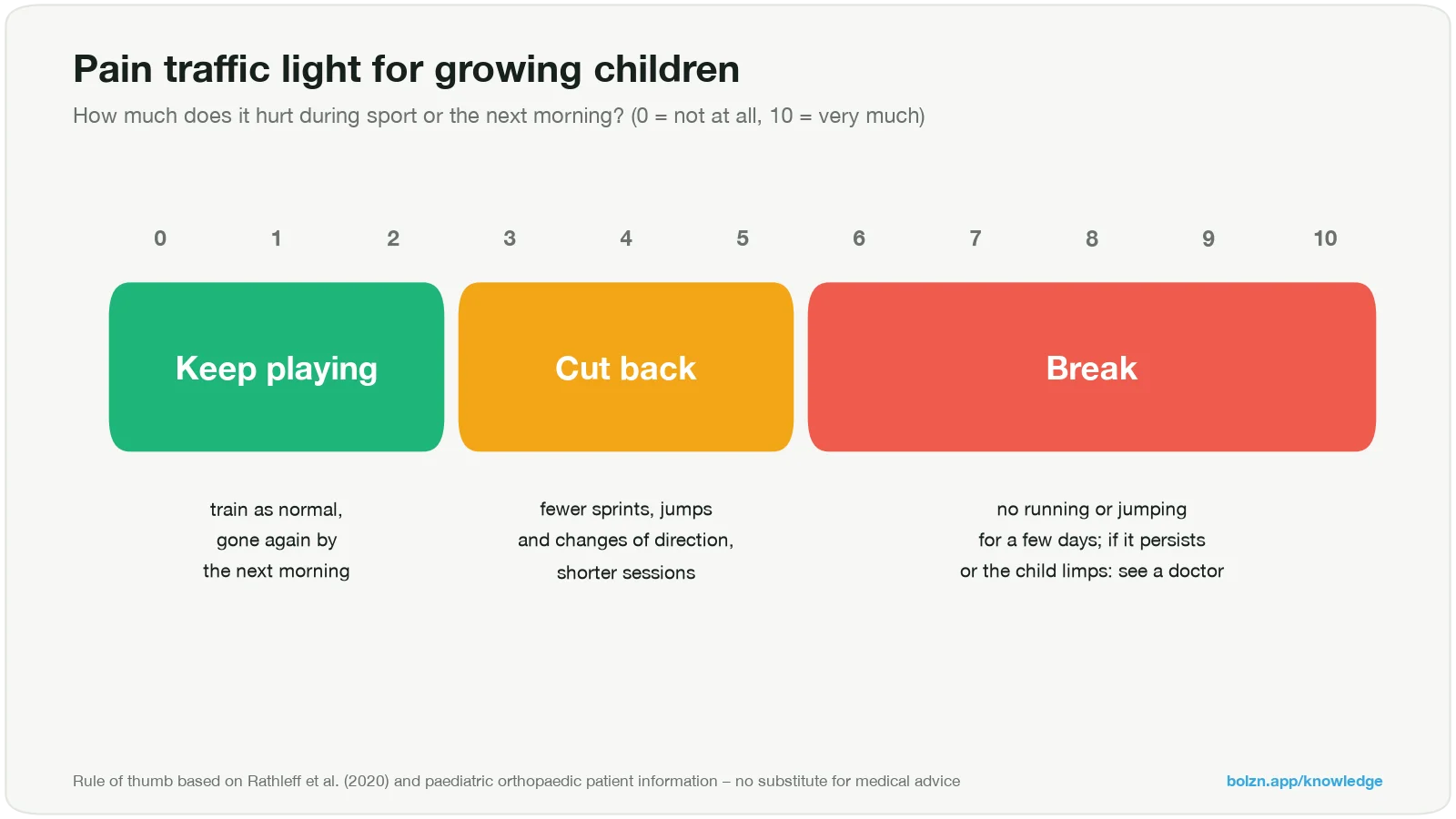
- Green (0 to 2 out of 10): train as normal. Mild pain is fine if it has gone by the next morning.
- Amber (3 to 5): fewer sprints, jumps and changes of direction, shorter sessions, preferably not two matches at the weekend. Ask again the next morning.
- Red (6 or more, limping or worse in the morning): a few days off running and jumping, then ease back in slowly. If it persists, have it checked by a doctor.
The limit of 2 out of 10 comes from a Danish programme for knee pain during growth. There the adolescents were allowed to move up a stage as long as the pain during activity and the next morning was no more than 2 out of 10. There is no tested programme of its own for the heel. The traffic light is therefore a rule of thumb, not a fixed law.
What helps against the pain?
- Adjust the load: the most important measure. Fewer sprints and jumps, no hard training on several days in a row.
- Heel raise or insoles: a small lift in the shoe takes load off the heel. In studies, heel raises and insoles helped a little in the first few weeks. After six months there was no longer any difference from other treatments.
- Cooling: about 15 minutes after training eases the pain.
- Painkillers: only for a short time and after consulting the paediatrician, not as a permanent solution before every match.
- Footwear: worn-out shoes or football boots with a hard heel and no cushioning can cause trouble. In one study, however, new running shoes alone brought no benefit.
- Stretching and strengthening the calf: often recommended, but the evidence is mixed. Gentle stretching does no harm as long as it does not hurt. Strengthening exercises belong in pain-free phases.
You can set up exercises for home in bolzn as a task plan for your child or the whole team, see session planning in bolzn.
When should I take my child to the doctor?
With typical load-related pain at the heel a visit to the doctor is not urgent, but it makes sense in order to confirm the diagnosis. You should see a doctor immediately if:
- the pain occurs at night or wakes the child from sleep,
- the heel is swollen, red or warm,
- the child has a fever, is unusually tired or is losing weight,
- the child limps even at rest,
- the pain is steadily increasing on one side only,
- it started after a fall, a twisted ankle or a blow and the child can hardly put weight on the foot.
In these cases other causes such as a stress fracture, an inflammation or a bone cyst have to be ruled out.
Heel pain, knee pain or growing pains?
| Sever's disease | Osgood-Schlatter | "Growing pains" | |
|---|---|---|---|
| Where? | back of the heel | below the kneecap, at the bony bump on the shin | diffuse in both legs, often calves and backs of the knees |
| Age | 8 to 14 years | 10 to 15 years | 3 to 12 years |
| When? | during and after sport | during sport, when kneeling, climbing stairs | in the evening and at night, gone in the morning |
| Tender to pressure? | yes, at the heel | yes, at the bump below the knee | no |
Osgood-Schlatter is the counterpart at the knee: there the kneecap tendon pulls on the growth plate of the shin bone. A bump you can feel often forms below the knee, and it remains later on. Unlike with the heel, the symptoms here last longer in some adolescents. A structured plan of load adjustment and strengthening is therefore worthwhile.
Growing pains, despite the name, have nothing to do with growth. The term refers to leg pain at night in younger children with no clinical findings. They are common (one in three children of preschool age) and harmless as long as no warning signs are added.
What can the coach do?
There are no studies for coaches, but there are some obvious rules:
- Talk to parents and child: anyone in pain should be allowed to say so without being seen as "soft".
- Look at the total load: many children play in two teams, have school PE and tournaments at the weekend. It all adds up.
- Avoid peaks: no sudden jumps in volume, surface or new shoes. More on this in the article Planning a training week.
- Alternatives instead of the bench: a child in the amber phase can work on technique, passing or finishing, just with fewer sprints and jumps.
- Look more closely during a growth spurt: anyone who has suddenly grown a lot often needs a little less for a few weeks. How to ask about tiredness and complaints in a simple way is covered in the article Recognising overtraining.
Can it be prevented?
There is no proven prevention. Anything that avoids overload makes sense: increase the load slowly, allow enough rest (see Recovery after the match), maintain calf mobility and build strength. And above all: take pain seriously before a small irritation turns into a long lay-off.
Sources
- Wiegerinck, J. I. et al. (2016). Treatment of calcaneal apophysitis: wait and see versus orthotic device versus physical therapy. Journal of Pediatric Orthopaedics, 36(2), 152–157.
- James, A. M., Williams, C. M. & Haines, T. P. (2016). Effectiveness of footwear and foot orthoses for calcaneal apophysitis: a 12-month factorial randomised trial. British Journal of Sports Medicine, 50(20), 1268–1275.
- Wiegerinck, J. I. et al. (2014). Incidence of calcaneal apophysitis in the general population. European Journal of Pediatrics, 173(5), 677–679.
- Nieto-Gil, P. et al. (2023). Risk factors and associated factors for calcaneal apophysitis: a systematic review. BMJ Open, 13, e064903.
- Fares, M. Y. et al. (2023). Clinical and diagnostic characteristics of calcaneal apophysitis: systematic review. Journal of the American Podiatric Medical Association.
- Rathleff, M. S. et al. (2020). Activity modification and knee strengthening for Osgood-Schlatter disease: a prospective cohort study. Orthopaedic Journal of Sports Medicine, 8(4).
- Guldhammer, C. et al. (2019). Long-term prognosis and impact of Osgood-Schlatter disease 4 years after diagnosis. Orthopaedic Journal of Sports Medicine, 7(10).
- O'Keeffe, M. et al. (2022). Defining growing pains: a scoping review. Pediatrics, 149(2).
- Swiss Society for Paediatric Orthopaedics (Schweizerische Gesellschaft für Kinderorthopädie): information sheet "Apophysitis calcanei".