FIFA 11+: warm-up programme to prevent injuries from age 14
The FIFA 11+ cuts injuries by around 40 per cent. All 15 exercises with levels and dosage, the routine before training and matches, and tips for coaches.
What is the FIFA 11+?
The FIFA 11+ is a warm-up programme for footballers aged about 14 and over that prevents injuries. It consists of 15 exercises in three parts, takes about 20 minutes and replaces the normal warm-up before training. It was developed by sports physicians on behalf of FIFA.
Its effect has been well studied: in a review of several studies, teams using the 11+ had around 40 per cent fewer injuries. In a large study with men's teams the figure was as high as 46 per cent fewer, and among adolescent female players severe injuries fell by almost half. For children aged 7 to 13 there is a separate version, FIFA 11+ Kids.
The three parts of the FIFA 11+
Part 1: Running exercises
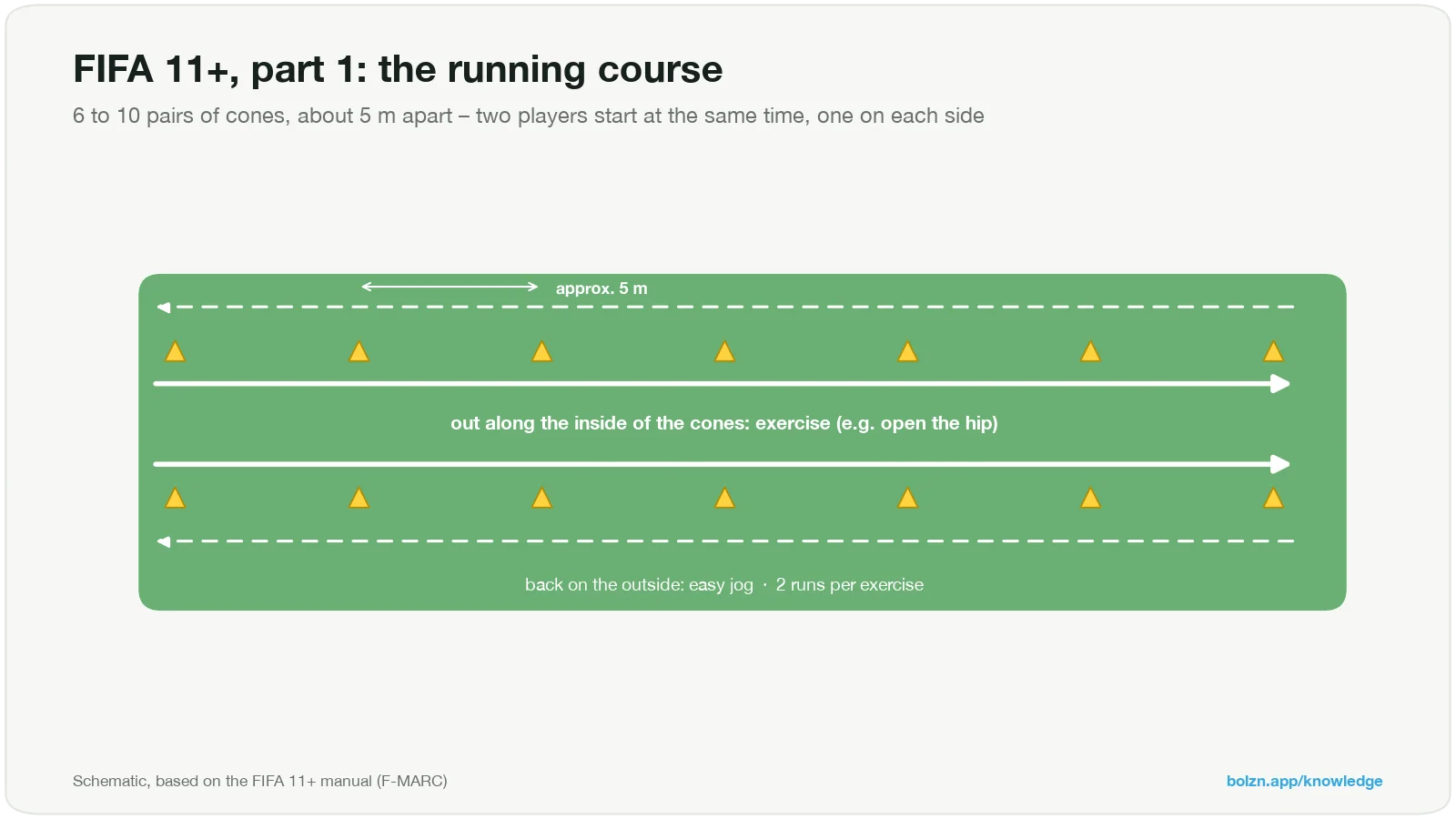
Six running exercises at a slow pace, combined with active stretching and controlled contact with a partner. A course of 6 to 10 pairs of cones about 5 metres apart is set up, and each exercise is run twice.
| No. | Exercise |
|---|---|
| 1 | Running straight ahead |
| 2 | Hip out |
| 3 | Hip in |
| 4 | Circling partner |
| 5 | Jumping with shoulder contact |
| 6 | Quick forwards and backwards |
Part 2: Strength, plyometrics and balance
Six exercises, each at three levels. Everyone starts at level 1 and only moves on once the exercise is performed cleanly. Allow about four weeks per level.
| No. | Exercise | Level 1 | Level 2 | Level 3 |
|---|---|---|---|---|
| 7 | The bench (forearm plank) | static, 3 × 20–30 s | lift legs alternately, 3 × 40–60 s | hold one leg lifted, 3 × 20–30 s per leg |
| 8 | Sideways bench (side plank) | knee on the ground, 3 × 20–30 s per side | raise and lower hip | with leg lift |
| 9 | Nordic hamstrings | 3–5 repetitions | 7–10 | 12–15 |
| 10 | Single-leg stance | holding a ball, 2 × 30 s per leg | throwing a ball with a partner | partner pushes you off balance |
| 11 | Squats | with toe raise, 2 × 30 s | lunges, 2 × 10 per leg | one-leg squat, 2 × 10 per leg |
| 12 | Jumping | vertical, 2 × 30 s | lateral | over an imaginary cross |
Part 3: Running exercises at speed
| No. | Exercise | Pace |
|---|---|---|
| 13 | Running across the pitch | 75–80 per cent |
| 14 | Bounding | high knees, long bounds |
| 15 | Plant and cut | acceleration at 80–90 per cent |
FIFA provides the detailed description with pictures free of charge in its official manual and on the FIFA Training Centre.
What matters when performing the exercises?
- Knee over foot: In landings, squats and the single-leg stance, the knee must not buckle inwards. This is the most important point for protecting the cruciate ligament (ACL).
- Land softly: on the forefoot, with knees and hips bent.
- Stable trunk: In the bench positions, head, shoulders, hips and feet form a line.
- Nordic hamstrings slowly: resist the fall for as long as possible, then catch yourself with your hands.
How often and when?
- At least twice a week, ideally before every training session as the complete warm-up.
- Before matches only part 1 and part 3, that is, the running exercises. The strength exercises from part 2 belong in training, not right before the match. What the warm-up looks like on match day is covered in the article Pre-match warm-up.
- Regularity is decisive: In one study, players who did the programme consistently had 35 per cent fewer injuries than those who did it only now and then. Teams whose coaches already had experience with prevention training did even better.
What the 11+ does not cover
- Adductors: The programme hardly strengthens the inner thigh. If you often have groin problems, add the Copenhagen exercise: in the side plank, rest the top leg on a bench or a partner and lift the body.
- Match-day sprints: Before a match you also need short, maximal accelerations and small-sided games with the ball.
Frequently asked questions
Isn't the 11+ boring? After a few weeks the players know the routine, which saves time on explanations. The levels and a ball drill afterwards add variety.
Does the 11+ replace strength training? No, but it is a good foundation. If you have more time, add one or two short strength sessions a week.
Does it also help women's and girls' teams? Yes, the first large study was carried out with adolescent female players. The risk of cruciate ligament injury is particularly high there, and programmes with jumping and landing training reduce it considerably.
In bolzn, the 11+ can be built into your session templates as a fixed warm-up block, see Training planning. What makes a good warm-up in general is covered in the article Warming up in football.
Sources
- Bizzini, M., Junge, A. & Dvorak, J. / F-MARC: FIFA 11+ – Ein komplettes Aufwärmprogramm (manual and poster).
- Thorborg, K. et al. (2017). Effect of specific exercise-based football injury prevention programmes on the overall injury rate in football: a systematic review and meta-analysis of the FIFA 11 and 11+ programmes. British Journal of Sports Medicine.
- Silvers-Granelli, H. et al. (2015). Efficacy of the FIFA 11+ injury prevention program in the collegiate male soccer player. American Journal of Sports Medicine.
- Soligard, T. et al. (2008). Comprehensive warm-up programme to prevent injuries in young female footballers: cluster randomised controlled trial. BMJ, 337, a2469.
- Soligard, T. et al. (2010). Compliance with a comprehensive warm-up programme to prevent injuries in youth football. British Journal of Sports Medicine.
- Sadigursky, D. et al. (2017). The FIFA 11+ injury prevention program for soccer players: a systematic review. BMC Sports Science, Medicine and Rehabilitation.
- Al Attar, W. S. A. et al. (2016). How effective are F-MARC injury prevention programs for soccer players? A systematic review and meta-analysis. Sports Medicine.
- Al Attar, W. S. A. et al. (2017). Effect of injury prevention programs that include the Nordic hamstring exercise on hamstring injury rates in soccer players. Sports Medicine.
- Harøy, J. et al. (2017). Including the Copenhagen adduction exercise in the FIFA 11+ provides missing eccentric hip adduction strength effect in male soccer players. American Journal of Sports Medicine.