Pre-match warm-up: routine, half-time and substitutes
How to warm your team up properly before a match: a routine with timings, why half-time matters and how substitutes stay ready.
How do you warm up before a match?
Before a match, about 20 to 30 minutes of warm-up are enough, finishing 5 to 10 minutes before kick-off. It starts gently with the ball, builds up through running exercises and passing drills and ends with short sprints and a small-sided game. Strength exercises and long stretching have no place in it. Just as important as the warm-up before kick-off: do not just sit at half-time, and keep substitutes warm.
A sample routine with timings
| Minutes before kick-off | Content | Aim |
|---|---|---|
| −35 to −30 | easy jog, passing in pairs over a short distance | raise heart rate and temperature, feel for the ball |
| −30 to −22 | running exercises: hip out and hip in, sideways running, fast feet, lunges (like part 1 of the FIFA 11+) | prepare muscles and joints dynamically |
| −22 to −15 | passing over a longer distance, one-touch play, goalkeepers warm up separately with shots | technique and awareness |
| −15 to −10 | rondo or keep-ball, for example 6v2 or 10v4 with the starting eleven | tempo, communication, getting into the game |
| −10 to −7 | accelerations, changes of direction, 3 to 4 short sprints at full speed (like part 3 of the 11+) | "switch on" speed |
| −7 to 0 | short break, drink, final team talk, walk out onto the pitch | – |
If you have less time, shorten the passing drills and small-sided games. The running exercises and the sprints at the end should stay. For youth teams, 20 minutes are often enough.
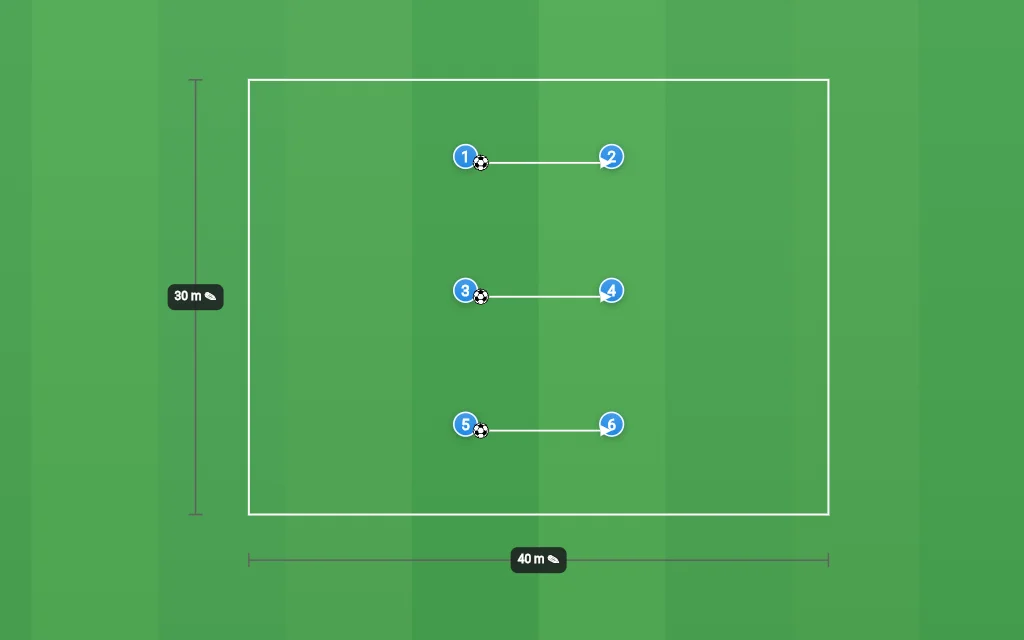
From the bolzn drill library: "Pre-match warm-up" in five phases, here the start with passing in pairs.
You can find the complete programme with passing, rondo and position-specific drills in the bolzn football drills.
How professionals warm up before a match
A look at the warm-up of professional teams such as West Ham United shows that the routine is essentially the same, just timed more precisely:
- The goalkeepers start first, about 45 minutes before kick-off, with the goalkeeping coach. The outfield players join around 35 minutes before.
- Running drills in two groups: fast feet, heel flicks, sideways running, hip out and hip in.
- A tight game without tackles, for example 5v5 on about 18 × 14 metres with target players at the ends: two minutes of play, one minute's rest, another two minutes. Fast, lots of touches, but no tackling.
- Tasks by position: centre-backs play long balls and headers, midfielders and forwards finish after passive pressure from the coach, the goalkeepers save shots.
- To finish, a few short jumps and sprints, then it is back to the dressing room.
Amateur teams can adopt this easily: let the goalkeepers start a little earlier, play a tight game without tackles instead of long passing drills, and use the last few minutes for short, fast actions.
And the day before the match?
The day before the match, the warm-up should activate without tiring: short, sharp movements, reacting to signals, quick passes, all in short rounds with breaks. The mood should be relaxed. One example is a one-two circuit in which the players dribble in a circle and play a one-two with a wall player at each pole, in rounds of about 30 seconds.
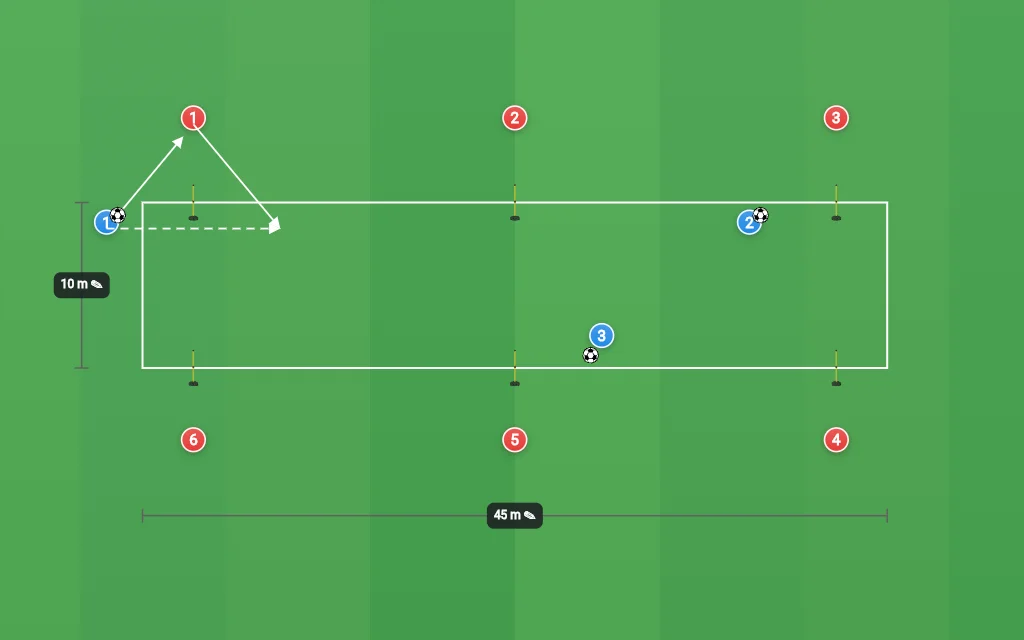
From the bolzn drill library: "One-two circuit around six poles" as a short activation the day before the match.
How the whole week between two matches is structured is covered in the article Planning the training week.
Why not finish too early?
The warm-up raises muscle temperature from about 36 to over 39 °C. If the team then stands around for a quarter of an hour, part of the effect is lost again. So plan for no more than 10 minutes between the last sprint and kick-off. In cold weather, make it even shorter and keep jackets on until kick-off.
What matters at half-time?
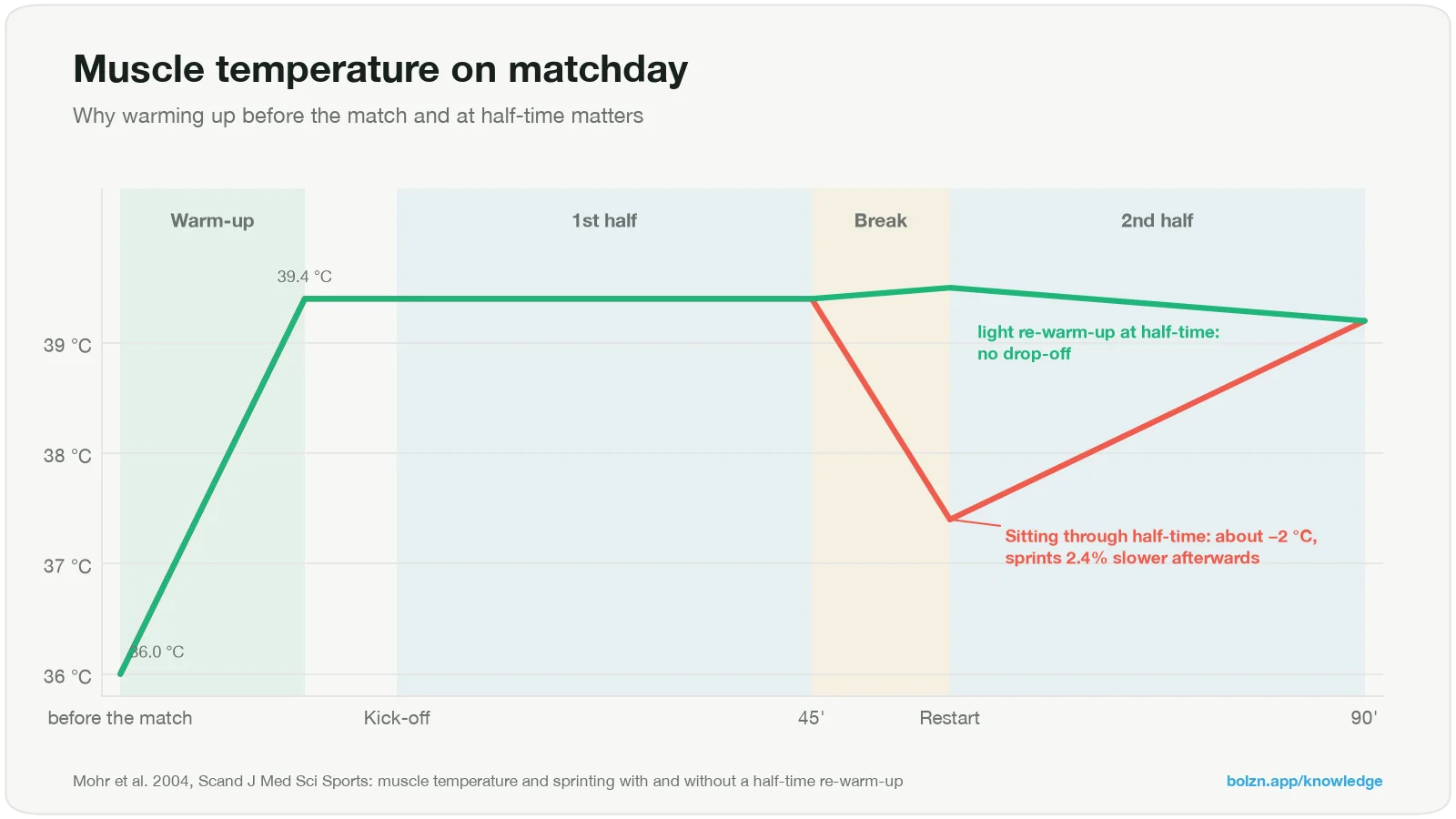
A Danish study with footballers measured what happens at half-time: players who only sit for the 15 minutes lose about 2 degrees of muscle temperature and are 2.4 per cent slower in the sprint at the start of the second half. Players who did a light re-warm-up in the last minutes of the break did not have this drop in performance.
This is how it works in practice:
- The first minutes of the break are for drinking, the team talk and catching your breath.
- 5 to 7 minutes before the restart, go out onto the pitch: easy jogging, a few running exercises, 2 to 3 short accelerations, a few passes.
- In cold weather, keep moving until the restart.
How do I keep substitutes ready?
Substitutes are often forgotten. Research in professional football shows that by the time they come on, their body temperature is back to the level before the warm-up. They then sprint almost 4 per cent slower and jump almost 10 per cent less high than after the warm-up. Yet substitutes in particular do a great deal of running in their first minutes on the pitch.
What helps:
- Warm up together with the team and do not go to the bench before kick-off.
- Join in at half-time when the team warms up again.
- Re-warm regularly: every 10 to 15 minutes a short routine behind the goal or along the touchline with easy jogging, running exercises and 2 to 3 accelerations.
- Before coming on, another 3 to 5 minutes with sprints, not just jacket off and on you go.
- One fixed person, such as an assistant coach, takes care of this.
Pre-match warm-up for children
For the youngest, a short, playful warm-up with the ball is enough: a dribbling or tag game, a few shots at goal, done. Long laps and exercises in a circle tend to take children out of the flow of play. For training, FIFA 11+ Kids is a good choice.
Common mistakes on match day
- Finishing the warm-up too early and waiting 15 minutes in the dressing room.
- Strength exercises right before the match: part 2 of the 11+ belongs in training.
- Long stretching in a circle instead of movement.
- No sprints: the first full-speed acceleration should not come only in the match.
- Just sitting at half-time, especially in cold weather.
- Forgetting the substitutes.
Recovery begins after the match; how to get it right is covered in the article Recovery after the match. General information on structure, duration and stretching can be found in the article Warming up in football.
Sources
- Mohr, M. et al. (2004). Muscle temperature and sprint performance during soccer matches – beneficial effect of re-warm-up at half-time. Scandinavian Journal of Medicine & Science in Sports, 14(3), 156–162.
- Hills, S. P. et al. (2021). Body temperature and physical performance responses are not maintained at the time of pitch-entry … Journal of Science and Medicine in Sport.
- Hills, S. P. et al. (2019). A match-day analysis of the movement profiles of substitutes … PLoS One.
- Hills, S. P. et al. (2020). Modifying the pre-pitch entry practices of professional soccer substitutes … PLoS One.
- Bizzini, M. et al. / F-MARC: FIFA 11+ (before matches only parts 1 and 3).
- SoccerTutor: West Ham United FC – Pre-Match Warm-Up Session and Warm Ups to Maximise Performance – Pre-Match Activation Warm Ups.
- UYSA: Pre-game Warm-up.
- Behm, D. G. et al. (2016). Acute effects of muscle stretching on physical performance, range of motion, and injury incidence. Applied Physiology, Nutrition, and Metabolism.
- Fradkin, A. J. et al. (2010). Effects of warming-up on physical performance: a systematic review with meta-analysis. Journal of Strength and Conditioning Research.