Football warm-up: structure, duration and common mistakes
How a good football warm-up is structured, how long it should last, whether to stretch beforehand and what children need that adults do not.
How do you warm up properly in football?
A good football warm-up lasts about 10 to 20 minutes and builds the load from easy to fast: first raise heart rate and body temperature, then move joints and muscles dynamically, and finish with short sprints and jumps. Long static stretching has no place in it. If you use a prevention programme such as FIFA 11+ instead of just any warm-up, you also cut the risk of injury by a third to almost a half.
So the warm-up is not just a duty before the actual training, but the best opportunity to prevent injuries and train technique and speed at the same time.
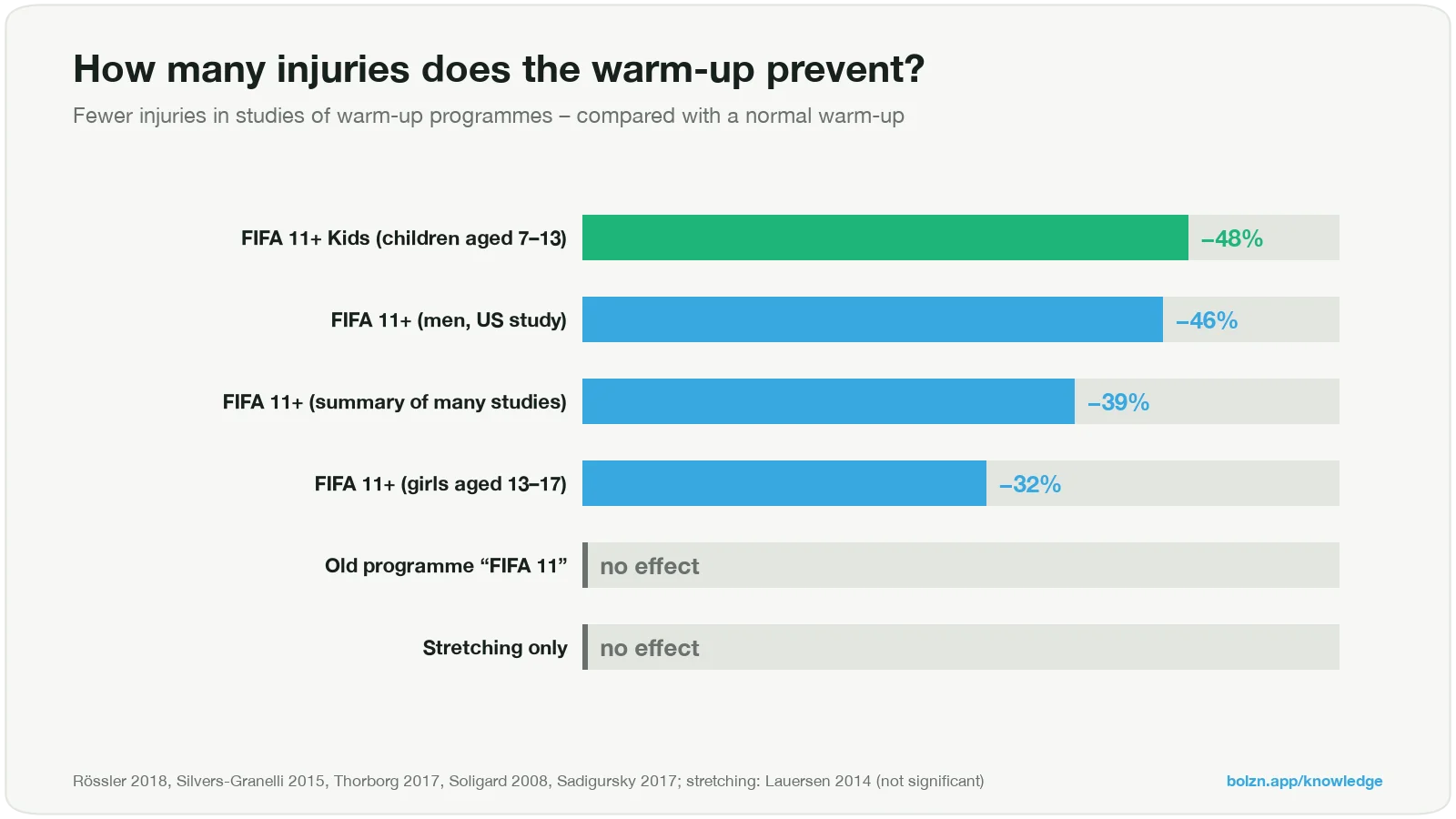
What does the warm-up achieve?
- Performance: In a review of 32 studies, warming up improved performance in almost four out of five areas measured, such as sprinting, jumping and strength. The main reason is the higher muscle temperature: warm muscles contract faster and more powerfully.
- Injuries: A normal warm-up on its own offers little protection. Structured programmes with strength, balance and jumping exercises, on the other hand, reduce injuries considerably, as the chart above shows.
- Mind: Players arrive mentally in training and in the match, and concentration and communication are ramped up.
The structure: from easy to fast
A proven pattern is the RAMP principle from sports science:
- Raise: easy jogging, passing or a game with lots of touches. Heart rate and temperature rise. About 5 minutes.
- Activate and mobilise: movements that take muscles and joints through their full range of motion: hip out and hip in, lunges, squats, sideways running, fast feet. Plus strength and balance exercises. About 5 to 10 minutes.
- Potentiate (build up): short accelerations, changes of direction, jumps, fast passing drills. The intensity rises to just below match pace. About 3 to 5 minutes.
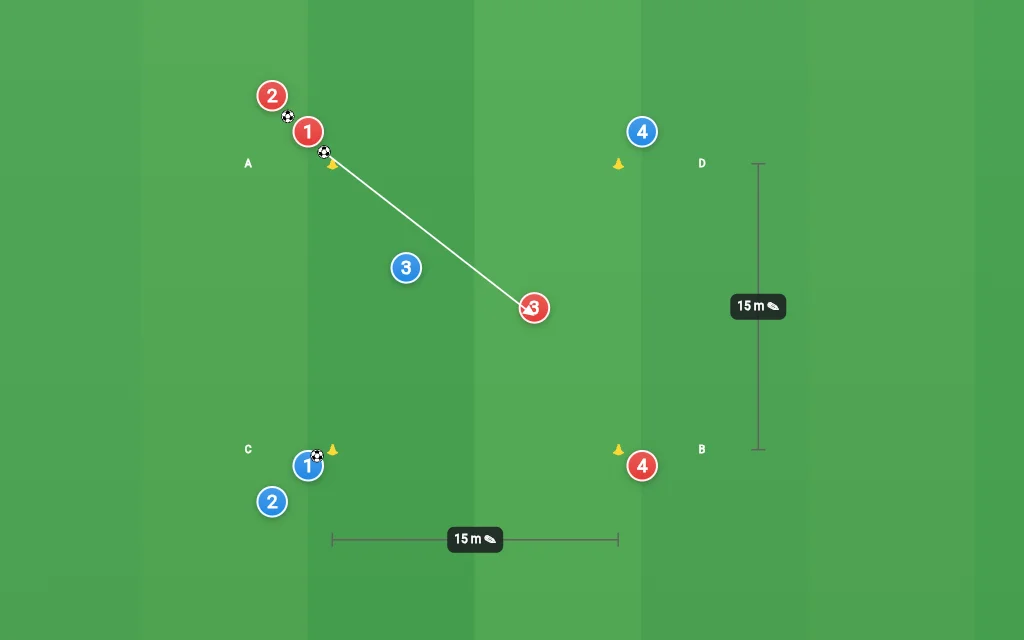
Warm-up with the ball from the bolzn drill library: passing square on the call "Turn!" or "Bounce!". The ball keeps moving, heart rate and concentration go up.
The FIFA 11+ follows exactly this structure: running exercises, then strength, balance and jumps, and fast runs to finish. How it works in detail is covered in the article FIFA 11+.
How long should the warm-up last?
There is no fixed, scientifically optimal duration. The tried-and-tested programmes last between 8 and 20 minutes:
| Programme | Duration | Who it is for |
|---|---|---|
| FIFA 11+ Kids | 15–20 minutes | children aged 7 to 13 |
| FIFA 11+ | about 20 minutes | young players from about 14 and adults |
| Short programmes (e.g. only the running parts of the 11+) | 8–10 minutes | before a match, when time is short |
The exact duration matters less than the sequence: by the end of the warm-up, the players should be able to run fast and with purpose. And after that, things should continue without a long break, because muscle temperature drops again quickly when players stand around.
Should you stretch before a match?
Classic static stretching, where a position is held for a long time, is not useful before training and matches:
- Static stretching for more than a minute per muscle makes sprinting and jumping measurably weaker immediately afterwards.
- Short stretching of less than 30 to 45 seconds does hardly any harm, especially if sprints and jumps follow afterwards.
- Stretching does not protect against injuries. Strength and balance training, on the other hand, does.
Dynamic stretching is better: movements such as leg swings, lunges with trunk rotation or opening the hip while running. They prepare the muscles and improve performance slightly. If you like static stretching, you can do it after training or on days off.
Warm-up for children
Children do not need a long warm-up with laps and stretching exercises. They warm up best through play and with the ball: tag games, dribbling games with a story, small passing drills. That gets them up to temperature and gives them lots of touches along the way.
Running laps around the pitch is a no-go for under-7s and under-9s. Children of this age warm up on their own while playing. A lap without a ball gives them nothing, but it costs training time and motivation. A child who loses the fun during the warm-up is less likely to come back. So the rule for the little ones is: every child has a ball or is part of a game from the very first minute. Whoever arrives early can start kicking.
What that looks like in practice:
- Under-7s (Bambini): story games with the ball, such as fire brigade, wizards or animals at the zoo. Every child has a ball and the coach tells the story.
- Under-8s to under-11s: tag and dribbling games with the ball, small competitions, a short 2v2 or 3v3.
- From about 11: running and strength parts such as FIFA 11+ Kids are added, but here too with the ball and as a competition wherever possible.
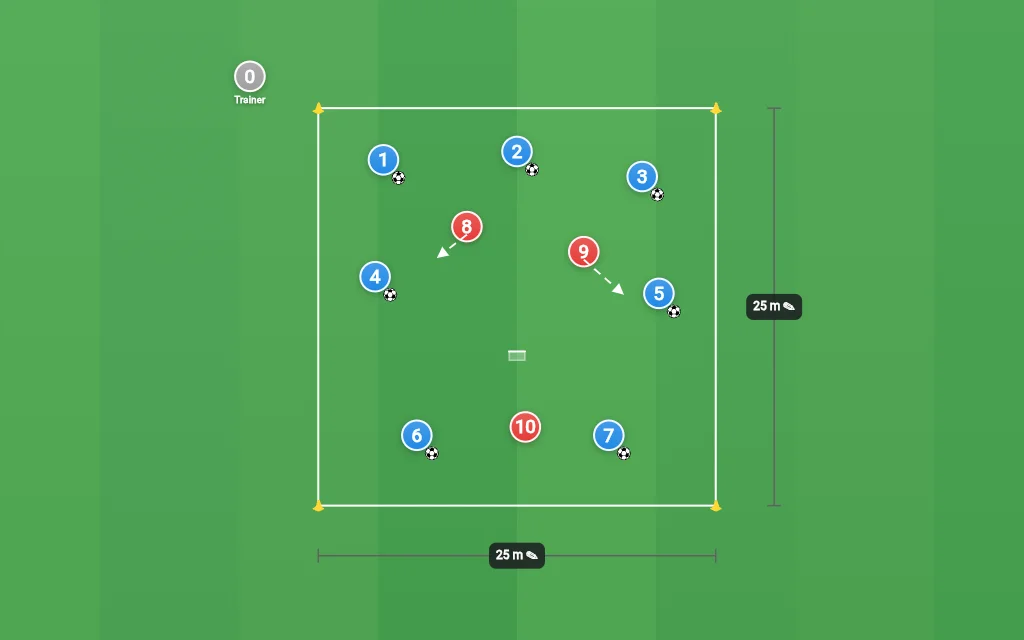
Warm-up game for children from the bolzn drill library: "Bees and Beekeepers". The bees protect their honey (the ball), the beekeepers want to steal it.
For children aged 7 to 13 there is a dedicated programme, FIFA 11+ Kids, which has been shown to halve injuries. It takes about 15 to 20 minutes, replaces the normal warm-up and trains balance, strength and falling correctly.
You can find hundreds of warm-up games for all age groups, from "Bees and Beekeepers" for the under-7s (Bambini) to the passing square for youth players, in the bolzn football drills.
Warm-up for adults and veterans' teams
With age, the warm-up becomes more important, not less. Especially in veterans' teams (Ü-Mannschaften), where many play only once a week, muscle injuries to the back of the thigh and the calf are common. The following help:
- Nordic hamstrings (part of the FIFA 11+): programmes that include this exercise halve hamstring injuries.
- Strengthen the adductors: The 11+ hardly trains the inner thigh. The Copenhagen exercise in the side plank closes this gap.
- Build up slowly: Do not start with shots from 25 metres straight after getting changed.
Common warm-up mistakes
- Finished too early: 15 minutes of standing around pass between the warm-up and kick-off, and the temperature is back down. More on this in the article Pre-match warm-up.
- Only easy: If you never move really fast, you are not ready for the first sprint in the match.
- Long stretching in a circle instead of movement.
- Running laps with children: they give the little ones nothing and take away their enjoyment. Start with a game with the ball instead.
- Something different every time: Prevention programmes only work if they are done regularly. In studies, teams with high participation had considerably fewer injuries.
- Shots without preparation: Hard shots with cold muscles put strain on the groin and thigh.
In bolzn, a fixed warm-up can be built into any session template as a block, see Training planning.
Sources
- Fradkin, A. J., Zazryn, T. R. & Smoliga, J. M. (2010). Effects of warming-up on physical performance: a systematic review with meta-analysis. Journal of Strength and Conditioning Research, 24(1), 140–148.
- Jeffreys, I. (2007). Warm-up revisited: the RAMP method of optimizing warm-ups. Professional Strength and Conditioning, 6, 12–18.
- Behm, D. G. et al. (2016). Acute effects of muscle stretching on physical performance, range of motion, and injury incidence in healthy active individuals: a systematic review. Applied Physiology, Nutrition, and Metabolism, 41(1), 1–11.
- Kay, A. D. & Blazevich, A. J. (2012). Effect of acute static stretch on maximal muscle performance: a systematic review. Medicine & Science in Sports & Exercise.
- Lauersen, J. B., Bertelsen, D. M. & Andersen, L. B. (2014). The effectiveness of exercise interventions to prevent sports injuries: a systematic review and meta-analysis. British Journal of Sports Medicine.
- Thorborg, K. et al. (2017). Effect of specific exercise-based football injury prevention programmes on the overall injury rate in football: a systematic review and meta-analysis of the FIFA 11 and 11+ programmes. British Journal of Sports Medicine.
- Rössler, R. et al. (2018). A multinational cluster randomised controlled trial to assess the efficacy of '11+ Kids'. Sports Medicine.
- Soligard, T. et al. (2010). Compliance with a comprehensive warm-up programme to prevent injuries in youth football. British Journal of Sports Medicine.
- Al Attar, W. S. A. et al. (2017). Effect of injury prevention programs that include the Nordic hamstring exercise on hamstring injury rates in soccer players. Sports Medicine.
- Harøy, J. et al. (2017). Including the Copenhagen adduction exercise in the FIFA 11+ provides missing eccentric hip adduction strength effect in male soccer players. American Journal of Sports Medicine.