Growth-related pain in children: where does it hurt?
Heel, knee, groin, back: make sense of typical growth-related pain in young footballers, what it is called, what helps and when to see a doctor.
What complaints do growing children have?
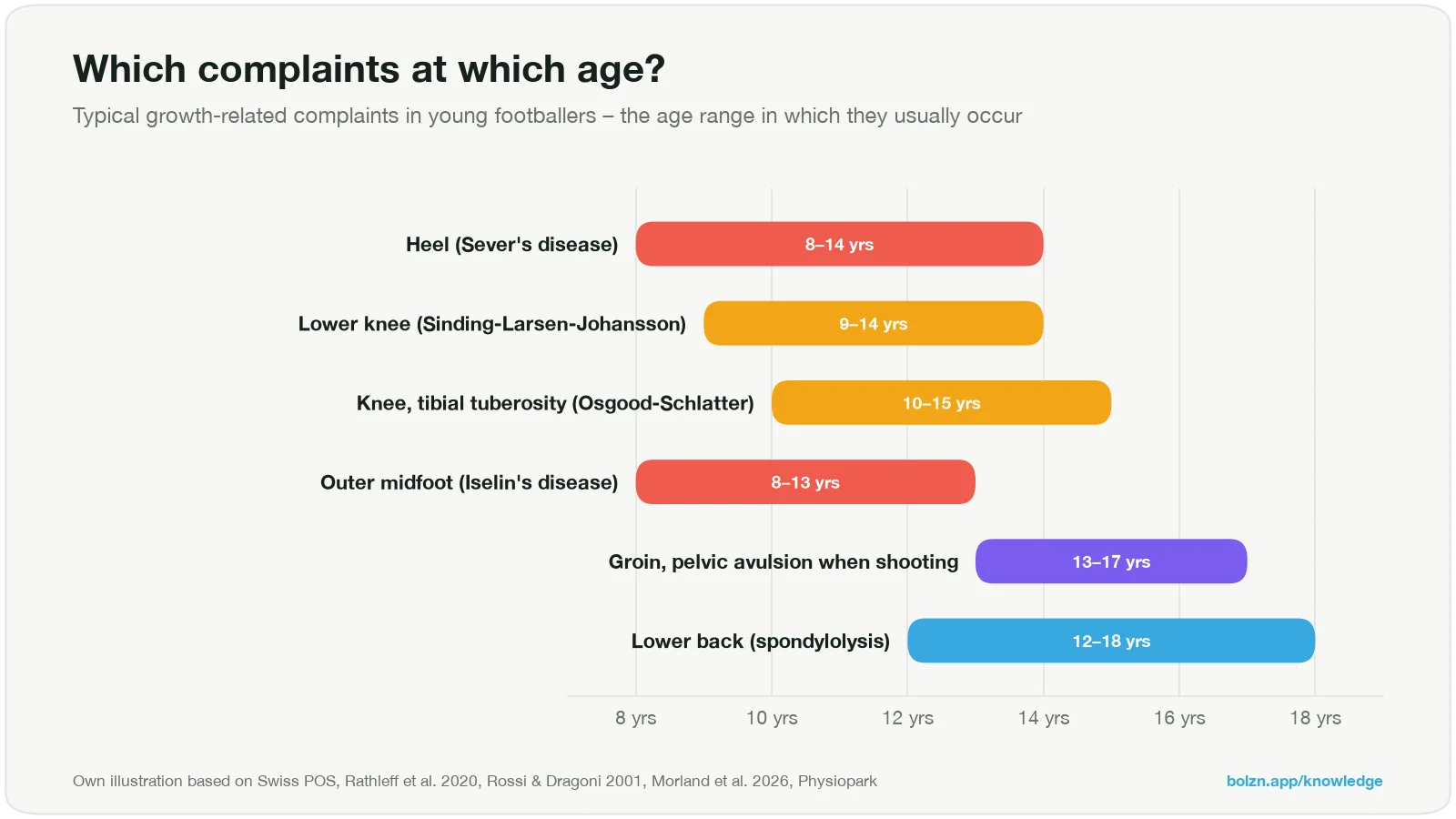
The most common complaints of young footballers during growth are irritations at the points where tendons attach to the still soft, growing bone: at the heel, below the kneecap and on the shin, at the pelvis and in the back. They have names of their own such as Sever's disease or Osgood-Schlatter, are mostly harmless and disappear once growth is complete. In one academy study, growth-related complaints of this kind were the third most common cause of time lost, after bruises and ligament sprains.
This article helps you make sense of complaints: where does it hurt, what is it called, what else could it be? It is no substitute for an examination, though.
Important: With severe or persistent pain, after an accident or with any of the warning signs further down, the child needs to see a paediatrician or orthopaedic specialist.
Heel: Sever's disease
Who: 8 to 14 years, more often boys, often both heels. Signs: pain at the back or side of the heel during and after sport. The heel hurts when you squeeze it from both sides. What it is: the Achilles tendon pulls on the growth plate of the heel bone. Outlook: good, disappears once growth is complete.
In detail in the article Heel pain in children.
Knee: Osgood-Schlatter and Sinding-Larsen-Johansson
Osgood-Schlatter (10 to 15 years): pain and often a bump you can feel below the knee on the shin. Typical with jumps, sprints, climbing stairs and kneeling. The kneecap tendon pulls on the growth plate of the shin bone. About one in ten adolescents is affected. In some of them the symptoms last longer, which is why a structured plan of load adjustment and strengthening is worthwhile. The bump often remains visible later on.
Sinding-Larsen-Johansson (9 to 14 years): the same principle, but at the lower edge of the kneecap.
A proven grading for sport:
| Grade | Pain | Sport |
|---|---|---|
| 1 | only after activity, gone the next day | carry on as normal |
| 2 | also during activity, but not limiting | adapt training (fewer jumps, sprints, kneeling) |
| 3 | constant, limiting | rest, then a step-by-step return, with medical supervision |
Not to be confused with: pain at the front behind the kneecap when going downstairs, squatting or after sitting for a long time is more likely patellofemoral pain, common in girls. Knee pain with a limp in an adolescent, especially one who is overweight, can come from the hip (slipped upper femoral epiphysis). That is an emergency and must be examined immediately.
Groin and pelvis: avulsion when shooting
Who: 13 to 17 years, mostly boys. Football is the sport in which it happens most often. Signs: a sudden, stabbing pain in the groin or at the front of the hip during a powerful shot or sprint, sometimes with a pop, followed by limping. What it is: a muscle tears a small piece of bone away at the still open growth plate of the pelvis. What to do: stop immediately and have it examined by a doctor (X-ray). Almost all heal without surgery, with a few weeks of offloading and a slow build-up.
Groin pain when shooting that creeps in gradually, without a sudden onset, is by contrast usually an irritation at the pelvis. Here it helps to reduce the number of shots temporarily.
Back: spondylolysis
Who: 12 to 18 years, especially at U17 and U15 (B- and C-Jugend). In a Norwegian study it affected about one in eight players between 15 and 17 within three years, above all after periods with many training and match minutes. Signs: pain in the lower back, often on one side, when arching backwards and twisting, for example when shooting or taking a throw-in. What it is: a stress fracture in the vertebral arch, usually in the lowest lumbar vertebra. What to do: have back pain that lasts longer than two to four weeks in adolescents checked by a doctor. Caught early, it usually heals well.
Other back issues during growth are a rounded back (Scheuermann's disease) and scoliosis. With both, football is generally still possible.
Foot: Iselin's disease and Köhler's disease
- Iselin's disease (8 to 13 years): pain on the outer edge of the foot at the bony bump of the fifth metatarsal, with side steps and shots with the outside of the foot. Rare and harmless. After a twisted ankle with pain at this spot, however, a fracture has to be ruled out.
- Köhler's disease (4 to 7 years): pain and swelling on the inside of the midfoot, the child limps. Rare, heals without lasting effects.
And what about "growing pains"?
What is commonly called growing pains is pain in both legs at night in children between 3 and 12, gone again in the morning, with no clinical findings. They are common, harmless and, despite the name, have nothing to do with growth. They do not appear during sport and do not affect one particular spot.
When does my child need to see a doctor immediately?
- After an accident (fall, twisted ankle, collision) the child can no longer put weight on the leg or cannot move the joint.
- Sudden pain with a pop when shooting or sprinting.
- Pain at night that wakes the child.
- Swelling, redness, warmth without an accident, fever, unusual tiredness or weight loss.
- Limping for longer than a week, or even at rest.
- Knee pain with a limp in adolescents (think of the hip).
- Back pain radiating into the leg, numbness or tingling.
- Complaints that do not get better despite rest.
What can coaches and parents do to prevent it?
- Warm up with FIFA 11+ Kids: halves injuries in 7- to 13-year-olds.
- Manage the load during the growth spurt: fewer series of jumps, sprints and hard shots for players who are growing quickly at the moment. More on this in the article Growth spurt in football.
- Build strength and core stability, well coached and age-appropriate.
- Not too much: no more hours of organised sport per week than the child's age in years, and regular days off.
- Take pain seriously and talk to child and parents.
Sources
- Materne, O. et al. (2021). Injury incidence and burden in a youth elite football academy: a four-season prospective study of 551 players aged from under 9 to under 19 years. British Journal of Sports Medicine.
- Rossi, F. & Dragoni, S. (2001). Acute avulsion fractures of the pelvis in adolescent competitive athletes. Skeletal Radiology.
- Schuett, D. J., Bomar, J. D. & Pennock, A. T. (2015). Pelvic apophyseal avulsion fractures. Journal of Pediatric Orthopaedics.
- Morland, N. et al. (2026). Incidence and risk factors of spondylolysis in youth football. BMJ Open Sport & Exercise Medicine.
- Rathleff, M. S. et al. (2020). Activity modification and knee strengthening for Osgood-Schlatter disease. Orthopaedic Journal of Sports Medicine.
- Guldhammer, C. et al. (2019). Long-term prognosis and impact of Osgood-Schlatter disease 4 years after diagnosis. Orthopaedic Journal of Sports Medicine.
- Smith, B. E. et al. (2018). Incidence and prevalence of patellofemoral pain: a systematic review and meta-analysis. PLoS One.
- O'Keeffe, M. et al. (2022). Defining growing pains: a scoping review. Pediatrics.
- Swiss Society for Paediatric Orthopaedics (Schweizerische Gesellschaft für Kinderorthopädie): information sheets.
- Lower Saxony Ministry of Education (Kultusministerium Niedersachsen) (2007). Das chronisch kranke Kind im Schulsport.