Growth spurt in football: what coaches and parents need to know
When the growth spurt comes, why injury risk rises then, what happens to strength and technique, and how coaches adapt training.
When does the growth spurt come?
The growth spurt in puberty peaks on average at about 12 years in girls and at about 14 years in boys. In this phase adolescents grow 8 to 11 centimetres per year, faster than at any time since they were toddlers. The spurt lasts about two years in total.
This matters for football because in exactly this period injury risk rises markedly, differences between players of the same age are especially large, and children sometimes have to find their way around their own body again. Anyone who knows this can adapt training and avoid many problems.
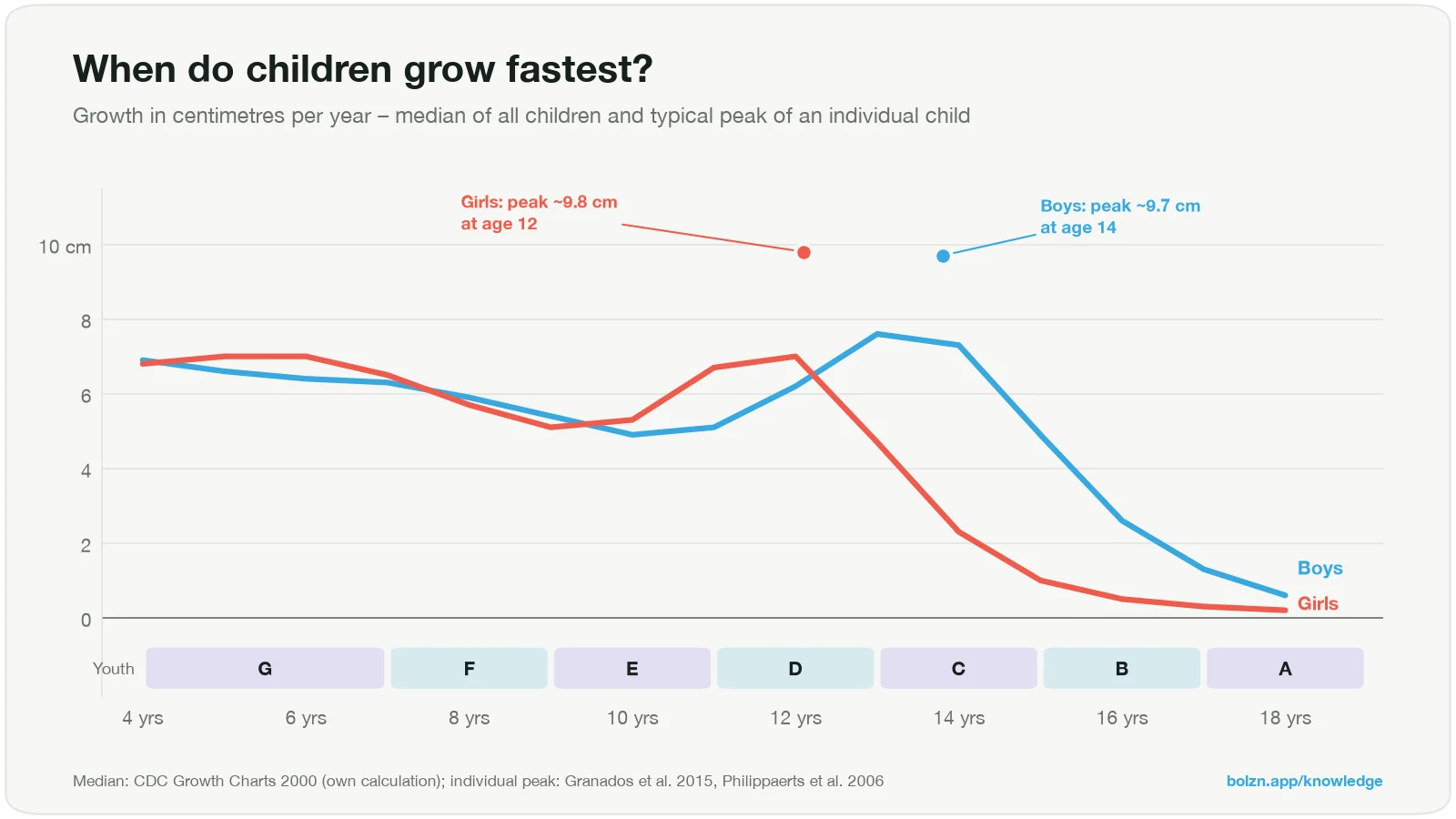
The curves show the average of all children. Because every child has their spurt at a different time, the peak looks flat in the average. In an individual child it is much steeper; the dots show a typical individual peak.
Biological age: why children of the same age are so different
The timing of the growth spurt varies a great deal. In boys it can come as early as 11 or as late as 16. In a U15 squad (C-Jugend) you therefore have players standing side by side who are biologically up to five years apart: one looks like a young man, the other like a child.
- Early developers are often taller, heavier and faster. They get their way easily in youth football, but sometimes rely too much on their body.
- Late developers have to get by on technique and game understanding. They are frequently underestimated and overlooked in selection. In English academies there were practically no late developers left at U15 and U16.
For coaches this means: performance in youth football is to a large extent a question of maturity, not just of talent. Those who are patient with late developers often end up with the better players later on.
How do I tell where a child is?
Without an X-ray there are two simple ways:
- Measure regularly: note height every three months. If a child grows more than about 7 centimetres per year (around 0.6 centimetres per month), they are in the middle of the spurt.
- Estimate expected adult height: from the child's height and weight and the parents' height, later adult height can be estimated. If a child has reached about 88 to 95 per cent of it, they are in the spurt.
Professional clubs use this for bio-banding: for a time they let players compete against each other by stage of development instead of by birth year. Players report that early developers then have to solve more through technique and late developers get more space.
What happens to strength, speed and technique during the growth spurt?
- Strength and speed: in young footballers, sprinting, jumping power, agility and endurance improve most right in the growth spurt. At the same time weight increases quickly.
- Flexibility: the bones grow faster than muscles and tendons can keep up. Many adolescents become stiffer for a while.
- Coordination: the idea that "everyone gets clumsy in the growth spurt" is not quite true. Some adolescents temporarily have problems with technique and balance, but many do not. If a player suddenly looks wooden, patience is better than criticism.
The old doctrine of fixed "golden ages of learning" or "sensitive phases" is also not scientifically proven. Children can train all abilities at any age; only the weighting changes.
Why does injury risk rise during the growth spurt?
Several studies with youth footballers show the same picture:
- In a Dutch study, talented players had twice as many days lost in the year of their fastest growth as before (about 16 instead of 7 days per year).
- Those who grow more than about 0.6 centimetres per month get injured more often.
- Typical of this phase are irritations where tendons attach at the heel and knee (for example Sever's disease and Osgood-Schlatter) and avulsions of small pieces of bone at the pelvis. Muscle and ligament injuries, by contrast, only become more common after the spurt.
The reason: at the growth plates the bone is still soft, and the muscles pull harder on the tendon attachments because they cannot keep pace with bone growth. Which complaints are typical and when to see a doctor is covered in the article Where does it hurt? Growth-related pain in young footballers.
How do I adapt training during the growth spurt?
- Keep an eye on growth: measure height regularly and note who is growing quickly at the moment.
- Avoid peaks: for fast-growing players reduce the volume of jumps, sprints and shots a little, and no sudden increases after breaks.
- Build strength and stability: strengthening the core, hips and legs is safe and worthwhile at any age if it is well coached. The warm-up programme FIFA 11+ Kids is a good way in.
- Count the total load: club, representative squad, school PE and a second sport add up. A rule of thumb from research: no more hours of organised sport per week than the child's age in years.
- Take pain seriously: anyone who complains about heel, knee or groin is not "soft". The pain traffic light helps you decide how much training is possible.
- Be patient: fluctuations in performance during the spurt are normal. Do not judge players on the current season alone.
In bolzn you can keep an eye on your players' height together with attendance and load, see Sessions and matches.
Sources
- Granados, A. et al. (2015). Relationship between timing of peak height velocity and pubertal staging. Journal of Clinical Research in Pediatric Endocrinology.
- Philippaerts, R. M. et al. (2006). The relationship between peak height velocity and physical performance in youth soccer players. Journal of Sports Sciences.
- Malina, R. M. et al. (2000). Height, mass and skeletal maturity of elite Portuguese soccer players aged 11–16 years. Journal of Sports Sciences.
- Cumming, S. P. et al. (2017). Bio-banding in sport. Strength and Conditioning Journal, 39(2), 34–47.
- Cumming, S. P. et al. (2018). Premier League academy soccer players' experiences of competing in a tournament bio-banded for biological maturation. Journal of Sports Sciences.
- Hill, M. et al. (2020). Relative age and maturation selection biases in academy football. Journal of Sports Sciences.
- van der Sluis, A. et al. (2014). Sport injuries aligned to peak height velocity in talented pubertal soccer players. International Journal of Sports Medicine.
- Kemper, G. L. et al. (2015). Anthropometric injury risk factors in elite-standard youth soccer. International Journal of Sports Medicine.
- Quatman-Yates, C. C. et al. (2012). A systematic review of sensorimotor function during adolescence. British Journal of Sports Medicine.
- Lloyd, R. S. et al. (2014). Position statement on youth resistance training: the 2014 International Consensus. British Journal of Sports Medicine.
- Jayanthi, N. A. et al. (2015). Sports-specialized intensive training and the risk of injury in young athletes. American Journal of Sports Medicine.
- CDC (2000). Growth Charts, Stature-for-age (data for the chart).