Groin pain and adductors in football: how to prevent it
Learn why footballers often have groin problems, how the Copenhagen exercise prevents them, how the squeeze test works and what helps an adductor strain.
Why do footballers so often have groin problems?
Groin injuries are among the most common injuries in football: in men they account for about one in eight injuries, in professional football for 12 to 16 per cent of all injuries in a season. In most cases the adductors are to blame, the muscles on the inside of the thigh. They work hard with every shot, every change of direction and every sliding tackle.
On top of that, many groin problems never appear in any injury statistics. Players carry on playing in pain. In a Spanish study, about one in nine amateur players had groin complaints in a normal week, but only a small proportion were out because of them.
The good news: with a single exercise, the Copenhagen exercise, the risk can be reduced markedly.
This article does not replace a medical examination. If symptoms are severe or persistent, or if you notice the warning signs further below, please have them checked by a doctor.
Where does groin pain come from?
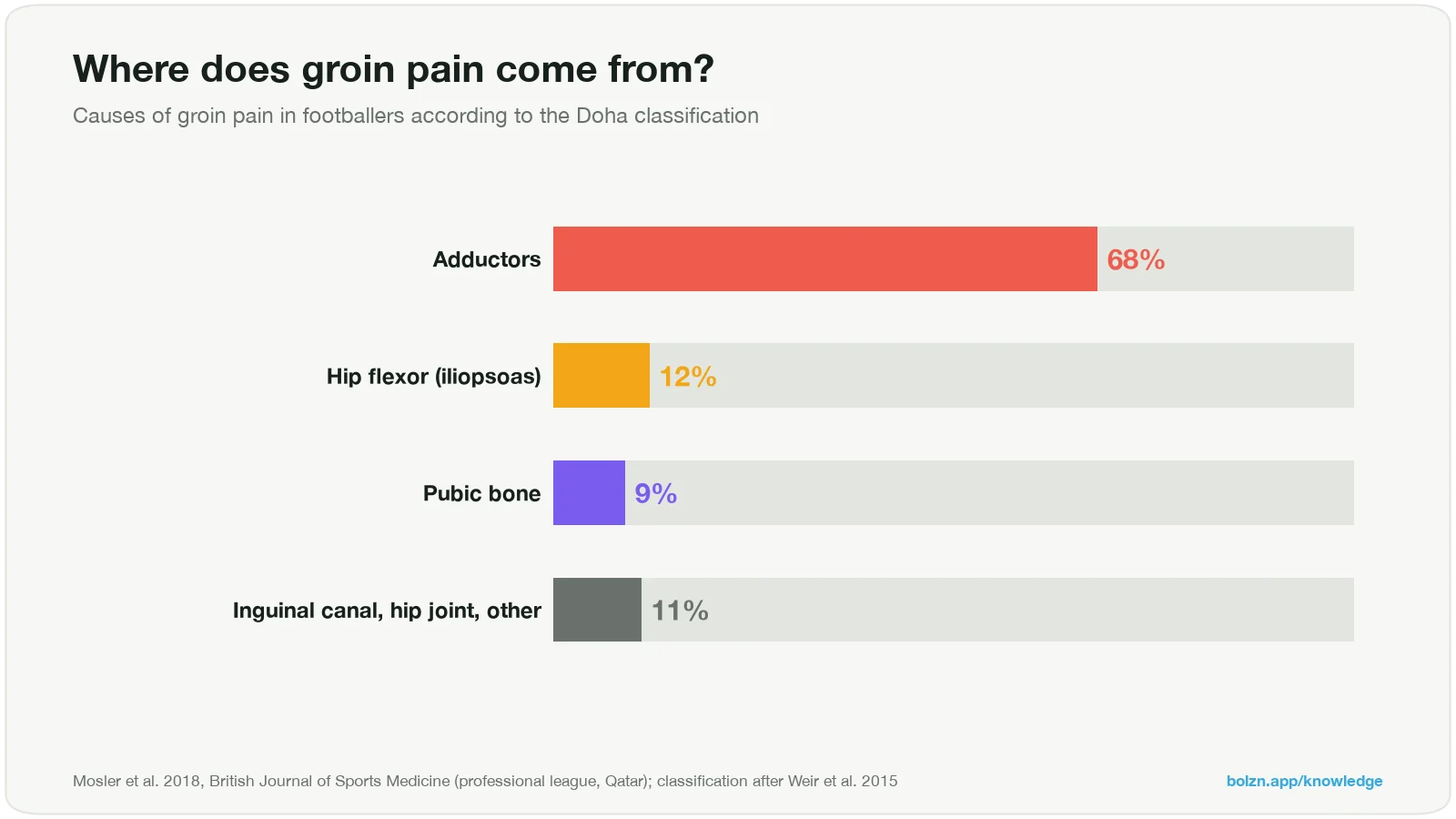
Sports physicians classify groin pain according to the so-called Doha classification:
- Adductors: pain on the inside of the thigh close to the pubic bone, worse when squeezing the legs together. By far the most common.
- Hip flexor (iliopsoas): pain at the front of the groin, when lifting the leg against resistance.
- Inguinal canal: pain in the area of the inguinal canal, often when coughing or straining.
- Pubic bone: pain directly over the pubic bone in the middle.
- Hip joint: deep pain in the groin, often with twisting movements.
A distinction is also made between the acute strain, which occurs suddenly when shooting or changing direction, and long-standing groin pain, which develops gradually through overload and often lasts for months.
Who is particularly at risk?
- Anyone who has had groin problems before: the risk is about two to three times as high.
- Anyone with weak adductors, especially compared with the abductors on the outside.
- Men more often than women.
- A higher level of play and a high match and shooting load.
- Pre-season: at the start of the season groin complaints are almost twice as common as during the season.
The Copenhagen exercise
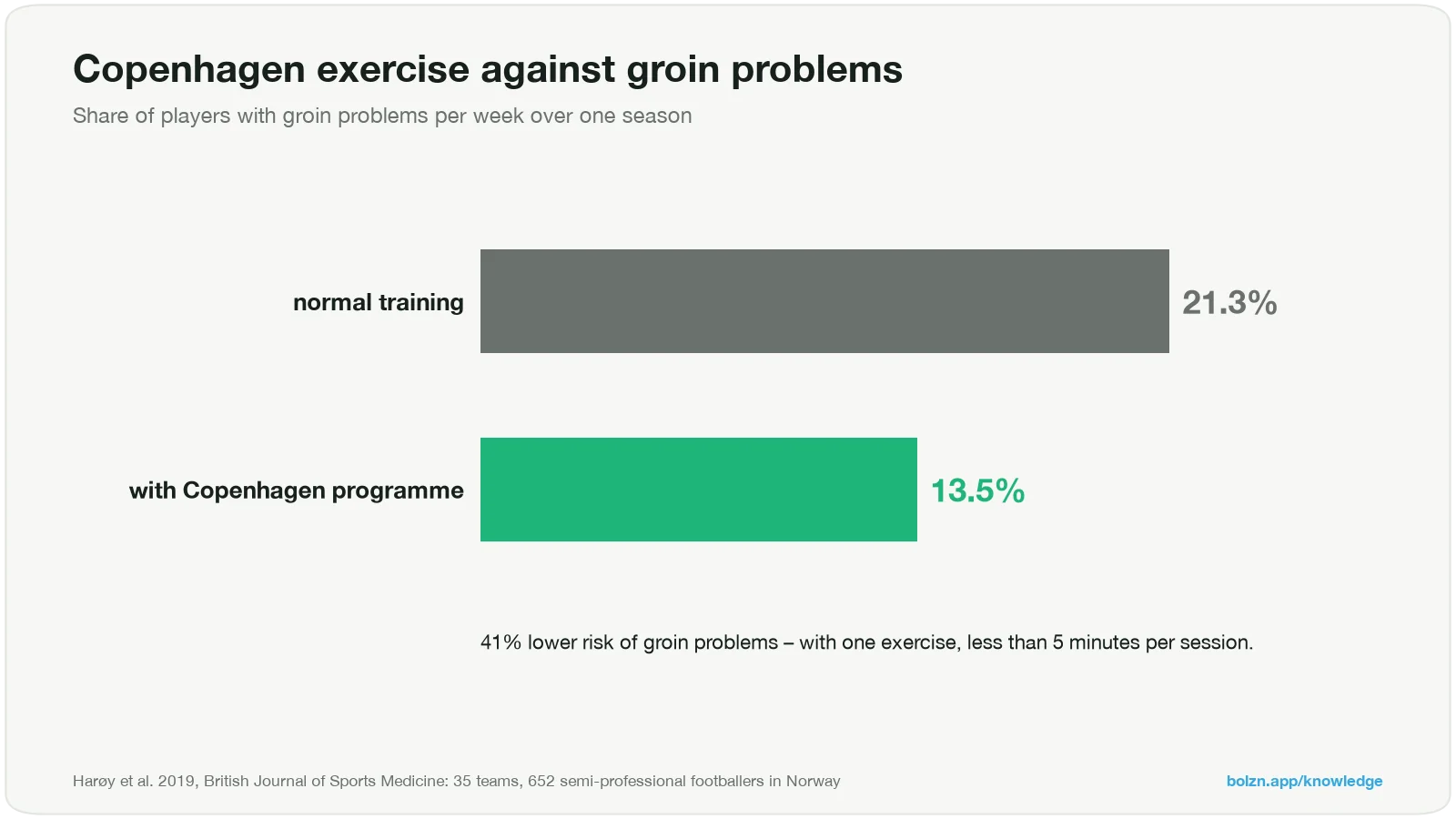
In a large study with 35 Norwegian teams, teams that built the Copenhagen exercise into their training had 41 per cent fewer groin problems. The players needed less than five minutes per session for it.
How to do the exercise
- Starting position: side plank on the forearm, elbow under the shoulder. A partner holds the top leg at about hip height, one hand at the ankle, one at the knee. Alternatively the leg rests on a bench.
- Movement: lift the hips until the body forms a straight line. At the same time bring the bottom leg up to the top leg until the feet touch.
- Back down: slowly lower the body halfway, the bottom leg briefly taps the ground without taking any weight.
- Tempo: slow and even, with no pause at the top or bottom. Train both sides.
Watch out for: do not let the hips sag or rotate backwards, keep the elbow under the shoulder, do not use the bottom leg for support.
Easier and harder
| Level | How to do it |
|---|---|
| 1 – entry level | lying on your side, the top leg is bent with the foot placed in front of the body, slowly raise and lower the straight bottom leg |
| 2 – short lever | as described above, but the partner holds the leg at the knee |
| 3 – long lever | the partner holds the leg at the ankle, this is the full exercise |
Pain rule: if the pain during the exercise is above 3 out of 10, go back one level.
The 8-week programme from the study
| Week | Sessions per week | Repetitions per side |
|---|---|---|
| 1 | 2 | 3–5 |
| 2 | 3 | 3–5 |
| 3–4 | 3 | 7–10 |
| 5–6 | 3 | 12–15 |
| 7–8 | 2 | 12–15 |
| afterwards during the season | 1 | 12–15 |
It is best done in the warm-up, for example as an addition to the FIFA 11+. The 11+ on its own barely strengthens the adductors, and the Copenhagen exercise closes this gap. In young players, adductor strength increased by a good third after eight weeks, and with hardly any muscle soreness.
To be honest: the exercise is hard work, and in the study only just under half of the players stuck to the programme as planned. Keep it short, schedule it firmly, do it together.
The squeeze test: a simple weekly check
A simple test shows early on whether a problem is developing:
- Lying on your back, knees bent (about 45 degrees at the hip), a ball between the knees.
- Squeeze for 5 seconds with full force.
- Rate the pain on a scale from 0 to 10.
Pain from about 6 out of 10 upwards points to a marked limitation. Studies also show that adductor strength often drops as early as a week before the pain starts. Anyone who does the test regularly can adjust the load in good time. How to ask about complaints in the team in a simple way is covered in the article Spotting overtraining.
What to do about an adductor strain?
- Immediately: stop, cool (15 to 20 minutes), apply light compression, elevate.
- In the days after: pain-free movement, then gradual strengthening. The most important indicator of progress is tenderness to pressure at the adductor attachment.
- Back to training: for a typical strain it took, in one study, a good three weeks on average until full team training. A complete tear of the tendon takes about two months or more.
For long-standing groin pain, active training helps most: in a classic study, markedly more athletes became pain-free with 8 to 12 weeks of strength and coordination training than with passive physiotherapy.
When to see a doctor?
- After an injury the leg cannot bear weight or cannot be moved actively.
- Swelling or a bulge in the groin, pain when coughing or straining (possible inguinal hernia).
- Deep pain in the hip, especially with twisting movements.
- Pain over the pubic bone that does not improve despite rest.
- Symptoms that last longer than two to three weeks.
In adolescents, a sudden groin pain when shooting can be caused by an avulsion at a growth plate of the pelvis. More on this in the article Growth-related pain in children.
Sources
- Harøy, J. et al. (2019). The Adductor Strengthening Programme prevents groin problems among male football players: a cluster-randomised controlled trial. British Journal of Sports Medicine. Study protocol ISRCTN98514933.
- Ishøi, L. et al. (2016). Large eccentric strength increase using the Copenhagen Adduction exercise in football. Scandinavian Journal of Medicine & Science in Sports.
- Harøy, J. et al. (2017). Including the Copenhagen Adduction Exercise in the FIFA 11+ provides missing eccentric hip adduction strength effect in male soccer players. American Journal of Sports Medicine.
- Weir, A. et al. (2015). Doha agreement meeting on terminology and definitions in groin pain in athletes. British Journal of Sports Medicine.
- Werner, J. et al. (2009). UEFA injury study: a prospective study of hip and groin injuries in professional football over seven consecutive seasons. British Journal of Sports Medicine.
- Waldén, M., Hägglund, M. & Ekstrand, J. (2015). The epidemiology of groin injury in senior football: a systematic review of prospective studies. British Journal of Sports Medicine.
- Mosler, A. B. et al. (2018). Groin injuries in a men's professional league (Qatar). British Journal of Sports Medicine.
- Esteve, E. et al. (2020). Weekly prevalence of groin problems in Spanish amateur football. Scandinavian Journal of Medicine & Science in Sports.
- Thorborg, K. et al. (2017). Copenhagen five-second squeeze: a valid indicator of sports-related hip and groin function. British Journal of Sports Medicine.
- Crow, J. F. et al. (2010). Adductor strength before and at the onset of groin pain in junior players. Journal of Science and Medicine in Sport.
- Serner, A. et al. (2020). Criteria-based rehabilitation and return to sport after acute adductor injuries. American Journal of Sports Medicine.
- Hölmich, P. et al. (1999). Effectiveness of active physical training as treatment for long-standing adductor-related groin pain in athletes: randomised trial. The Lancet.
- Engebretsen, A. H. et al. (2010). Intrinsic risk factors for groin injuries among male soccer players. American Journal of Sports Medicine.