Recovery after a football match: what really helps
Find out how long footballers need to recover after a match, why sleep, food and fluids are the basis and which recovery methods really work.
How long does recovery take after a football match?
After an intense match the body needs two to three days, often longer, to get back to full performance. Studies with footballers show that sprints are about 3 to 9 per cent slower after a match, jump height drops by up to 12 per cent, and thigh muscle strength has in some cases still not returned to its previous level after 72 hours. The energy stores in the muscles are only full again after two to three days.
For you as a coach this means: recovery starts with the final whistle and does not end after the shower. The most important part does not happen in the changing room but at home: sleeping, eating and drinking. Expensive equipment and special methods add only a little by comparison.
What happens in the body after a match?
A football match does not just tire “the legs”. Several systems are affected at the same time, and they recover at different speeds:
- Muscles: Sprints, braking, changes of direction and duels cause small amounts of damage in the muscle fibres. You feel this as muscle soreness, which is usually at its worst one to two days after the match. A blood marker that indicates this kind of damage (creatine kinase) peaks 24 to 48 hours after the match and takes just under three to five days (69 to 120 hours) to return to normal.
- Energy stores: The carbohydrate stores in the muscles are largely empty after the match. Players who eat little afterwards have only refilled about half of them even two days later.
- Nervous system: The nerve signals that activate the muscles also tire. This shows mainly in sprints and maximal strength.
- Fluids: In warm conditions players easily lose more than two per cent of their body weight in sweat.
- Mind: Concentration, pressure, emotions and, for away matches, the journey also take their toll.
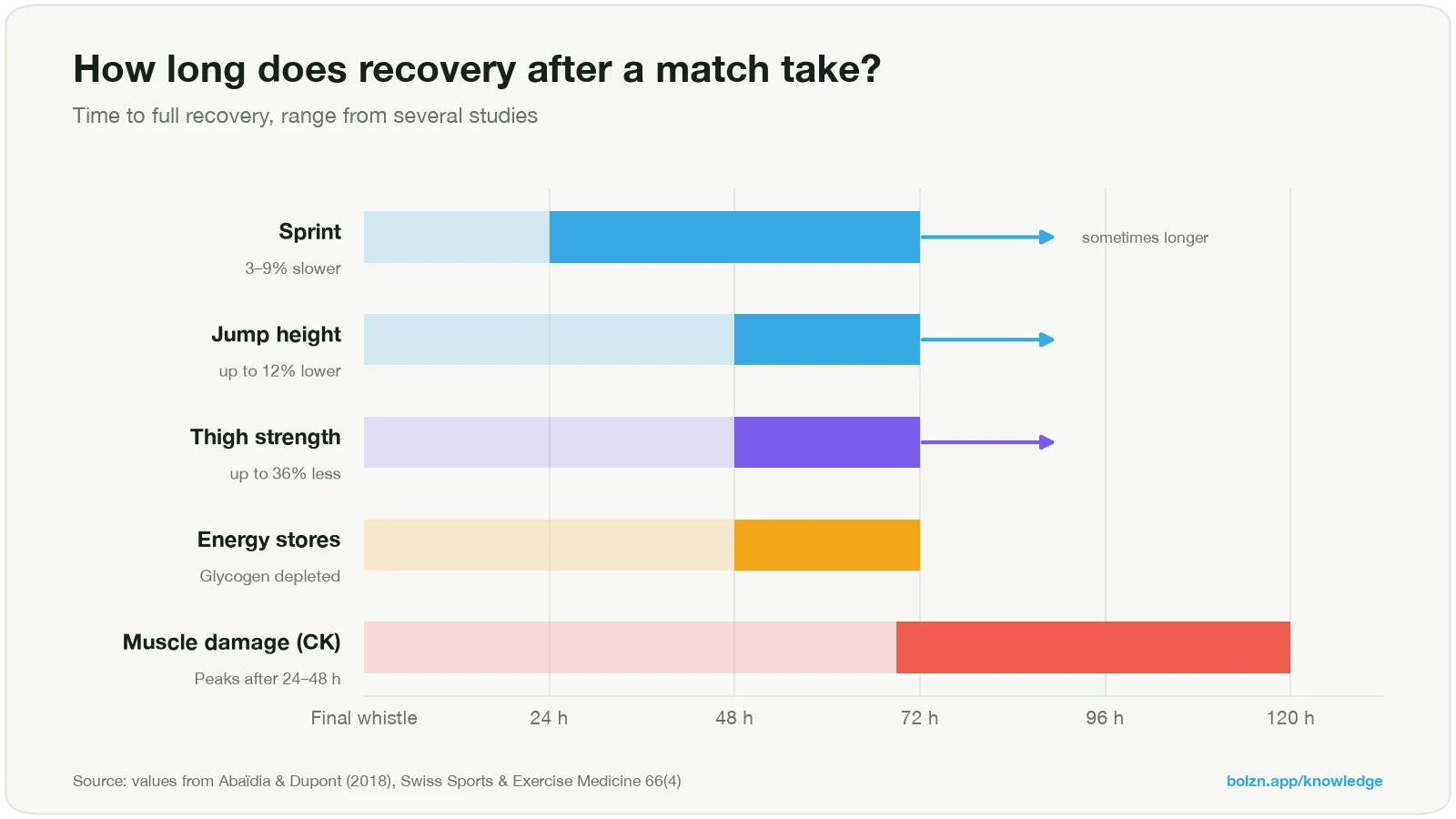
How long it takes in an individual case depends heavily on the match: how the game went, the opponent, the pitch, the weather, playing time and the player's fitness. A substitute who played 15 minutes needs something quite different from the centre-back who played the full 90.
The basis of recovery: sleep, food and fluids
All review articles on recovery in football reach the same conclusion: without enough sleep, food and fluids, all other measures achieve little.
Sleep
Sleep is the most effective recovery measure of all, and it is free. Eight to ten hours are recommended for athletes. After evening matches almost all players sleep worse, because adrenaline, floodlights, phones and late meals delay falling asleep. Getting a long night's sleep again the very next night, or taking a short nap at midday (about 30 minutes at most), partly makes up for it. Those who regularly sleep less than seven hours also fall ill more often.
Good sleep habits are simple: a dark, cool room, no caffeine in the late afternoon, no phone in bed and, as far as possible, fixed times.
Eating after the match
In the first one to two hours after the match the player should take in carbohydrates and protein. Carbohydrates refill the empty stores, protein helps repair the muscles. It does not have to be an elaborate meal:
- a glass of cocoa or chocolate milk straight after the match,
- a roll with cheese or turkey breast, a banana, quark with fruit,
- then a normal meal with pasta, rice or potatoes and some protein (meat, fish, eggs, pulses).
Anyone who eats nothing after the match, or just grabs a few crisps from the clubhouse, is giving away the easiest part of recovery.
Drinking
Fluid loss is easy to check: weigh yourself before and after the match. Every kilogram lost equals about one litre, and in the hours afterwards you should drink slightly more than you lost. Water is enough in most cases. After heavy sweating, a pinch of salt or something salty with the meal helps the fluid stay in the body.
And the beer after the match?
Alcohol worsens sleep and slows muscle recovery. In one study, strength was still measurably lower 36 hours after a larger amount of alcohol. One beer to toast the match is no drama. But those who party after every match prolong their recovery.
Which recovery methods really help?
Professional football has a whole industry built around recovery. For amateur football it is worth taking a sober look at the evidence:
| Method | What it does | For amateurs |
|---|---|---|
| Sleep, food, fluids | Biggest effect, the basis for everything else | Essential |
| Cold bath (approx. 10 °C, approx. 10 minutes) | Sprint, jump and strength recover slightly faster | An option in tournament weeks, not in phases with strength training |
| Compression socks | Small effect on muscle soreness, hardly any risk | You can use them, you do not have to |
| Massage | Less muscle soreness, feels better, but performance does not recover faster | Nice if it is available |
| Foam roller | More mobile in the short term, possibly slightly less muscle soreness | Fine as a ritual |
| Stretching | No faster recovery, no less muscle soreness | For flexibility yes, for recovery no |
| Light cool-down jog | Performance does not recover faster | Fine as a calm way to finish |
| Sauna, heat, contrast shower | Hardly studied | As you like |
One point is often overlooked: cold can slow adaptation to strength training. Players who regularly get into an ice bath after a strength session get stronger more slowly. In pre-season, when the body is supposed to adapt, less recovery effort is therefore often better. Late in the season or with several matches a week, by contrast, fast recovery is the priority.
In addition: a player is welcome to use a method he believes in and that does no harm. The placebo effect helps recovery too.
Cool-down and stretching after the match: worthwhile or not?
A light cool-down jog and stretching are a fixed post-match ritual at many clubs. The evidence is clear: neither speeds up the recovery of performance, and stretching does not prevent muscle soreness either. That is no reason to ban the ritual. Jogging gently for a few minutes, talking through the match together and winding down does no harm. You just should not believe that it will keep muscle soreness away the next day. It is far more important that the players eat and drink something promptly afterwards.
The first 24 hours after the match
- Straight after the final whistle: drink, and have a carbohydrate-rich snack with some protein (cocoa, banana, roll).
- In the first two hours: a proper meal. Make up for the weight lost by drinking.
- In the evening: little alcohol, screens away in good time, to bed early enough.
- The next day: sleep in, eat normally and with a balanced diet, light movement such as walking or easy cycling instead of lying on the sofa all day.
How should training continue after the match?
The days after the match determine how fresh your team is the following weekend. What has proved effective: little or no load on the first day after the match, the second day off, the most intense session in midweek and less again shortly before the match. How to do this with two or three sessions a week is covered in the article Planning a training week. Why the old model of supercompensation is only of limited help here is explained separately.
Players who played little or not at all, on the other hand, do not need a break but a replacement load, for example a short small-sided game or a few sprints. You will find suitable drills in the bolzn football drills.
Typical recovery mistakes
- Training hard on Monday or Tuesday because “the lads were poor on Sunday”. The muscles have not yet recovered by then, and performance and injury risk suffer.
- Eating nothing after the match and then having one big meal late in the evening.
- Too little sleep because of partying, shift work or gaming deep into the night.
- Relying on aids and forgetting the basics: a foam roller does not replace eight hours of sleep.
- Treating everyone the same: a player who played 90 minutes needs something different from the substitute.
- Missing warning signs: a player who is tired, irritable or constantly has a cold for weeks is not recovering enough. More on this in the article Spotting overtraining.
Sources
- Abaïdia, A.-E. & Dupont, G. (2018). Recovery strategies for football players. Swiss Sports & Exercise Medicine, 66(4), 28–36.
- Gregson, W., Howatson, G. & Thorpe, R. (2022). A periodised recovery strategy framework for the elite football player. Aspetar Sports Medicine Journal, 11.
- Nédélec, M. et al. (2012/2013). Recovery in soccer, Part I and Part II. Sports Medicine, 42(12) and 43(1).
- Nédélec, M. et al. (2015). Sleep hygiene and recovery strategies in elite soccer players. Sports Medicine, 45(11).
- Herbert, R. D., de Noronha, M. & Kamper, S. J. (2011). Stretching to prevent or reduce muscle soreness after exercise. Cochrane Database of Systematic Reviews.
- Roberts, L. A. et al. (2015). Post-exercise cold water immersion attenuates acute anabolic signalling and long-term adaptations in muscle to strength training. Journal of Physiology, 593(18).
- VBG (2017). Diagnostik & Betreuung im Fußball – Leistungsdiagnostik und Verletzungsprävention. Hamburg.