Supercompensation: what the model explains and gets wrong
Supercompensation explained simply: how the model of load and recovery works, why it is too simple and what you can take from it for your training.
What is supercompensation?
Supercompensation is a model from training theory. It describes how training makes you better: a load first tires the body and its performance drops. In the recovery that follows, it does not just rebuild but goes slightly beyond its previous level. If the next training stimulus is placed exactly in this phase, performance rises from one time to the next.
The model is easy to picture and features in almost every coaching course. But it has a weakness: it is much simpler than reality. The basic idea “load plus recovery leads to adaptation” is correct. The notion that you can calculate the perfect moment for the next session is not. Modern sports science therefore tends to work with the fitness-fatigue model, which we explain further below.
The phases of supercompensation
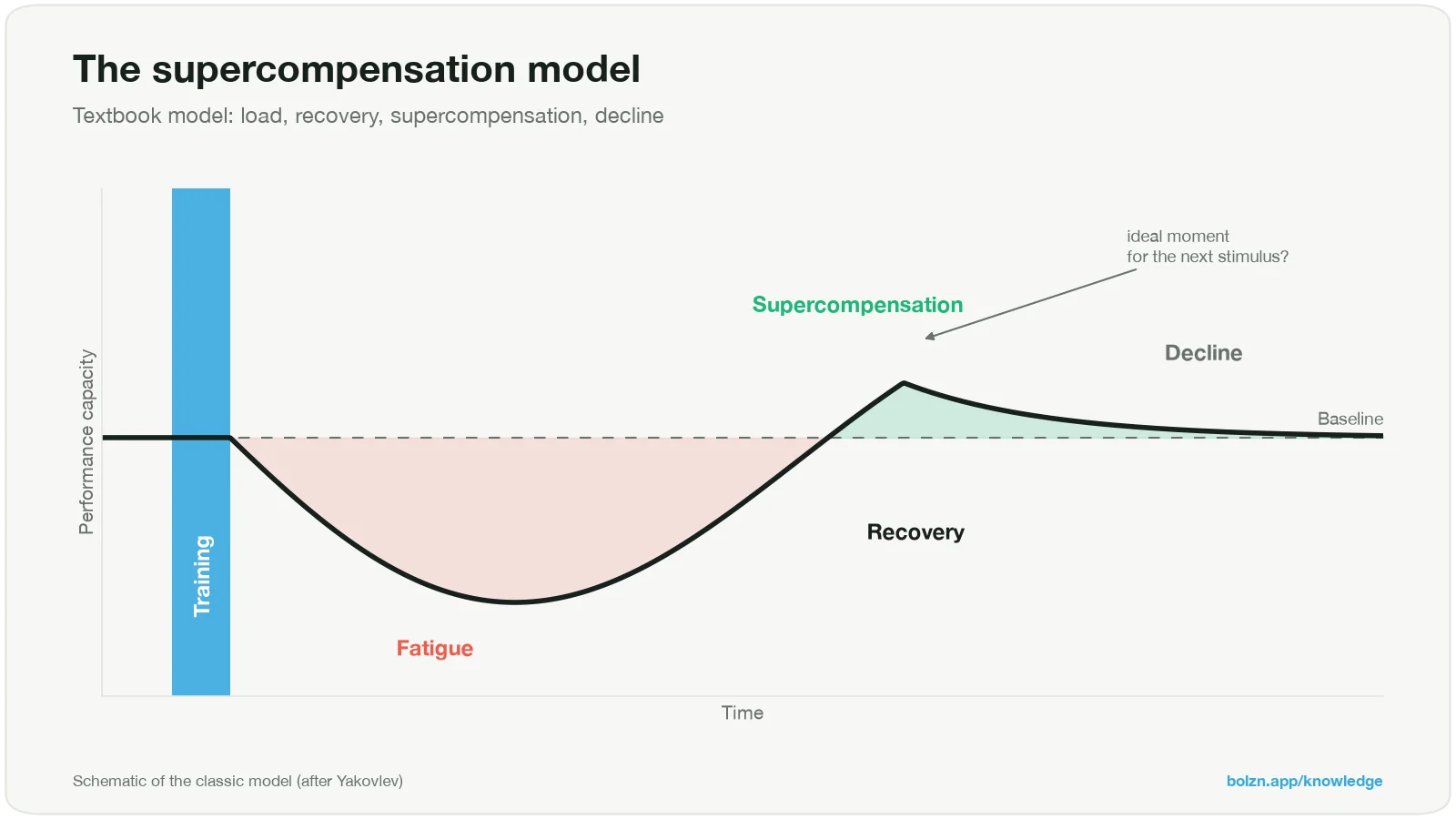
The textbook distinguishes four phases:
- Load: Training costs energy and causes fatigue. Performance capacity drops below the baseline.
- Recovery: The body repairs itself and refills its stores. Performance rises back to the baseline.
- Supercompensation: The body “adds a little extra” to be better prepared for the next load. Performance is briefly above the baseline.
- Decline: If no new stimulus follows, performance slowly drops back to the old level.
From this the model derives three rules:
- Next stimulus too early: The player has not yet recovered. Performance drops from session to session, in the worst case all the way to overtraining.
- Next stimulus too late: The gain has already fizzled out. Performance stagnates.
- Next stimulus at exactly the right time: Performance rises step by step.
Where does the model come from?
The idea goes back to the Soviet biochemist Nikolai Yakovlev. From the 1950s to the 1970s he studied how the carbohydrate stores (glycogen) in the muscles refill after exercise, among other things in rats. This did indeed show that after exercise and good nutrition the stores are filled beyond the baseline level.
Later this observation was applied to everything: muscle growth, endurance, speed, technique and coordination. This is exactly where the problem lies. For glycogen, supercompensation is well documented. For the other abilities it has never been demonstrated in this form.
Why the model is too simple
Critics such as Sandig and Mühlenhoff (2009) or Kiely (2018) mainly raise these points:
- The body does not recover in step. Energy stores are full again after one to three days. Muscle damage after a football match often takes three to five days. The nervous system, tendons and ligaments each have their own time courses. So there is not the one curve but many at the same time.
- There is no measurable “right moment”. No test shows you on Tuesday morning whether your player is in supercompensation right now.
- Everyone responds differently. The same session is too much for one player, challenges the second and is too little for the third. Training status, age, sleep, stress at school or work and genetic make-up all play a part.
- Training is not a single stimulus. In football, strength, endurance, speed, technique, tactics and the match at the weekend overlap. The model, by contrast, describes a single stimulus and a single ability.
The alternative: the fitness-fatigue model
The fitness-fatigue model (after Banister) describes training differently: every load produces two things at once, fitness and fatigue. Fitness builds up slowly and lasts a long time. Fatigue is there immediately but disappears faster. How well a player can perform on a given day results from the difference: fitness minus fatigue.
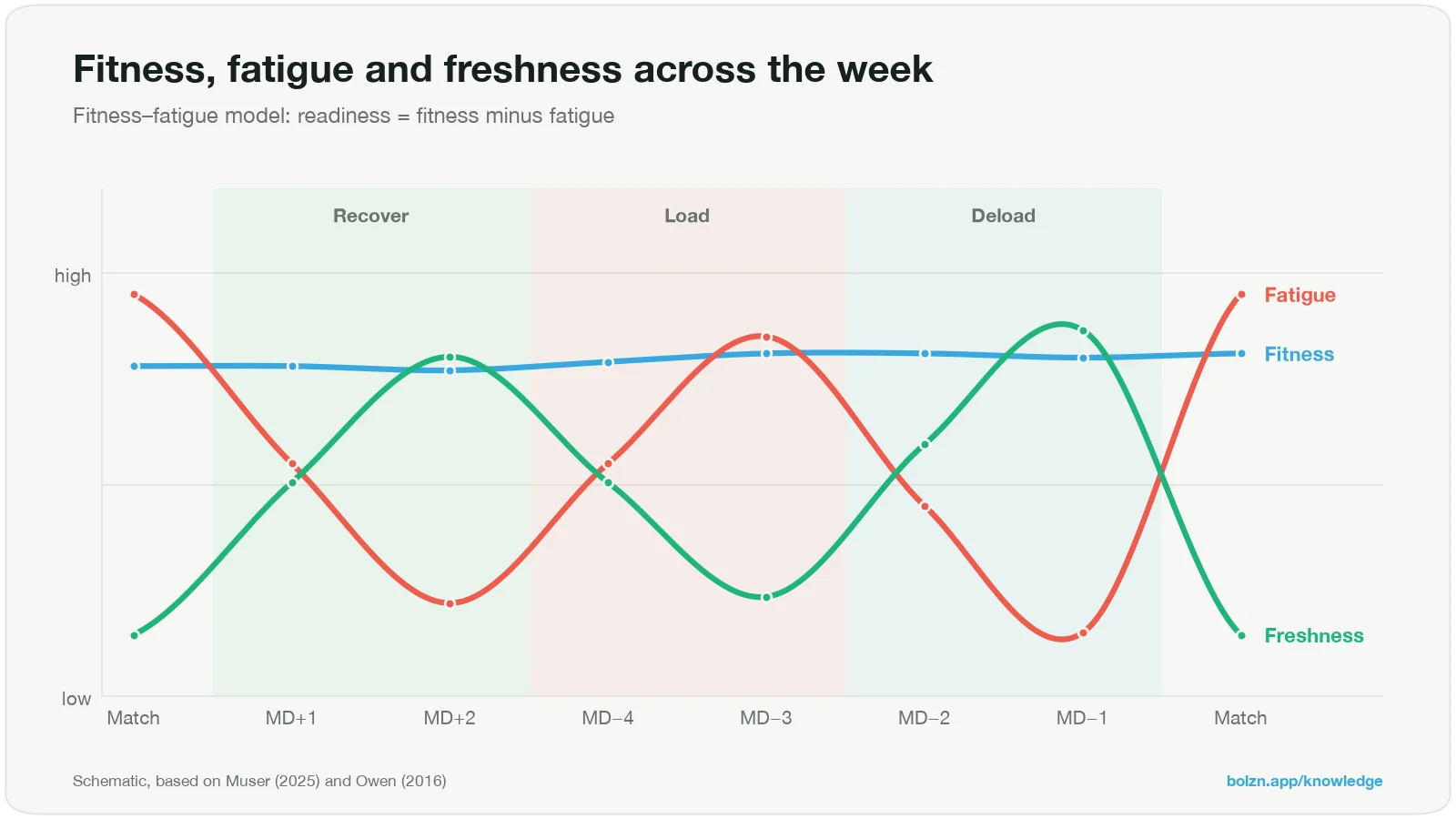
This explains things that supercompensation does not explain well:
- Why you can improve even when fatigued: fitness is growing, it is just masked by fatigue.
- Why a quieter week before an important match lifts performance: fatigue fades, fitness stays.
- Why too many hard weeks in a row depress performance even though the players ought to be “fitter”: fatigue grows faster than it is cleared.
This model is a simplification too. For practical purposes, though, it is the better thinking tool.
What does this mean for your training?
You do not have to throw the supercompensation model away. As a picture for “no improvement without recovery” it works well, including when you explain it to the team. For planning, these principles will take you further:
- Recovery is part of training. Plan rest as deliberately as load. More on this in the article Recovery after a match.
- The week has a rhythm. Little after the match, a lot in midweek, less before the match. What that looks like in practice is covered in the article Planning a training week.
- Consistency beats one-off efforts. A single hard session makes nobody fit. Many suitable sessions over weeks do.
- Increase load slowly. First volume, then intensity. After three weeks of high load, a lighter week can help.
- Look at the players, not at the curve. Ask about fatigue, muscle soreness and sleep. The article Spotting overtraining shows how to do this simply.
- Intense stimuli need more recovery. Sprints, jumps and strength training put a heavy load on muscles and the nervous system. Schedule them so that there are still two days to go before the match.
For planning your sessions, the training planner in bolzn will help you.
Common misconceptions
- “You have to rest for exactly 48 hours.” Fixed numbers of hours are rules of thumb. How long recovery takes depends on the load, the player and life circumstances.
- “Muscle soreness shows that the training worked.” Muscle soreness mainly shows that the load was unfamiliar. Good training works without it too.
- “More is better.” In the model as in practice: without recovery, more training becomes a step backwards.
- “After a week off, everything is gone.” Fitness declines more slowly than it is built up. A few days off do no harm, and often they even help.
Sources
- Bisanz, G. & Gerisch, G. (2010). Fußball – Kondition, Technik, Taktik und Coaching (2nd ed.). Aachen: Meyer & Meyer.
- Sandig, D. & Mühlenhoff, S. (2009). Die Superkompensation, ein Modell aus der Trainingslehre – kritisch betrachtet. Peak Performance, September 2009, 6–8.
- Kiely, J. (2018). Periodization theory: confronting an inconvenient truth. Sports Medicine, 48(4), 753–764.
- Banister, E. W. et al. (1975). A systems model of training for athletic performance. Australian Journal of Sports Medicine, 7, 57–61.
- Gregson, W., Howatson, G. & Thorpe, R. (2022). A periodised recovery strategy framework for the elite football player. Aspetar Sports Medicine Journal, 11.
- Muser, B. (2025). Periodisierung des Athletiktrainings im Wochenverlauf. Presentation, VBG-Präventionssymposium Fußball, Hamburg.