Goalkeeper 1v1: coming off the line, blocking, foot saves
How the goalkeeper comes out correctly in a 1v1, when to stay on their feet, how blocking and foot saves work, and which mistakes lead to conceding.
How should the goalkeeper act in a 1v1?
In a 1v1 the rule is: close the distance quickly while the attacker is running with the ball at their feet, then come to a stop 2 to 3 metres in front of them and make yourself big. At the moment of the shot the keeper is set, has lowered their centre of gravity and does not turn away. If the ball gets too far away from the attacker's foot, the keeper attacks the loose ball.
An analysis of 1v1 duels in the Premier League showed: saves went hand in hand with coming out early, goals conceded with coming out hesitantly.
“Come out early” or “stay on your feet”?
Both are right, and they do not contradict each other:
- Come out early refers to the approach: while the attacker is dribbling and looking at the ball, the keeper closes in quickly and narrows the angle (see positioning).
- Stay on your feet refers to the moment of the shot: do not go down or commit too early. A keeper who is on the ground too early gets rounded or chipped.
A DFB (German FA) training sheet sums it up like this: narrow the angle cleverly and stay on your feet for as long as possible.
Rule of thumb from practice: if the attacker draws their leg back to shoot, the keeper stops and is set. If the attacker pushes the ball too far ahead, the keeper goes for the ball straight away.
The techniques in a 1v1
| Technique | When | How |
|---|---|---|
| Making yourself big | attacker close, shot imminent | centre of gravity low, arms out to the sides and down, legs shoulder-width apart, chest facing the ball |
| Blocking | shot from close range | brake, get low, shoulders square to the ball; one knee turns inwards behind the ball and closes the gap between the legs |
| Foot save, short leg | low shot just to the side of the keeper | leg turned outwards, foot firm, the inside of the foot deflects the ball forwards and wide |
| Foot save, long leg | low shot further away | leg extended, the arm nearest the ball covers the space above it |
| Diving at the feet | ball is loose in front of the attacker | hands first, body behind the ball, head protected |
What matters is choosing the technique to suit the situation. Bravery alone is not enough. That also includes deciding whether the keeper comes out at all: if a defender gets to the ball first, the keeper stays away. Once the keeper has decided to come out, they see it through without hesitation.
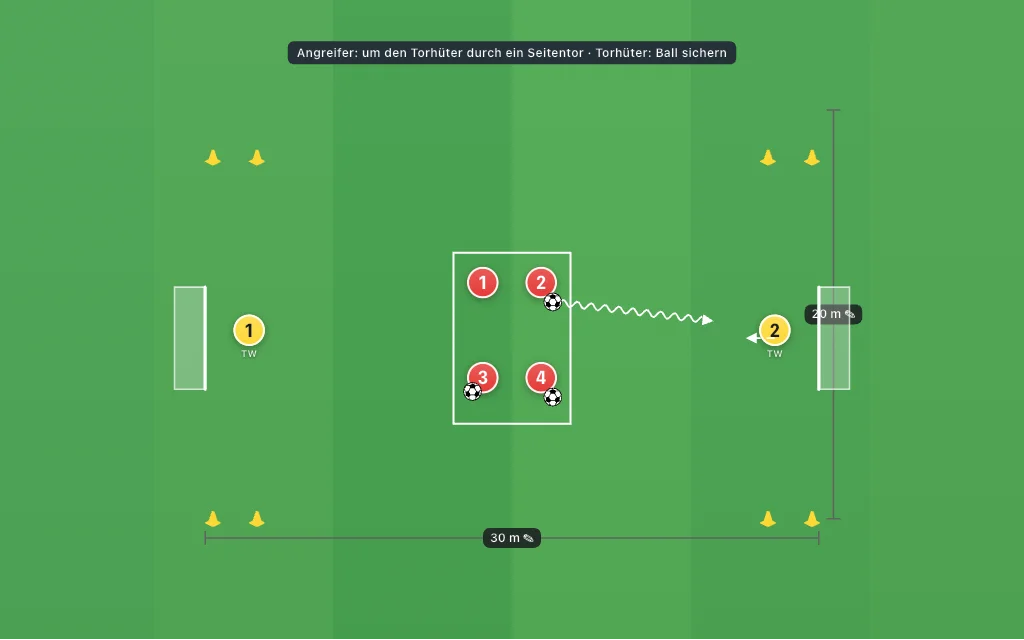
From the bolzn drill library: goalkeeper in a 1v1 with side goals – force the attacker wide, secure the ball with both hands.
Steering the attacker wide
A good keeper does not just wait, they steer the attacker: they approach slightly off-centre so that the route inside is closed and the attacker has to go wide. From out wide the angle gets tighter and the goal smaller. Defenders coming back from behind gain time.
Common mistakes in a 1v1
- Hesitating: half out, half in. The keeper is stuck in no-man's-land.
- Going down too early: the attacker goes round the keeper on the ground.
- Turning away or falling backwards: the ball goes through the gap.
- Legs too far apart: the ball goes through the legs.
- Going in feet first on the opponent: risk of injury for both, and a penalty.
And what about penalties?
At penalties, goalkeepers almost always dive to one corner. A well-known analysis of almost 300 penalties found that, on the numbers, staying in the middle would have been successful more often. Other analyses disagree, because penalty takers adjust to it. Studies also show that experienced goalkeepers wait longer and watch the taker's standing leg. A keeper who moves before the kick can distract the taker. There is no simple rule, but good timing beats guessing.
How to train the 1v1
- Scripted: the attacker dribbles in slowly, the keeper practises closing down and getting set.
- Situational: the attacker decides freely whether to shoot, dribble or chip.
- In the game: small-sided games with lots of 1v1 situations. On big pitches there are more duels, on small ones more blocks from close range (see Small-sided games on a small pitch).
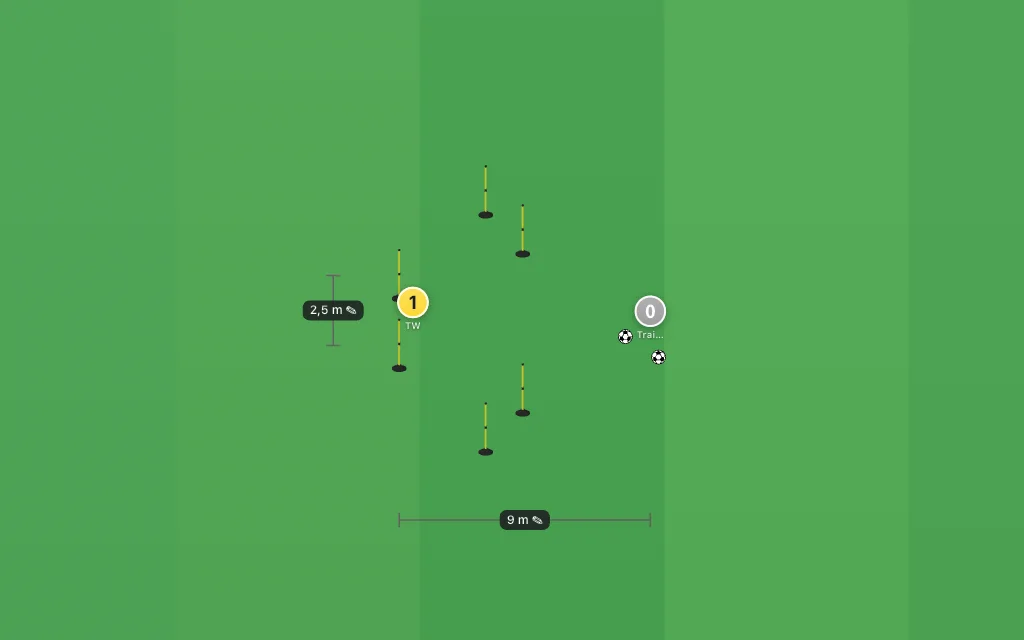
From the bolzn drill library: foot saves in a pole goal – save the low shot with the leg nearest the ball.
You will find more goalkeeper drills in the bolzn football drills.
Sources
- DFB (n.d., c. 2016). Leitfaden Torwartspiel (youth national teams, Köpke/Fuchs), pp. 78–92 and 112–113.
- mobilesport.ch (BASPO): Entraînement gardien – Duels 1:1 (04/2018).
- The FA: Youth goalkeeping techniques and practices.
- Shafizadeh, M. et al. (2016). Duels between goalkeeper and attacker in the Premier League. Journal of Sports Sciences.
- Jara, D. et al. (2018). Goalkeeper actions in small-sided games on pitches of different sizes. Journal of Human Kinetics.
- Bar-Eli, M. et al. (2007). Action bias among elite soccer goalkeepers: the case of penalty kicks. Journal of Economic Psychology, 28, 606–621.
- Savelsbergh, G. J. P. et al. (2005). Anticipation and visual search behaviour in expert soccer goalkeepers. Ergonomics.
- Wood, G. & Wilson, M. R. (2010). A moving goalkeeper distracts penalty takers and impairs shooting accuracy. Journal of Sports Sciences.