Small-sided games in football: how to steer your training
Designing small-sided games: how player numbers, pitch size, touches and goals change load, technique and tactics – with figures from studies.
What are small-sided games?
Small-sided games (SSGs) are football games with few players on a reduced pitch, usually 2v2 to 8v8, often with extra rules. They are the most important form of training in modern football because they train technique, tactics and fitness at the same time while staying close to the real game.
The secret of good small-sided games: you steer through the rules, not through instructions. Player numbers, pitch size, touches, goals and scoring determine what the players do. If you know these levers, you can turn a simple 4v4 into an endurance session, a technique session or a tactical exercise.
What do all small-sided games have in common?
- Lots of actions on the ball: the fewer the players, the more often each one is on the ball.
- Decisions under pressure: opponents, team-mates and goals constantly force decisions, as in a match.
- Constant transition between having the ball and losing it.
- Competition and fun: players compete, count goals and want to win.
- Fitness on the side: intense small games are among the best endurance training with the ball. Studies show similar effects on endurance to running intervals.
The rondo is the possession variant without a goal. Small-sided games add the goal and with it the purpose of the game.
The levers and what they do
| Lever | What happens |
|---|---|
| Fewer players (2v2, 3v3) | more actions on the ball per player, more dribbles, shots and duels, highest load |
| More players (6v6, 8v8) | less load per player, more long passes and headers, tactically closer to a match |
| Bigger pitch | more running and sprints, fewer duels and shots |
| Smaller pitch | less time on the ball, more duels and shots |
| Touch limit (two-touch, one-touch) | higher tempo, more thinking, harder |
| No goalkeepers / stopping the ball on the line | intensity goes up |
| Mini goals | less running at similar perceived exertion |
| Overloads, floaters, support players | easier for the attackers, more successful actions; the floaters themselves run considerably less |
| Coach encouragement | intensity goes up noticeably |
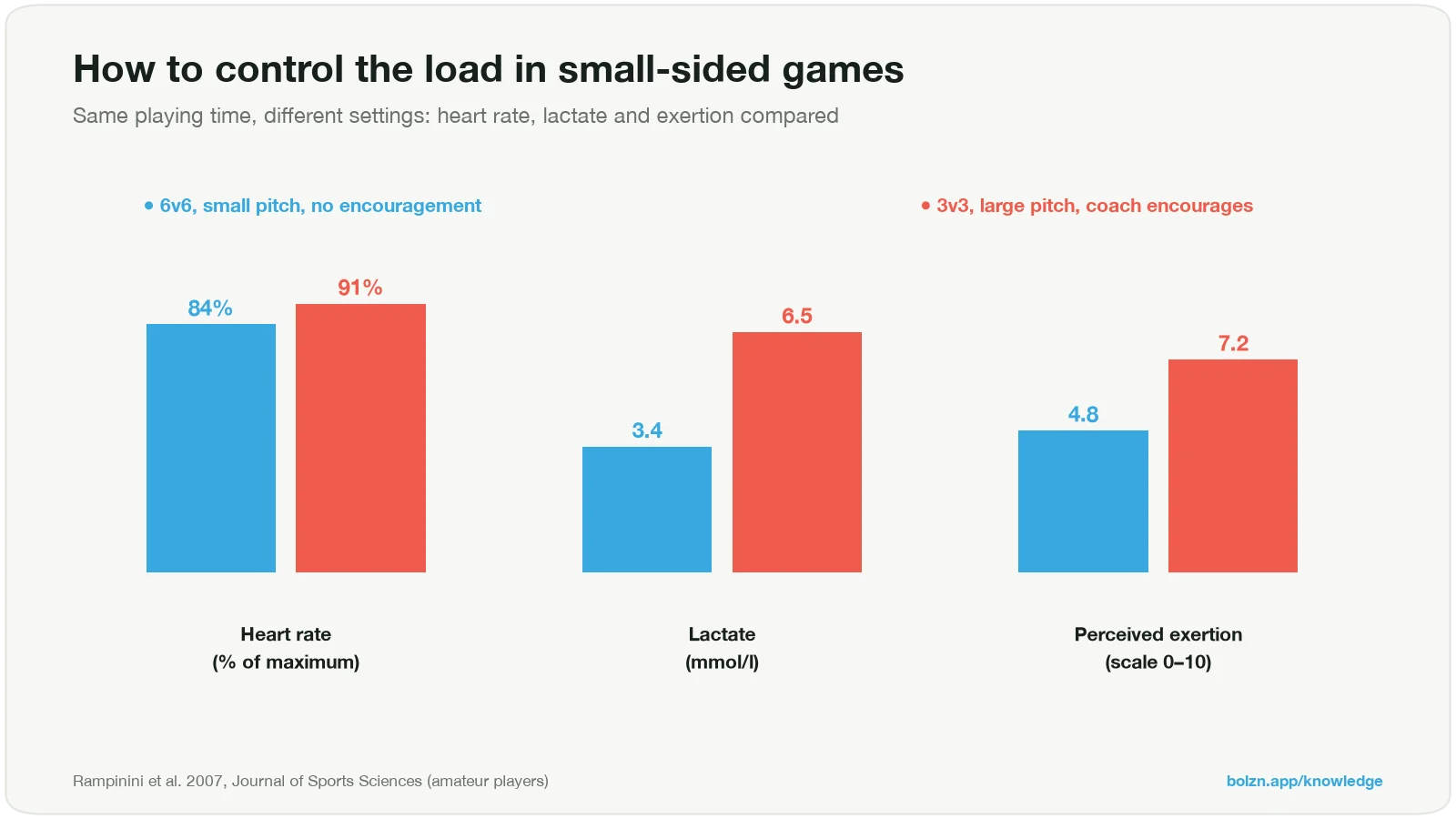
These effects add up. In a study with amateur players the extremes were far apart:
How big should the pitch be?
A good guide is the area per player: pitch length times pitch width divided by the number of outfield players.
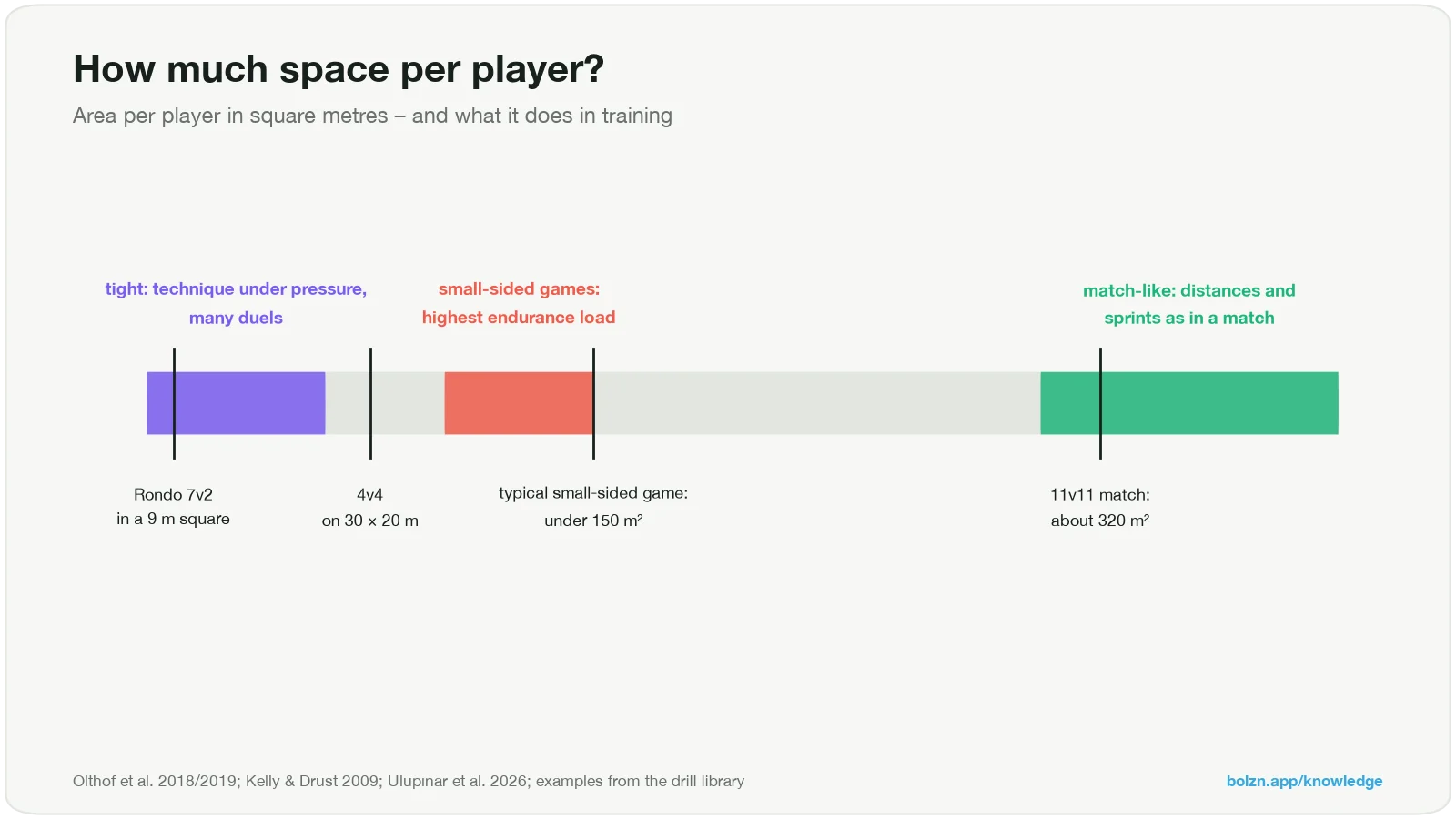
- Tight (under about 60 m²): technique under pressure, quick decisions, lots of duels.
- Medium (about 100 to 150 m²): the highest endurance load, typical of 3v3 to 5v5.
- Match-realistic (about 300 m² and more): in a match each outfield player has around 320 m². Only at this size do the distances between the players match those in a match, and high-speed sprints occur.
Rule of thumb: play tight for fitness and technique, and match-realistically large for game understanding and team tactics. More on this in the article Positional play.
How long and with what rest?
The sources do not agree, but these have proved effective:
- 2v2 to 4v4: 1 to 4 minutes of play, 1 to 2 minutes of rest, 4 to 6 rounds.
- 5v5 to 8v8: 4 to 8 minutes of play, 1 to 3 minutes of rest.
- At the end: a free game to finish the session.
The smaller the game, the shorter the rounds. Small formats are very intense, and quality should not suffer from fatigue. How to build small-sided games into the training week is covered in the article Planning the training week.
What small-sided games cannot do
- Sprints at top speed: long sprints hardly occur in small-sided games. One study found only a fraction of the sprint distance of the most intense match periods in 4v4 and 6v6. So train long sprints separately as well.
- Equal load for everyone: floaters and support players run considerably less, and winners run more than losers. So swap roles regularly.
- Guaranteed transfer to 11v11: that small-sided games improve game understanding is plausible, but there is hardly any direct evidence. The more the small-sided game resembles your own game, the better.
Coaching in small-sided games
- The rule does the work: instead of “Play down the wings more!”, use a rule such as “Goals from a cross count double”.
- Shout little from the touchline: when the players are fully involved, cut back the coaching.
- Questions instead of solutions: in the break ask “Where was the free space?” instead of giving the solution.
- Stop play selectively: at an important moment, stop briefly, show the situation and let them play on.
You will find more than 300 small-sided games with mini goals, one goal and two goals in the bolzn football drills.
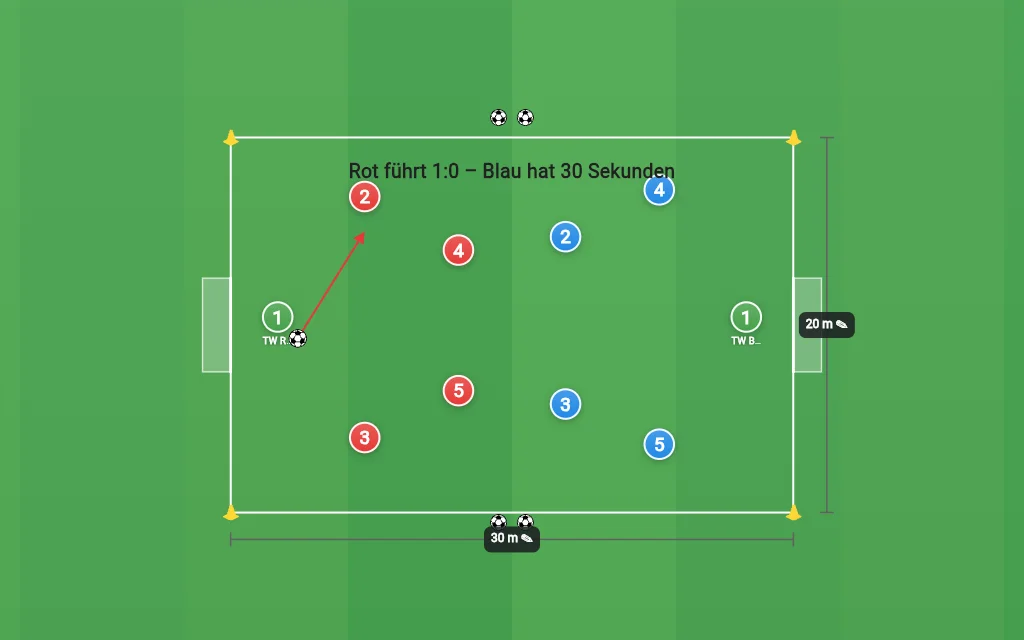
From the bolzn drill library: 4v4 with a goal lead – the team in front has to protect the ball, the team behind has to attack.
Sources
- Hill-Haas, S. V. et al. (2011). Physiology of small-sided games training in football: a systematic review. Sports Medicine.
- Rampinini, E. et al. (2007). Factors influencing physiological responses to small-sided soccer games. Journal of Sports Sciences.
- Kelly, D. M. & Drust, B. (2009). The effect of pitch dimensions on heart rate responses and technical demands of small-sided soccer games in elite players. Journal of Science and Medicine in Sport.
- Halouani, J. et al. (2014). Physiological responses according to rules changes during 3 vs. 3 small-sided games in youth soccer players. Journal of Sports Sciences.
- Owen, A. L. et al. (2014). Physical and technical comparisons between various-sided games within professional soccer. International Journal of Sports Medicine.
- Olthof, S. B. H. et al. (2018). Match-derived relative pitch area changes the physical and team tactical performance of elite soccer players in small-sided soccer games. Journal of Sports Sciences.
- Clemente, F. M. et al. (2021). Effects of small-sided games vs. running-based high-intensity interval training on physical performance in soccer players. Frontiers in Physiology.
- Clemente, F. M. et al. (2025). Physiological, physical and technical demands during sided soccer game formats. International Journal of Sports Medicine.
- Dalen, T. et al. (2021). Differences in acceleration and high-intensity activities between small-sided games and peak periods of official matches. Journal of Strength and Conditioning Research.
- Lacome, M. et al. (2018). Small-sided games in elite soccer: does one size fit all? International Journal of Sports Physiology and Performance.
- German FA (DFB): DFB-Trainingsdialog 3 and 4 (4v4 and 3v3); FAI: Small-Sided Games.