Goalkeeper set position: stance, catching and diving
The correct goalkeeper set position: feet, knees, upper body and hands, plus catching techniques and diving, and what keepers should learn at each age.
What does the correct set position in goal look like?
The set position (also called the ready position) is the stance from which a goalkeeper can reach any ball. According to the goalkeeper coaching guide of the German FA (DFB):
- Feet about shoulder-width apart, toes pointing forwards.
- Weight on the balls of the feet, not on the heels.
- Knees slightly bent, upper body leaning slightly forwards.
- Arms in front of the body, elbows at roughly a right angle, palms facing the ball, wrists firm.
- Eyes on the ball, body tension.
The keeper must be set when the shooter strikes the ball. Anyone who is still moving or standing on their heels at that moment will be too late.
High or low? It depends on the distance
The DFB distinguishes between two heights:
- Ball more than about 16 metres away: tall stance, knees and hips only slightly bent. The keeper has to be able to reach high balls as well.
- Ball closer than 16 metres: lower stance, knees and hips bent more. Low shots arrive faster, so the way down to the ground has to be short.
Easy to remember: the closer the ball, the lower the stance.
A study with elite goalkeepers also showed that from a slightly wider stance (about three quarters of leg length) the keepers got across to the side faster than from the narrow stance they chose of their own accord. So many goalkeepers stand narrower than would be ideal for a quick push-off.
Common mistakes in the set position
- Standing flat-footed or on the heels: the keeper looks “rooted and immobile”.
- Hands hanging by the sides: by the time they are up, the ball has gone past.
- Standing too wide: low balls roll through the legs.
- Still moving when the shot is taken: small adjusting steps before the shot are right, but at the moment of the shot the keeper must be set.
Catching techniques
The most important principle when catching: get your body behind the ball. Then the body is the second barrier if the ball slips through the hands.
| Ball | Technique | Watch out for |
|---|---|---|
| low | get down over one bent leg, ball runs over the palms onto the forearms | chin to chest, no straddle stance |
| waist height | “cup”: the ball lands on the forearms and upper body, the arms close around it | elbows tight, do not back away |
| chest to head height | thumbs and index fingers form a triangle (W grip) | hands in front of the head, thumbs behind the ball |
| high | catch at the highest point in front of the body, pull the ball into the chest | one knee up for protection, take off going forwards |
Punching is the emergency option when catching under pressure is not possible. The DFB only introduces it from U15.
Diving
In the dive, what counts is the push-off from the leg nearest the ball; the far leg swings through and drives. The arms stay in front of the body, not behind the upper body. The ball is secured with the bottom hand behind and the top hand on top of the ball. The keeper lands on the side of the body, not on the stomach or the elbows.
Biomechanical studies show that when diving to their weaker side, many keepers rotate the pelvis and trunk too much and get to the ball more slowly. Train both sides equally often.
A common mistake is the “banana”: the keeper dives in an arc and too flat instead of in a straight line to the ball. Whether a dive is needed at all depends on the position. Close to the post, a step or a collapse dive is often enough, see Goalkeeper positioning.
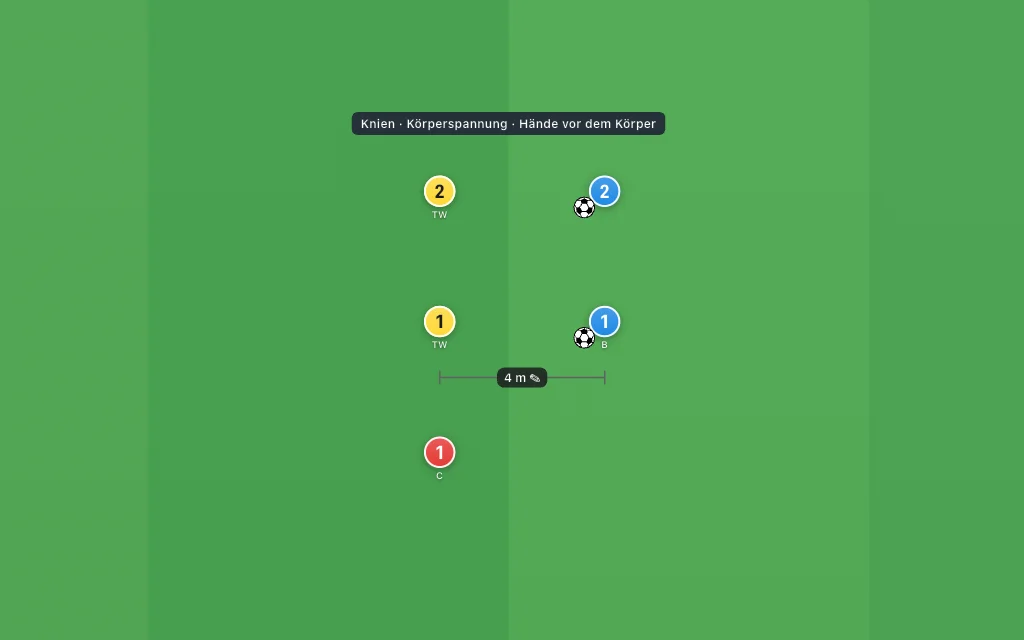
From the bolzn drill library: learning to dive for children – from a kneeling position, step by step up to a shot.
What should goalkeepers learn at what age?
| Age | Focus |
|---|---|
| up to U11 | Every child gets a go in goal, no fixed goalkeeper. Throwing, catching and falling through play, for everyone. |
| U12/U13 | Specialise now at the earliest. Learn the basic techniques: set position, catching, collapse dive, diving from a kneeling position, foot saves, getting to know the zones in the goal. |
| U15 | Consolidate techniques under pressure, punching, throws of 20–25 m, kicks from the hands as far as the halfway line. |
| U17/U19 | Complex practices with opponents, commanding the penalty area, coaching the defence. |
According to the DFB, the goalkeeper does not yet play a special role in children's football. Children should try things out and play outfield as well. Anyone who goes in goal permanently at an early age misses out on important football experience. A rule of thumb from many association recommendations: rotate in goal until about U11, specialise from U12/U13 at the earliest.
A word on safety: hard shots from close range can injure children's wrists. With young goalkeepers, use soft balls and sensible distances instead.
Goalkeepers play with their feet too
Modern goalkeepers play more balls with their feet than with their hands. The DFB sees the goalkeeper as the “first attacker” and expects them to be two-footed. Goalkeepers should therefore also train with the outfield players, in passing practices and rondos.
You will find more than 80 goalkeeper drills for all age groups in the bolzn football drills.
Sources
- DFB (n.d., c. 2016). Leitfaden Torwartspiel (youth national teams, Köpke/Fuchs).
- DFB: information evening Torhütertraining; DFB: Kinderfußball – Irrtümer.
- The FA: Youth goalkeeping techniques and practices; Early specialisation? Not yet (2019).
- mobilesport.ch (BASPO): Torhütertraining – Hechten (04/2018).
- Ibrahim, R. et al. (2019). Two studies on stance and push-off in the dives of elite goalkeepers. Journal of Sports Sciences; Frontiers in Sports and Active Living.
- Spratford, W., Mellifont, R. & Burkett, B. (2009). The influence of dive direction on the movement characteristics for elite football goalkeepers. Sports Biomechanics.
- Kraus, R. et al. (2007). Forearm fractures in children, including those caused by hard-struck balls. Sportverletzung Sportschaden.