Rondo in football: what it trains and how to coach it
What a rondo is, what it trains, which variations exist – from 3v1 to the positional rondo – and what to look for when you coach it.
What is a rondo?
A rondo is a keep-ball game with a numerical advantage: several players around the edge of a circle or square pass the ball to each other while one or more defenders in the middle try to win it. Whoever loses the ball or plays a bad pass goes into the middle. Typical formats are 3v1, 4v2, 5v2 or 6v3.
The term comes from Spanish: it alludes to the round the players form when they stand in a circle (Spanish ronda means “round”, redondo “circular”). In Germany, many people know the same game from childhood as “Schweinchen in der Mitte” (piggy in the middle).
The rondo trains almost everything a player needs on the ball: first touch, passing accuracy, body shape, awareness, tempo and quick decisions. Johan Cruyff is said to have remarked that the rondo contains everything that happens in a match except shooting. It became known worldwide through FC Barcelona and the Spanish national team.
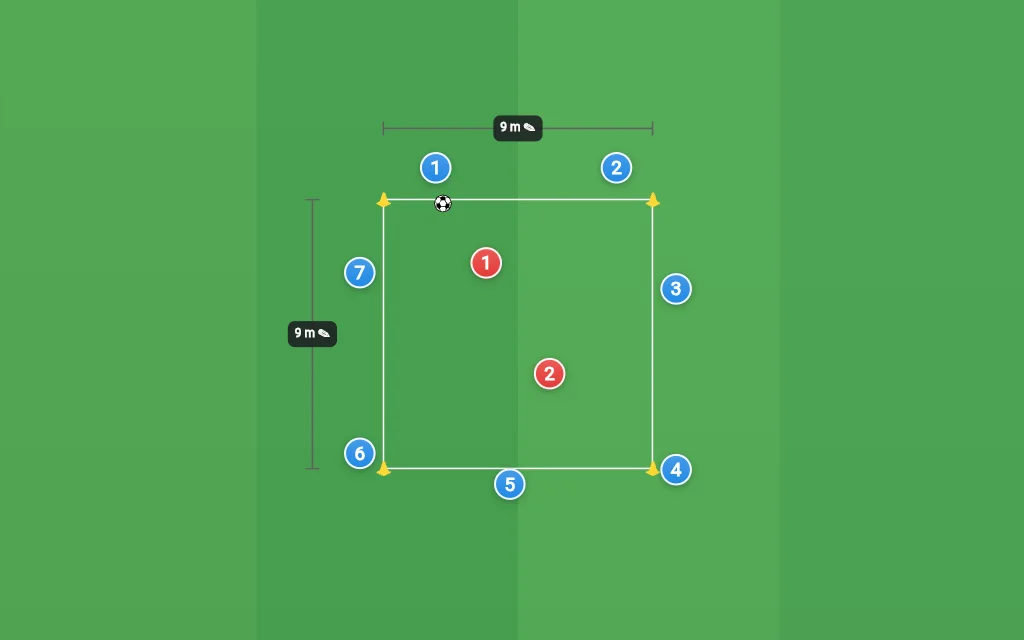
From the bolzn drill library: 7v2 rondo – keeping the ball in a tight square.
What does a rondo train?
For the players on the ball:
- First touch: receive the ball so that it ends up away from the defender and can be played on straight away.
- Open body shape: stand half-turned towards the pitch, on the balls of your feet, so that you can play to either side and forwards.
- Forming triangles: move so that the player on the ball always has two passing options.
- Awareness: before receiving the ball, look where the defenders are and where the next pass can go.
- Tempo and rhythm: know when to play quickly with one touch and when to calm the ball down.
For the defenders in the middle:
- Pressing with a plan: only go in fully if you arrive before the opponent's first touch. Otherwise keep your distance and block the passing lanes.
- Working together: in a 4v2 or 5v2 one defender presses, the second blocks the pass through the middle.
- Transition: whoever wins the ball switches roles immediately. That is a small, constant exercise for the moment after winning the ball.
On top of that: lots of touches in a short time, competition and fun. A rondo needs only a few cones and a ball.
The three passing lines
A helpful picture for players and coaches is the three passing lines:
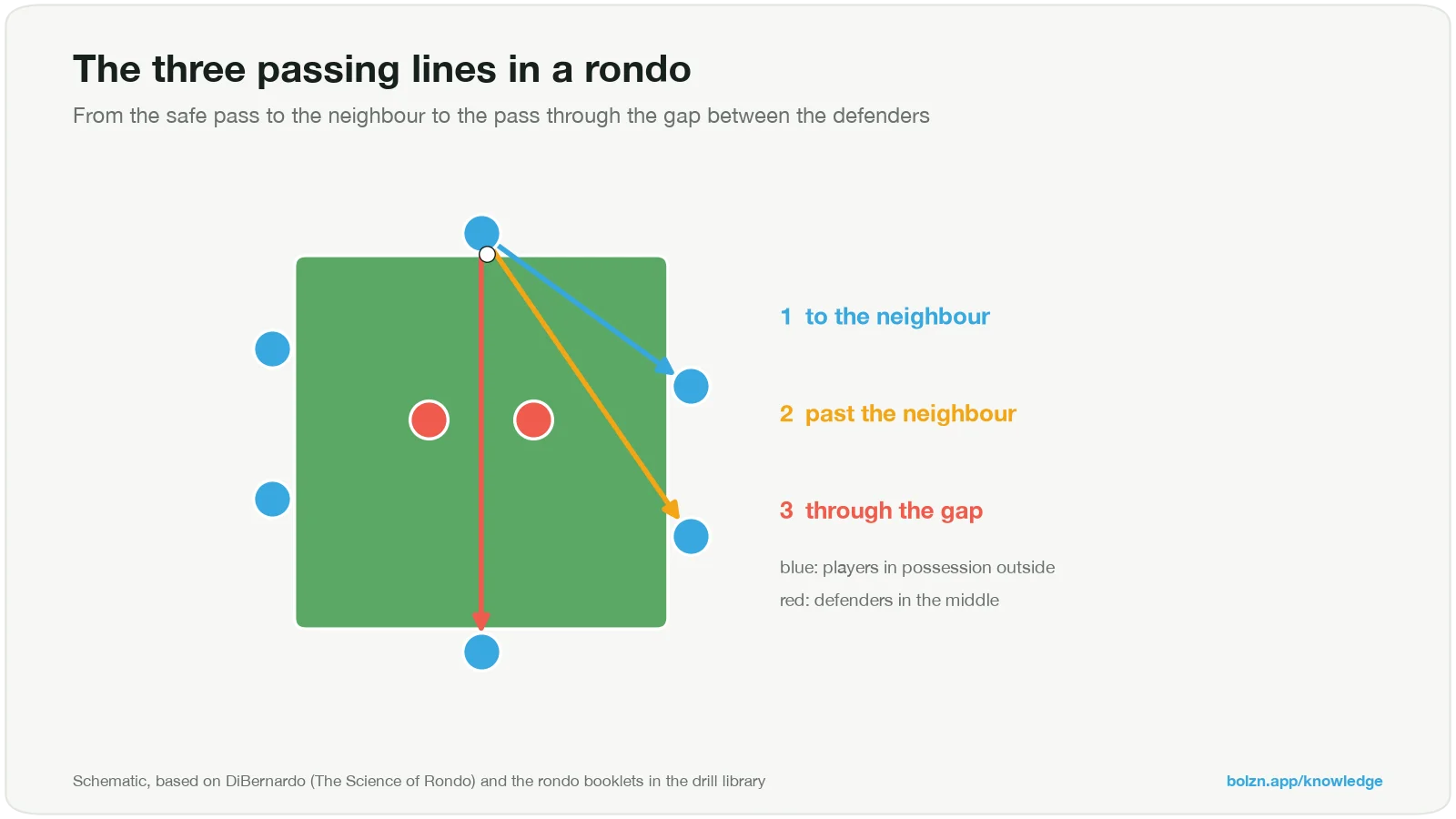
- To the neighbour: safe, keeps the ball, but poses no risk to the defenders.
- Past the neighbour: bypasses one defender and switches the play.
- Through the gap: between the two defenders. The most valuable pass, because it takes both defenders out of the game at once. In a match this is the pass that breaks an opposition line.
The aim is not to play as many passes to the neighbour as possible, but to keep the ball safely and use the third line as soon as it opens up. Many coaches therefore keep score: one point for ten passes in a row, three points for a pass through the gap.
What types of rondo are there?
| Format | For whom | What it is about |
|---|---|---|
| 3v1 | from about age 8 | Starting point: keep the triangle, offer yourself again after the pass |
| 4v1, 5v2 | from about age 10 | Basic format; in 5v2 more pressure from two defenders |
| 6v2, 7v2 | youth, adults | tight spaces, quick play, often one-touch |
| Zone rondo | youth, adults | every pass has to cross a line in the grid, which forces players to scan |
| Travelling rondo | youth, adults | after a set number of passes, move the play into the next grid |
| Positional rondo | from about age 12 | players stand in their positions from the team's own formation, see Positional play |
| Rondo with a finish | youth, adults | after winning the ball the defenders dribble out or shoot at a mini goal, the team in possession attacks a goal after a sequence of passes |
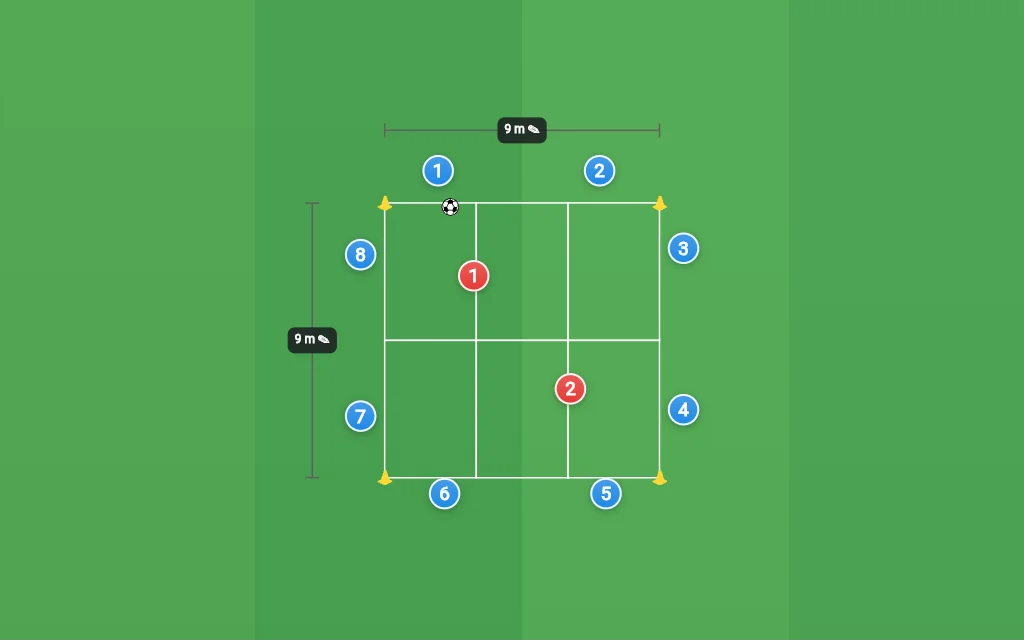
From the bolzn drill library: zone rondo – every pass has to cross a line.
How do I make a rondo easier or harder?
- Grid size: bigger is easier, smaller increases the pressure. A 5v2 works well for young players on about 10 × 10 to 12 × 12 metres.
- Number of defenders: 6v1 is easier than 5v2. If it isn't working, take one defender out.
- Touches: unlimited is easier, two-touch is normal, one-touch is hard. Children play without a touch limit.
- Scoring: points for passing sequences and for passes through the gap, and points for the defenders for winning the ball.
- Extra rules: no pass to the player next to you, offer yourself again once after the pass, a second ball that is played by hand, for more awareness.
How these levers also work in bigger games is covered in the article Designing small-sided games.
Common mistakes in the rondo
- Standing still after the pass: whoever has passed offers themselves again straight away. Otherwise the rondo turns into a static game.
- Only playing to the neighbour: possession is not an end in itself. The ball should move the opponent.
- Ball to the wrong foot: the pass belongs on the foot the team-mate wants to play on with, usually the back foot.
- Defenders sliding in blindly: if you arrive too late, you are better off blocking passing lanes.
- Rounds that are too long: rondos are intense, especially for the defenders in the middle. 60 to 90 seconds in the middle is enough, then swap.
How long and when in the session?
Rondos work well as a warm-up with the ball (see Warming up in football), as a technique block of their own and as a way into a tactical topic. Rounds of 2 to 5 minutes with one minute of rest have proved effective. What matters is that the quality stays high: shorter rounds at tempo are better than long, tired ones.
You will find more than 100 rondos and possession games for all age groups in the bolzn football drills.
Sources
- DiBernardo, M.: The Science of Rondo. Progressions, variations and transitions.
- Rondo and positional play booklets from the bolzn drill library (including 4-3-3 Positional Soccer Rondo).
- Silva, H. et al. (2026). Unraveling the physical demands of rondo drills. Journal of Strength and Conditioning Research.
- Baydemir, B. et al. (2026). Acceleration and deceleration responses to different small-sided game formats (4v1, 6v2). Frontiers in Physiology.
- Clemente, F. M. et al. (2021). Effects of small-sided game interventions on the technical execution and tactical behaviors of young and youth team sports players: a systematic review and meta-analysis. Frontiers in Psychology.