Planning a football training session: structure and flow
How to structure a training session: warm-up, main part, final game and huddle – with timings for kids and adults, season planning and organisation tips.
How is a training session structured?
Almost every coaching course teaches the same basic structure. A session has four parts:
- Warm-up: get moving, arrive, tune in to the topic.
- Main part 1, the drill: practise the topic of the day with many repetitions.
- Main part 2, the game: the same topic in a game with opponents, direction and goals.
- Finish: a free game, then a short cool-down or huddle.
The most important principle: one topic per session. If you try to fit passing, heading, pressing and endurance into 90 minutes, you train everything a little and nothing properly. The German Football Association (DFB) puts it like this: choosing one training content means choosing against another. So when you plan, also ask yourself: what are we not training today?
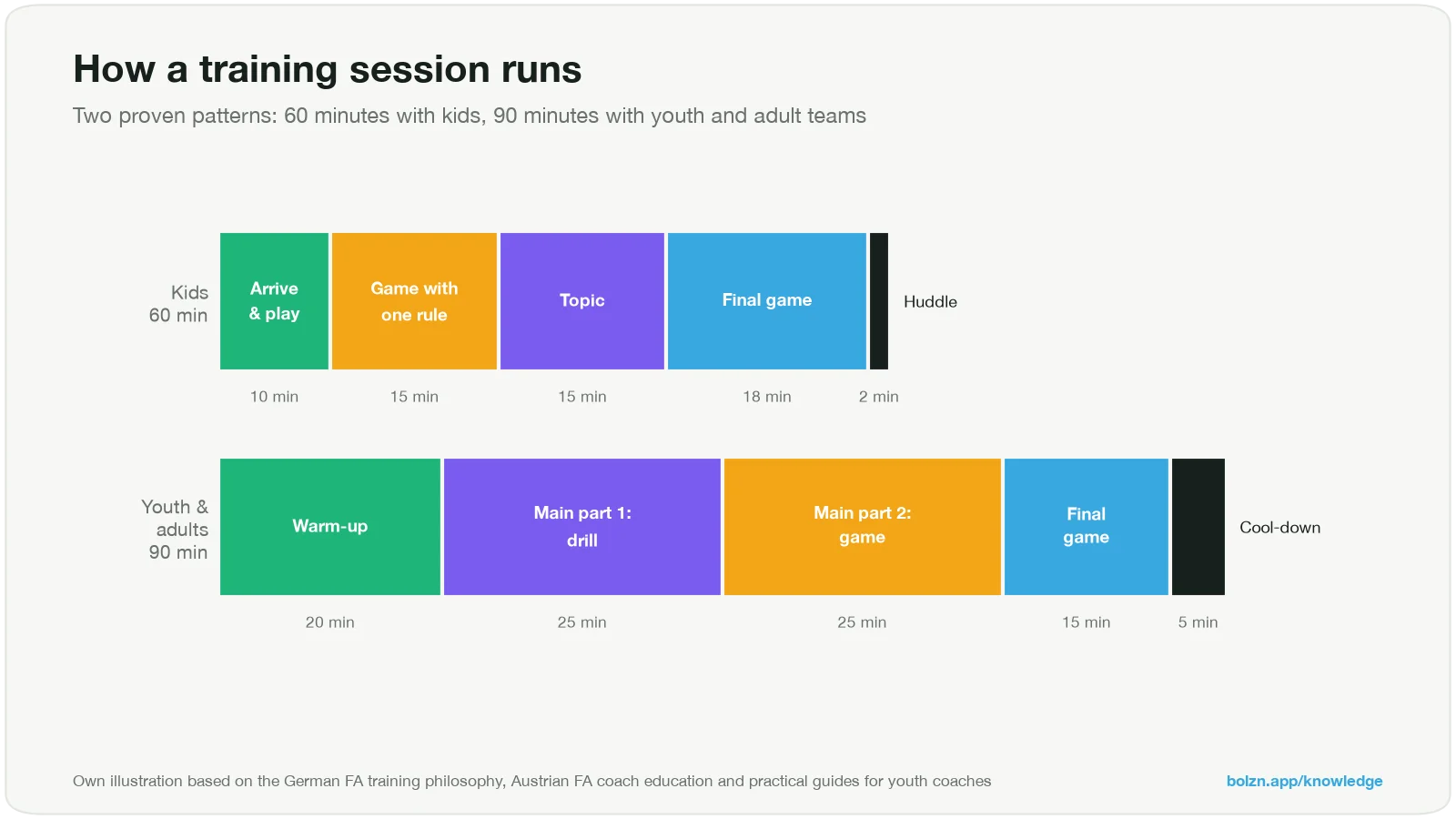
The four parts in detail
Warm-up
The warm-up has two jobs: the body gets up to temperature, and the players arrive mentally. With children and young players: use the ball instead of running laps. Children don't need stretching or jogging without a ball, they are flexible enough. Small games where everyone moves beat long explanations. Elimination games, where children drop out and then stand around, don't belong in the warm-up.
The second part of the warm-up already leads into the topic: if today is about passing, the players pass during the warm-up too. More in Warming up in football.
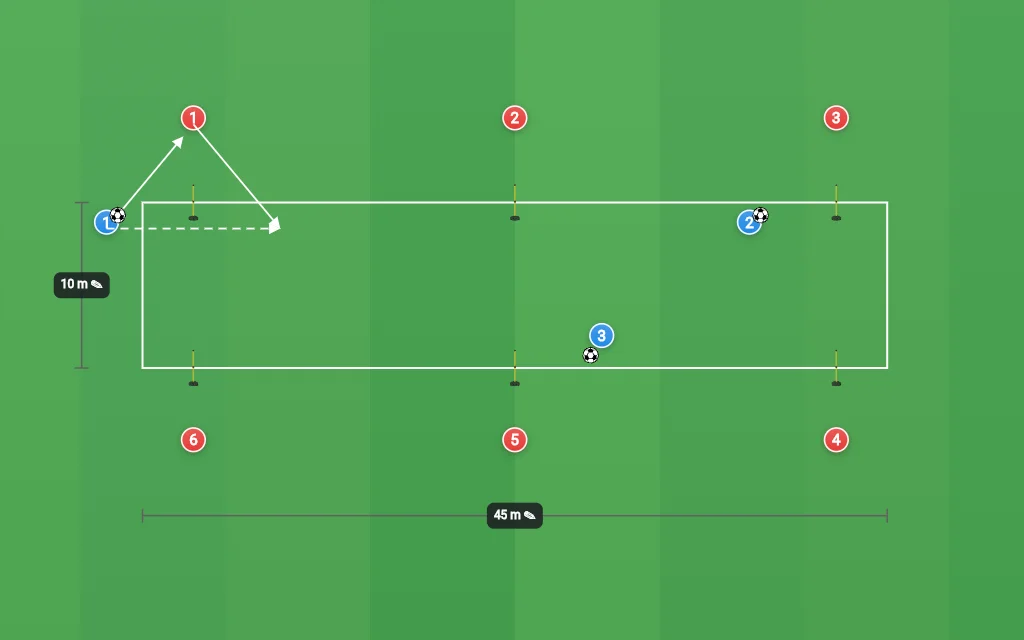
From the bolzn exercise library: one-two circuit around six poles – a warm-up with the ball that already leads into passing.
Main part 1: the drill
This is where the topic of the day is practised, with as many repetitions as possible and little waiting. The drills go from easy to hard: first without opponents or with a passive opponent, then with more pressure. At the start, clean technique matters more than speed.
Your job as the coach: correct briefly without stopping all the time. An assistant coach or smaller groups help a lot, because every player gets more turns.
Main part 2: the game
Every session should include at least one game. A game differs from a drill: there is a direction of play, an opponent and goals or points. The game should bring out the topic of the day again and again. You achieve that through the rules: pitch size, number of goals, overloads or underloads, zones, number of touches.
A good test: watch for two minutes without saying anything. Does the thing you want to train happen often, on its own? If not, change the pitch, the numbers or a rule, not the volume of your voice.
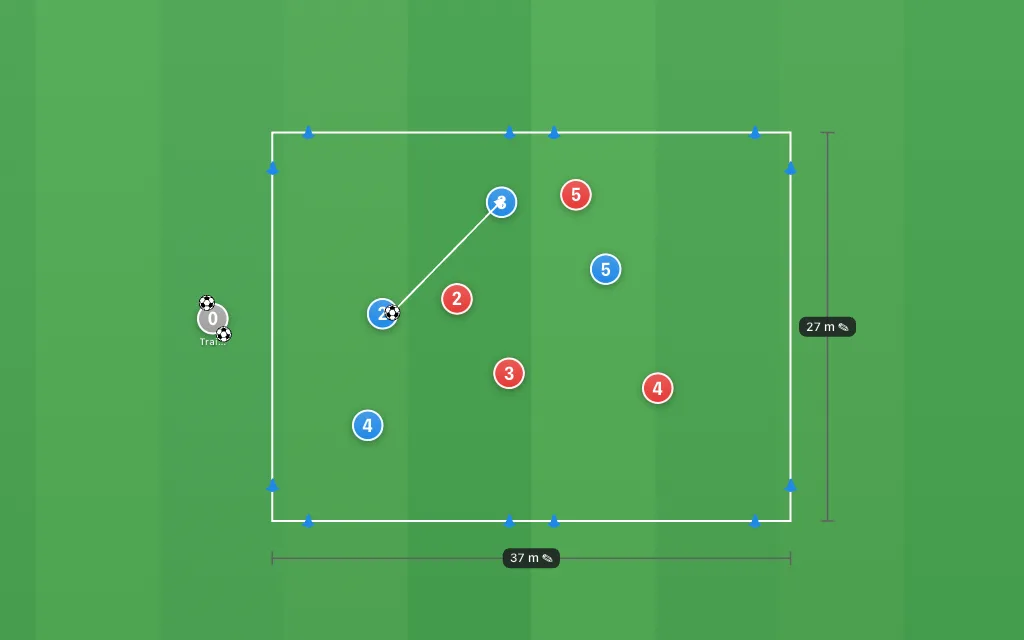
From the bolzn exercise library: billiards – two teams play on six pockets, whoever pots keeps the ball. The game rewards accurate passing.
Finish: game and huddle
The session ends with a free game on two goals. This is where you see whether anything from the topic has stuck. Hold back and let them play. For children, this is the part they come for. So never cut it short just because the main part ran over.
Then comes a short finish. With adults, that is a cool-down with easy jogging. With children, a two-minute huddle is enough: two or three things that went well, with names, and one sentence about next week.
Timings: kids 60 minutes, adults 90 minutes
With children (roughly U7 to U11), 45 to 60 minutes in short blocks have proven themselves:
| Block | Time | Content |
|---|---|---|
| Arrive and play | 10 min | Every child gets a ball straight away, free play in a marked area. Whoever arrives early plays longer. |
| Game with one rule | 15 min | 3 v 3 or 4 v 4 on small goals, with one rule that leads to the topic |
| Topic | 15 min | the topic in a game-like form, stop it three times at most |
| Final game | 18 min | free game, the coach is almost silent |
| Huddle | 2 min | praise with names, look ahead |
The DFB recommends a similar pattern for children and young players: blocks of 12 to 15 minutes with a ball for every child, alternating with several short 3 v 3 games (four to five rounds of about three minutes each, one minute rest). That way every child gets a huge number of touches, duels and shots in one session.
With youth and adult teams, 75 to 90 minutes are common: about 20 minutes warm-up, two main parts of 20 to 25 minutes each, 15 minutes final game and 5 to 10 minutes cool-down. How to spread sessions across the week is covered in Planning the training week.
Planning across the season: topics in blocks
A good session does not stand alone. In youth football, the DFB recommends training one topic for two to five sessions in a row before moving on. In its sample season plan for U12/U13, dribbling and passing are followed by 1 v 1 in attack, then 1 v 1 in defence, then combination play. Later, the topics return in harder forms.
In youth football, the last and the next league match should not dictate training. The content comes from the long-term development plan. In adult football, many coaches plan from match to match. Even there, it helps to set priorities over several weeks rather than a new topic every week.
How to go about it:
- Set goals for the season: what should the team be better at by the summer?
- Arrange topics in blocks: from easy to hard, technique before group tactics.
- Plan each session with one goal: one topic, one drill, one game.
- Make a short note after the session: what worked, what do I take into the next session?
Organisation: less idle time, more football
Most training time is not lost through bad drills but through waiting, explaining and rearranging. These tips save many minutes every week:
- Set up before the session. Be at the pitch before the players. That also shows them the session matters to you.
- Pick teams in advance, not in front of everyone and never by letting captains choose. That way nobody is left standing as the last pick.
- Hand out bibs as players arrive, in two colours.
- Set up the next drill during the current one: the cones for the main part are already down while the warm-up is running.
- Have a plan for odd numbers: a neutral player who always joins the team in possession solves almost any gap.
- Explain briefly: 30 seconds at most, then let them play and adjust during the game.
- Keep spare balls at the side, so nobody has to run behind the goal alone.
If every session follows the same pattern, the players know the routine. You only have to swap the content, and planning takes less than ten minutes. Rules of behaviour for training are covered in Team rules in football.
Drills for every part of the session are in the bolzn football drills. In the bolzn app you put the session together from the library and add it straight to the training event.
Sources
- German Football Association (DFB): Training philosophy Germany, competence team (The best training session, ages 6–18).
- German Football Association (DFB): DFB information evening, guide to a season training plan (sample season plan U12/U13).
- Age-appropriate football training in childhood and adolescence, final thesis for the Austrian FA coaching course (chapter on structuring a training session).
- Practical guide for youth coaches: four-block session template and organisation tips.
- Drills from the bolzn exercise library (one-two circuit around six poles, billiards on six pockets).