Back four: shifting, stepping out and covering
How a defensive line stays together: distances, shifting towards the ball, who steps out and what the others do then – with drills for training.
How does a back four stay together?
A back four stays together when all four shift towards the ball together, only one player steps out at a time and the others cover him straight away. The rule is simple: if one moves, everyone moves. The line works as if the players were tied together by a rope. It gets narrower when the ball is wide and moves up or drops off as a unit.
This applies to more than the defence. Midfield and attack are lines too, and there must be no big holes between them. A team that stays short and narrow without the ball is called compact.
What are the right distances?
There is no number of metres that is always right. It depends on age, pitch size and the opponent. Two questions help more than any number:
- Within the line: Can a pass get through between two defenders? Then they are too far apart. If they stand so close that all passing lanes out wide are open, they are too narrow. In our drills we use about 6 to 8 metres to the next defender near the ball as a guide for youth and adult players.
- Between the lines: Can an opponent receive the ball between defence and midfield and turn in peace? Then the space is too big. The distance is right when he is closed down from in front and behind as soon as he receives.
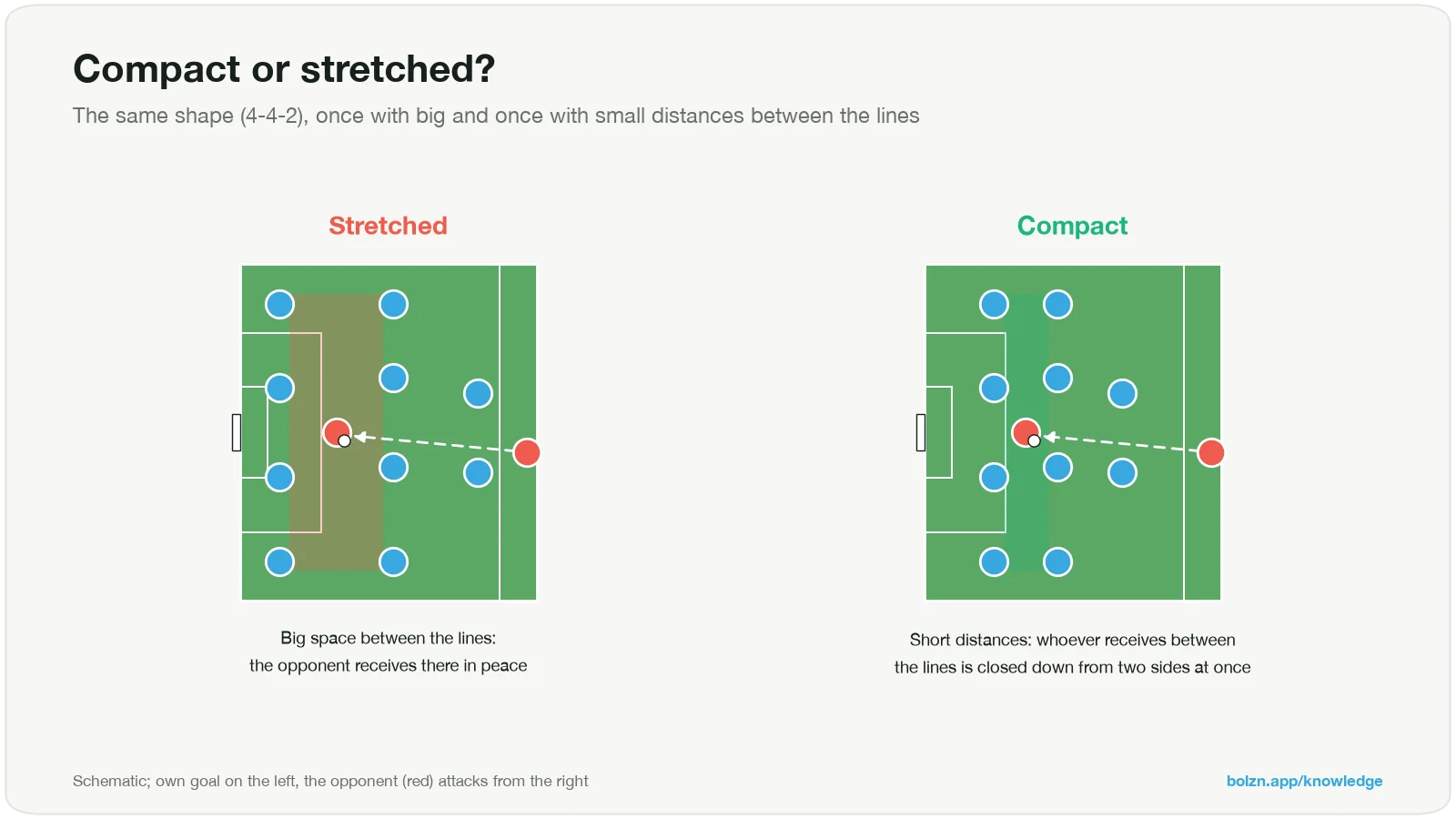
An analysis of 153 Bundesliga matches with tracking data is worth knowing here: when teams won the ball back, mainly the five defenders closest to the ball stood tighter together. How compact the whole team was made hardly any difference. For training, this means the distances around the ball matter most. The far side may be a little further away as long as it protects the centre.
Shifting towards the ball
The line orients itself first to the ball, then to space and only last to the individual opponent. When the ball is on the wing, the whole line shifts to that side. The far-side full-back tucks in to the edge of the penalty area. He deliberately leaves his winger free out wide, because a switch of play across the pitch takes time, and by then the line is back.
Typical mistakes when shifting:
- Everyone only defends his own man. The line tears apart as soon as an attacker makes a run.
- The line is too far apart. Nobody can cover anybody.
- The line is too narrow. The passing lanes out wide are open, and the opponent plays around the line.
- Running paths cross. Two defenders go for the same opponent and leave a hole behind them.
Who steps out?
Stepping out means a defender leaves the line, moves forward and closes down the player on the ball. The one who steps out is the player who can get to the ball fastest, usually the nearest one. He runs while the ball is travelling, slows down over the last few metres and ends up side-on, so he can steer the attacker in one direction, ideally towards the touchline.
Good moments to step out:
- a back pass by the opponent
- a player receiving with his back to goal
- a pass that travels for a long time, or a bad first touch
- an opponent appearing between the lines while the midfield cannot get there in time
The line should not step out when the player on the ball is free and looking forward. Then the pass into the space behind the defender who stepped out is the danger. In that case the line drops a few steps and buys time. A simple rule for the calls: if the ball is open (no pressure on it), the line drops. If the ball is closed (under pressure), it may step out or push up.
What do the others do when one steps out?
This is the most important part. When one player steps out, he is missing from the line. The others close the gap immediately:
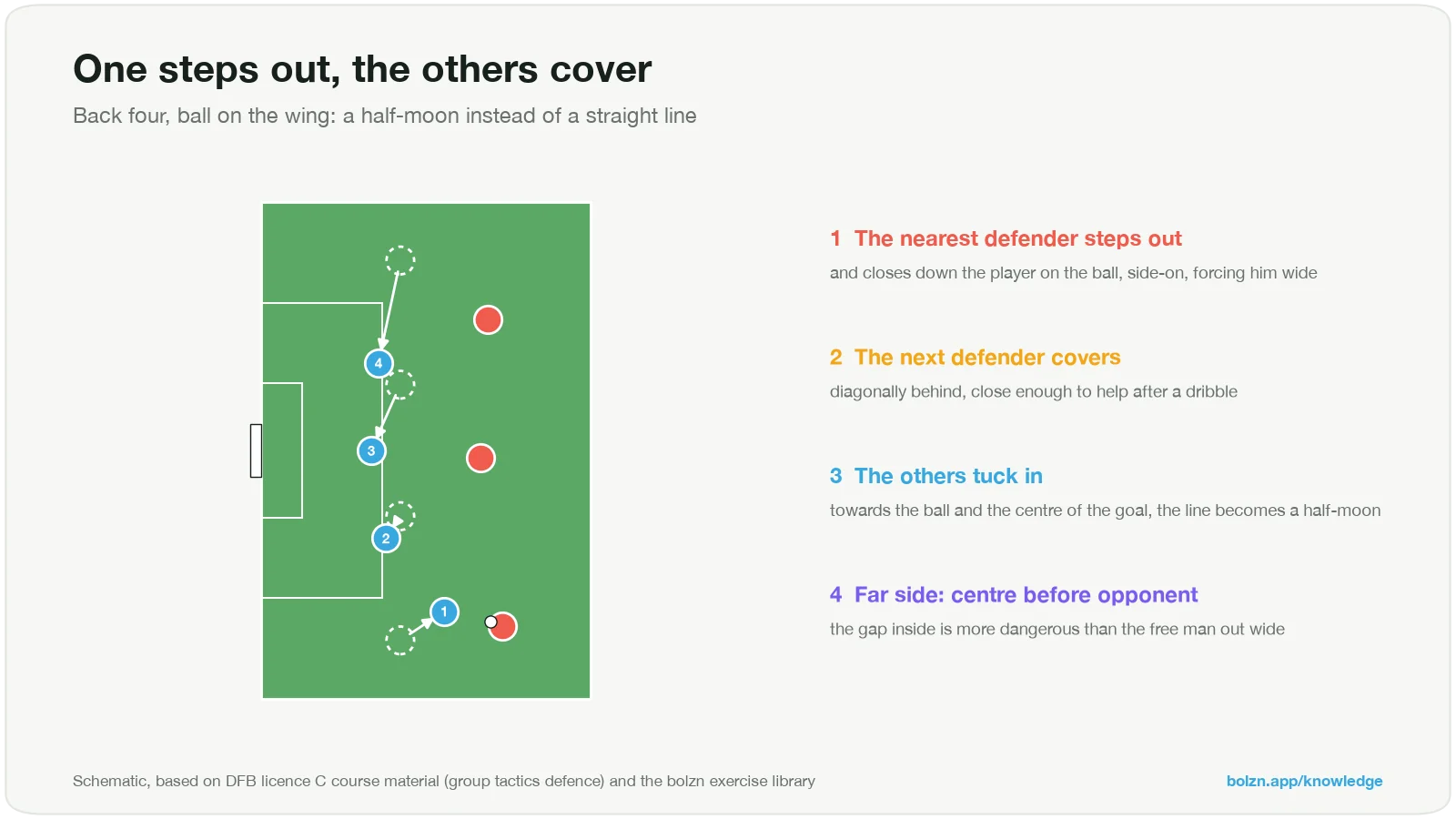
- The nearest team-mate covers. He takes up a position diagonally behind the defender who stepped out, close enough to help at once after a dribble and far enough away not to be beaten by the same move.
- The others tuck in. They shift towards the ball and the centre of the goal. The straight line becomes a half-moon when the ball is wide and a defensive triangle when the pressure comes through the middle.
- The far side protects the centre. The gap inside is more dangerous than a free opponent far out wide.
- If the defender who stepped out is beaten, he does not chase the attacker but recovers into the line, at an angle towards his own goal. The covering player takes over the ball and the line reorganises.
- The midfield helps. A holding midfielder can fill the space in the line when a centre-back has to step out far.
An idea attributed to Louis van Gaal sums it up well: three players can defend a line, so one can always step out. The others close the middle, because that is where the goal is.
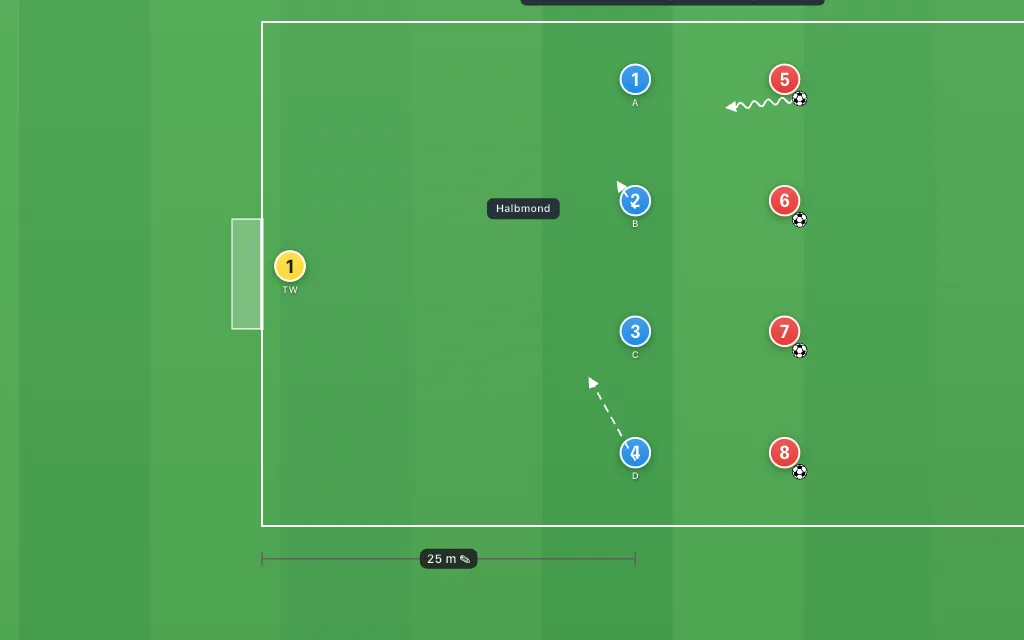
From the bolzn exercise library: shifting the back four – the nearest defender steps up, the others cover in a half-moon or a defensive triangle.
Talking and seeing
A defensive line only works if it talks. Short calls that are always the same help:
- "Out!" or "Press!": the player stepping out says so, or his team-mate sends him.
- "Shift!": the line moves towards the ball.
- "Hold!" or "Drop!": the ball is open, the line stays or drops off.
The defenders see the whole game in front of them. That is why they also coach the midfield ahead of them, for example "Six, step out!" or "Close the middle!". The other way round, when the midfield presses, the line has to push up too. Otherwise exactly the space between the lines appears that the opponent is looking for. More on this in Pressing in football.
The goalkeeper is part of it: he stands far enough off his line to sweep up a through ball behind the defence and gives instructions from behind. How he positions himself is explained in Goalkeeper positioning.
How do I train shifting and stepping out?
Build it up step by step, from a pair to the back four to the game:
- 2 v 2: one defender steps up, the other covers and tucks in. Don't cross running paths, talk to each other.
- Back four without duels: attackers dribble in one after another, the line shifts, one steps up, the others cover. Slowly at first, then at match speed.
- 4 v 4 small-sided games with an offside line: the defenders stand on a line, one may step out. After winning the ball, play continues freely for a short time.
- Back four plus holding midfielder against six attackers: with offside, the line steps up on every back pass and counters on two mini goals after winning the ball.
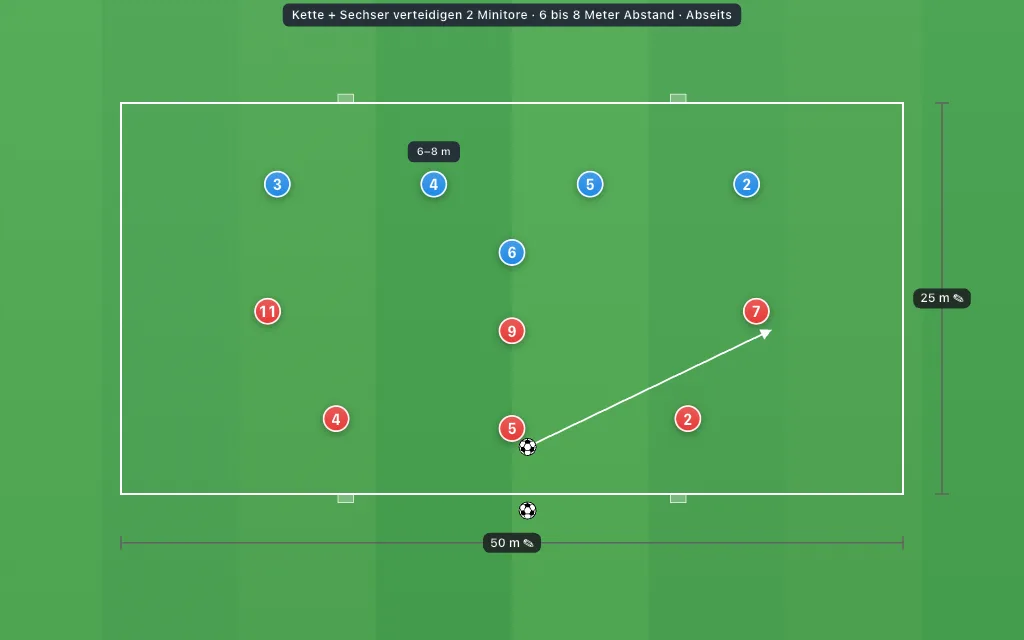
From the bolzn exercise library: back four and holding midfielder defend two mini goals – step out on a back pass, then counter.
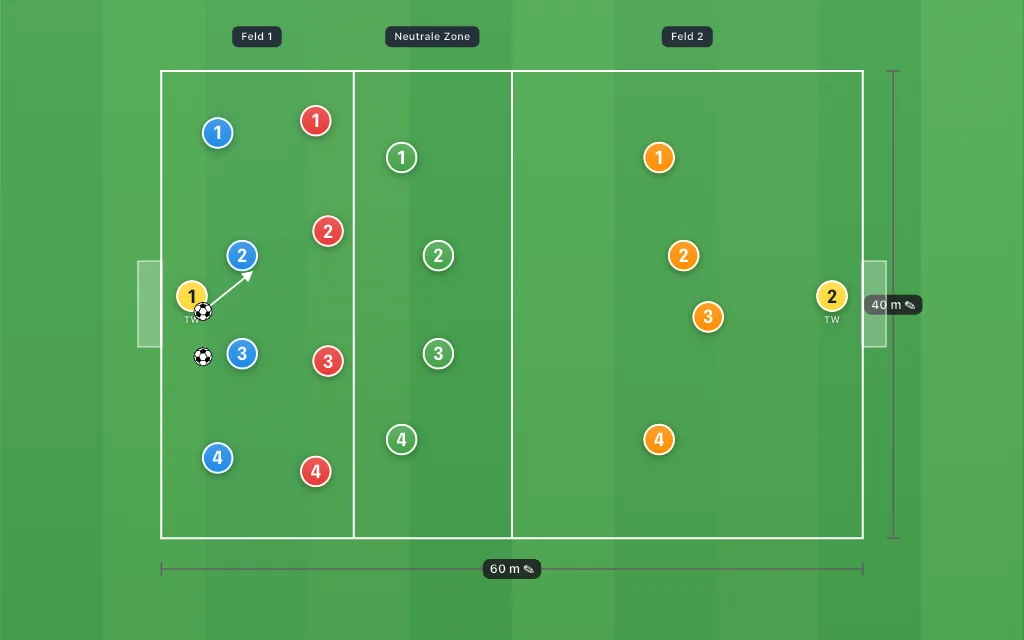
From the bolzn exercise library: 4 v 4 on 4 v 4 with a neutral zone – the line shifts and keeps the gaps small.
Coaching points for all forms: who steps out, who covers, who closes the middle? Stop briefly after an action and ask. Five clean repetitions are worth more than twenty hectic ones.
For children up to about 12, a fixed back four is not yet the topic. They learn defending 1 v 1 and in pairs, the basis for everything that follows. From U13/U14 and the full-size pitch, the defensive line becomes important. Matching small-sided games are in the bolzn football drills.
Sources
- DFB (German Football Association): coaching licence C, youth profile, group tactics attack/defence (course material).
- DFB: Training und Praxis im Juniorenfußball (TPD booklet), small-sided games for shifting, stepping out and covering.
- Renno-Report, issue 46: midfield pressing, back fours shifting as a unit.
- Forcher, L. et al. (2023). Is a compact organization important for defensive success in elite soccer? Analysis based on player tracking data. International Journal of Sports Science & Coaching.
- Drills from the bolzn exercise library (shifting the back four, back four and holding midfielder against six attackers, 4 v 4 with a neutral zone).