Pressing in football: triggers, curved runs and cover shadows
When a team should press, how to close down with a curved run, why the cover shadow shuts passing lanes and when the midfield has to step up too.
What is pressing?
Pressing means the team without the ball puts the opponent under pressure together to win the ball back quickly. One player closes down the player on the ball, the team-mates around him shut the passing lanes, and the whole team pushes up. Pressing is never one player's job. Whoever presses alone is just running.
Depending on where it starts, coaches speak of a high press (right at the opponent's box), a midfield press (from around the halfway line) or a low block (deep in your own half). Pressing straight after losing the ball is called counter-pressing.
Research supports the idea. In an analysis of 153 Bundesliga matches with tracking data, successful ball wins came with more pressure on the player on the ball, mainly close to the ball and in the last seconds before the ball was won. An older Bundesliga study showed that successful teams won the ball back faster after losing it than the others.
When do I press? The triggers
A team cannot chase every ball for 90 minutes. It needs triggers: situations in which everyone knows at the same moment that now is the time to press. Proven triggers from coaching practice:
| Trigger | Why it works |
|---|---|
| Back pass to a centre-back or the goalkeeper | The opponent plays backwards, everyone can push up with the ball |
| Receiving with the back to goal | The receiver cannot see what is behind him and has to turn first |
| Bad first touch, ball bouncing away | The opponent needs a moment longer, that is the window |
| Pass towards the touchline | The touchline works as an extra defender: the player on the ball loses a whole side to pass to |
| Long, high pass | While the ball is in the air, players can get close and attack the first touch |
| Slow square pass between the centre-backs | The ball travels for a long time, the presser is already running while it rolls |
| Receiving on the weaker foot | The opponent has fewer options and usually plays safe |
These triggers are coaches' experience, few of them have been studied one by one. What matters is that your team has two or three fixed triggers that everyone knows. Then nobody runs for nothing.
How do I close down correctly?
The first presser decides where the game goes. Three things make good closing down:
- Run while the ball is rolling. The presser starts with the pass, not with the first touch. Over the last few metres he slows down, bends his knees and stands side-on, otherwise a single feint beats him.
- Close down with a curved run. Instead of running straight at the player on the ball, the presser comes in a curve. While running he blocks a passing lane, usually the pass back to the other centre-back or the pass into midfield, and steers the opponent in one direction, ideally out wide.
- Use the cover shadow. Behind the presser, seen from the ball, there is an area no ground pass can reach. An opponent standing there is out of the game without anyone marking him.
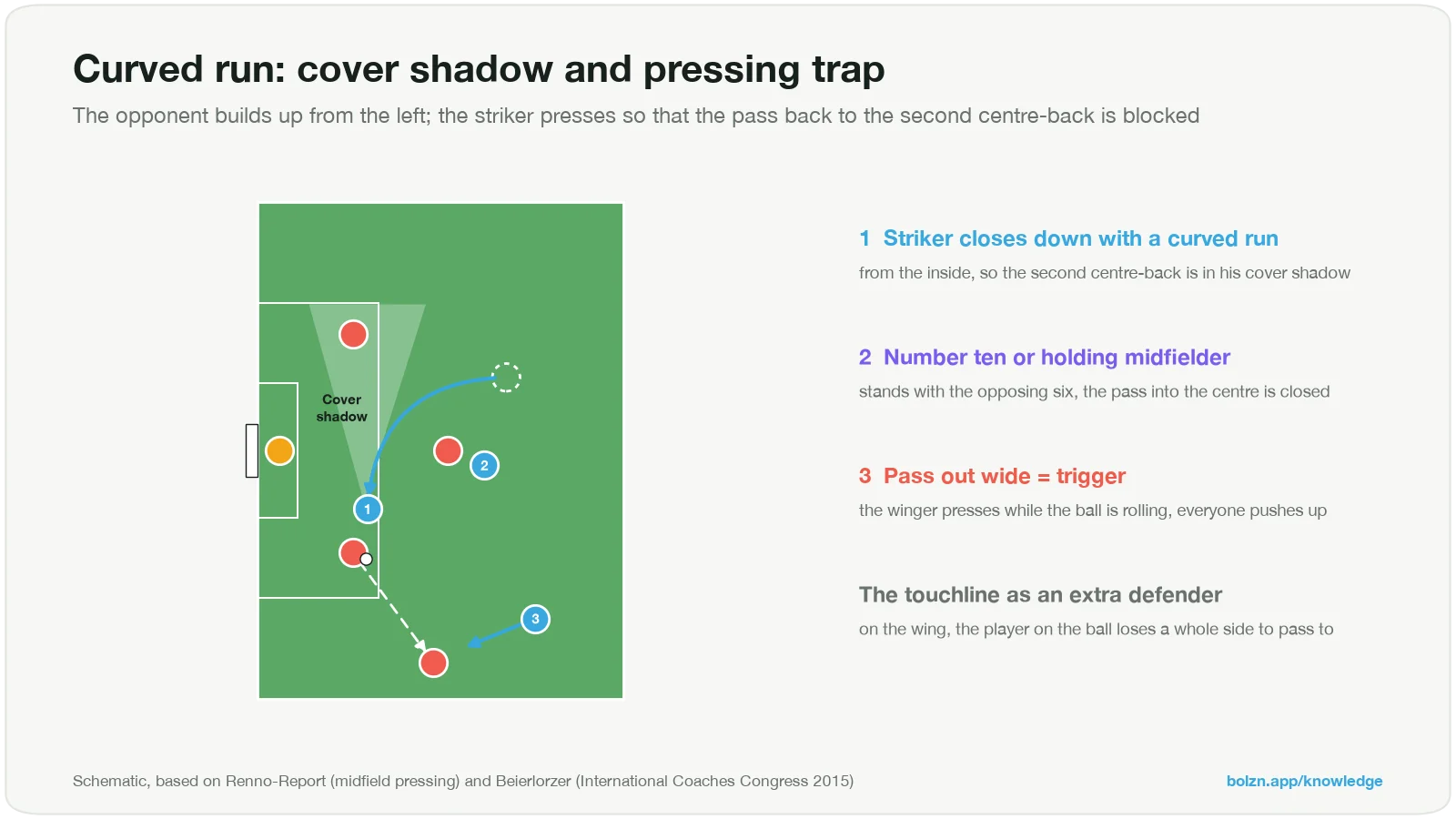
A common mistake with young players is closing down too wildly and then fouling or being beaten. The aim is not to win the ball with the first contact but to apply pressure and dictate the direction. Often it is the second or third player who wins the ball.
The pressing trap: forcing the opponent wide
A typical sequence in a midfield press against a back four looks like this:
- The opponent builds up through his centre-backs. Your striker closes down the centre-back on the ball with a curved run and cuts off the pass back to his partner.
- The number ten and the holding midfielders block the passes into the centre. The near-side winger tucks in a little and deliberately leaves the opposing full-back free.
- When the pass goes to that full-back, that is the trigger: the winger closes him down while the ball is rolling and blocks the pass down the line. The holding midfielder steps onto the next passing option, your own full-back pushes up behind.
- The player on the ball is now at the touchline with pressure in front of him and the short passes closed. Now you double up.
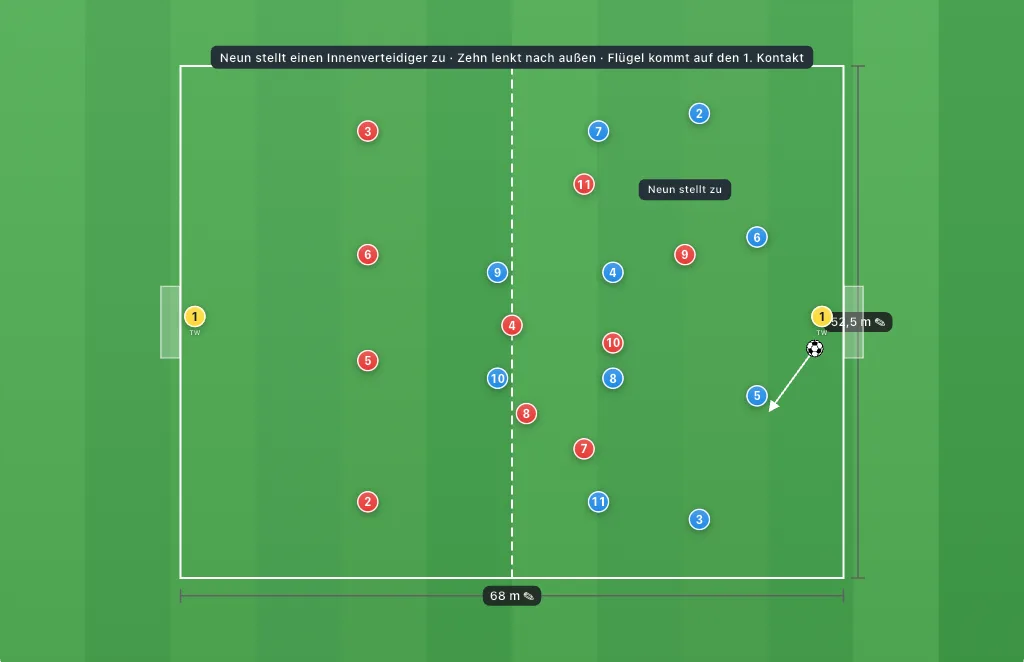
From the bolzn exercise library: pressing in a 1-4-2-3-1 – the nine blocks a centre-back, the ten forces play wide, the winger presses the first touch.
When does the midfield have to step up?
This is where pressing fails most often: two players press up front, the midfield behind them stays put, and the opponent simply plays into the free space in between. That is why the rule is: if the striker goes, everyone goes.
Midfielders have clear signals:
- The striker starts to press: the nearest midfielder steps onto the opposing holding midfielder or the next short option. He stands so that the pass to that player is in his cover shadow or can be attacked at once.
- The pass goes to an opponent nearby: whoever gets there fastest goes for the first touch. The others shift towards the ball.
- The opponent turns freely or the ball goes long: whoever cannot get there in time does not chase but drops off and closes the middle.
At the back, the defensive line has to follow. If the midfield presses, the line pushes up, otherwise the gap between the lines gets too big. The defenders see the whole game in front of them and give the calls: "Out!", "Shift!" or "Hold!". How the line shifts and who covers is explained in Back four: shifting, stepping out and covering.
When should I not press?
- The player on the ball has a clear view forward and time. Then the pass in behind is the danger. Better stay compact and wait.
- The team is not close enough together. If the distance to the ball is too big, the press arrives too late and opens gaps.
- The legs are not there. Pressing costs energy. Better press in clear phases, for example after a back pass or in the first minutes after half-time, than half-heartedly all the time.
How do I train pressing?
- Closing down 1 v 1 and 2 v 2: curved run, slow down, stand side-on, steer in one direction. The second player reads the first player's run and covers on the right side.
- Rondos with a pressing task: in a 4 v 2 or 5 v 2, the two defenders work together: one closes down, the other blocks the pass through the middle. More in Rondo in football.
- Small-sided games with a trigger: for example, the pressing team may only cross the halfway line after a back pass, or a ball won after a pass to the touchline counts double.
- Pressing against the build-up: one team builds up with goalkeeper and back four, the other presses with clear responsibilities. Whoever wins the ball counters on goal immediately.
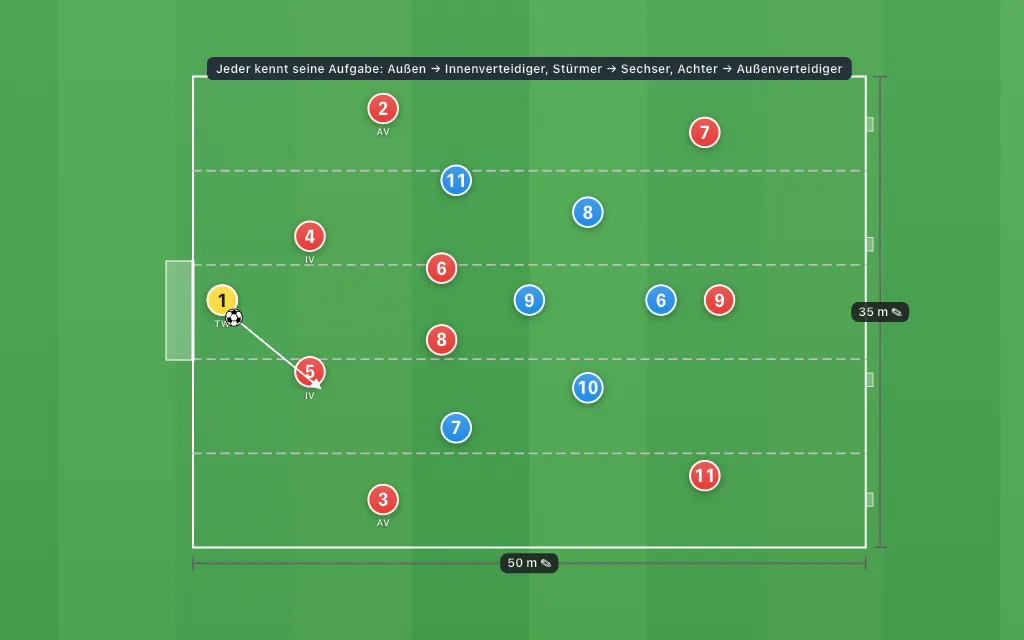
From the bolzn exercise library: high press 6 v 10 with clear responsibilities.
How the other side builds up against a press is explained in Building out from the back against a press. Pressing drills for all age groups are in the bolzn football drills.
Sources
- Forcher, L. et al. (2024). The keys of pressing to gain the ball: characteristics of defensive pressure in elite soccer using tracking data. Science and Medicine in Football.
- Vogelbein, M., Nopp, S. & Hökelmann, A. (2014). Defensive transition in soccer: are prompt possession regains a measure of success? A quantitative analysis of German Fußball-Bundesliga 2010/2011. Journal of Sports Sciences.
- Renno-Report, issue 46: midfield pressing (forcing wide, forcing inside, doubling up from behind).
- Bund Deutscher Fußball-Lehrer: International Coaches Congress 2015, practical session by Beierlorzer: closing down, cover shadow, pressure on space.
- Defending Sessions (coaching material): curved runs, pressure and cover.
- Drills from the bolzn exercise library (pressing in a 1-4-2-3-1, high press 6 v 10, press or drop off).