Grassroots vs elite youth football in Germany: the academy path
Grassroots club, DFB centre, youth academy (NLZ): how the elite pathway in German youth football works, when it starts and what coaches and parents should know.
What is the difference between grassroots and elite youth football?
Grassroots football (Breitensport) is football at the local club: children play because it is fun, with their friends, often two or three times a week. Every child can join in, however good they are. Elite football (Leistungssport) is the path that prepares players for the professional game. In Germany it mainly happens in the youth academies of the professional clubs, the Nachwuchsleistungszentren (NLZ). Players there are selected, train up to six times a week and are assessed again every year.
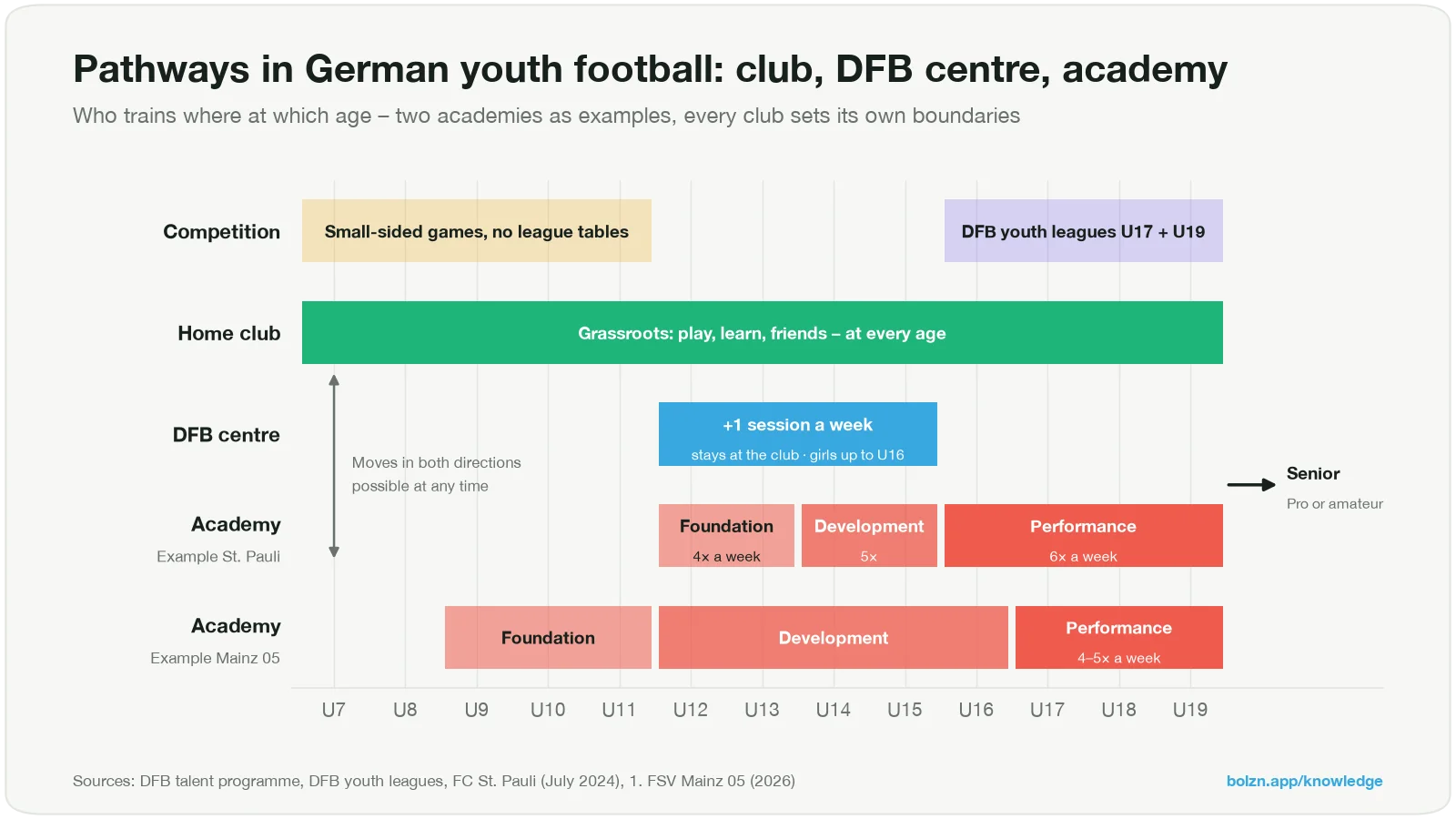
Between the two worlds sit intermediate steps: the DFB talent centres (Stützpunkte) and the regional association squads. There is no fixed date for the switch. Many academies take children from around U12, some earlier, many later. And the road runs both ways: players who leave an academy usually carry on at a normal club.
The levels of talent development at a glance
The German FA (DFB) describes talent development as a pyramid, with the base at the bottom and professional football at the top:
- Home club and school (base): roughly ages three to ten, U7 to U11. This is where almost every child learns the game.
- DFB talent programme: from about age eleven, U12 to U15. One extra session a week at a DFB centre.
- Elite development: academies, elite football schools, regional association squads.
- Professional level: youth national teams, the Bundesligas, the senior national team.
DFB talent centres: the first step
There are 339 DFB centres across Germany with about 14,000 players. Scouting covers U12 to U15, in some regions starting at U11. Girls stay until U16. The players train once a week on top of club training, usually for 90 minutes in small groups. It is free of charge.
Important for parents and club coaches: the child stays at their club. They do not have to move. The centre near home is responsible, so journeys stay short. The programme is meant for talents who are not at an academy. Players can join at any time, boys up to U15 and girls up to U16.
Regional association squads
The 21 regional associations within the DFB have their own representative squads. The DFB lists them as part of talent development alongside the centres, elite schools and academies. How they scout and which age groups they cover is up to each association. If in doubt, ask the centre coordinator in your region.
Youth academy (NLZ)
Every club in the Bundesliga and 2. Bundesliga must run a youth academy, otherwise it does not get a licence. This is set out in the German Football League's (DFL) licensing regulations. Clubs in the 3. Liga and the Regionalliga can apply to the DFB for recognition if they meet the same minimum standards. In July 2025 there were 58 recognised academies: 18 at Bundesliga clubs, 18 in the 2. Bundesliga, 14 in the 3. Liga and 8 in the Regionalliga.
Academies are checked regularly and placed in three categories. Category 3 is the minimum for recognition, category 1 the highest standard.
Elite football schools
Germany has 40 elite football schools (Eliteschulen des Fußballs). Their job is to make school and elite training fit together, so a talent is not worn down between lessons, training and travel. How that looks in detail (training slots in the timetable, catch-up lessons, boarding) differs from school to school.
Foundation, development and performance phase: what does that mean?
Many academies split their teams into three phases: Grundlagenbereich (foundation), Aufbaubereich (development) and Leistungsbereich (performance). The names are similar, but every club sets its own age boundaries. Two examples:
| Phase | FC St. Pauli (since 2024/25) | 1. FSV Mainz 05 |
|---|---|---|
| Foundation | U12 and U13, 4 sessions a week | U9 to U11 |
| Development | U14 and U15, 5 sessions a week | U12 to U16 |
| Performance | U16 to U19, 6 sessions a week | performance teams up to U19, 4 to 5 sessions a week |
Since the 2024/25 season FC St. Pauli has no longer grouped players strictly by birth year but by stage of development. The club no longer enters a U16 team. Instead of head and assistant coaches, mentors look after individual players. Mainz 05 says fun comes first in the foundation phase and results are not the main aim in the development phase.
What changes from phase to phase:
- Foundation: technique, coordination, lots of touches, enjoyment of the game. Training looks like good club training, only more often and with more coaches per child.
- Development: more tactics, positions, game understanding. The growth spurt falls in these years. School and travel become a real load; elite schools and transport services help.
- Performance: athletic development, competition at the highest level, preparation for senior football. Players are mostly 15 to 19, and the question of a first contract gets closer.
Sports science describes the same idea across all sports. The German Olympic Sports Confederation (DOSB) names the stages basic training (broad and varied, including other sports), build-up training (more sport-specific) and transition training (the bridge to adult high-performance training). It stresses that support should follow the child's development rather than calendar age, and that the path must stay open for late developers and late starters.
Which leagues do academies play in?
Until 2024 there were the U19 and U17 Junioren-Bundesliga. Since the 2024/25 season the top leagues are the U19 and U17 DFB youth leagues (DFB-Nachwuchsliga). They run in two parts: first a preliminary round in regional groups, then a main round in which League A plays for the German championship and the remaining teams play in League B. Clubs with an academy cannot be relegated. Teams without an academy can qualify through the regional youth leagues.
Below that are the regional leagues of the state associations. Academy teams in younger age groups (for example U15 Regionalliga) meet strong amateur clubs there. For many grassroots talents this is the stage where they get noticed.
When is a move to an academy realistic?
That depends on the club. Some academies have teams from U9 (Mainz 05, for example), others only start at U12 (St. Pauli, for example). The DFB centres also start at U12. Worth knowing:
- Earlier is not better. In 2025 the DFL and DFB changed the compensation rules for moves between academies up to U15. The stated aim is for players aged U12 to U15 to stay longer at one club instead of moving early and often.
- Many arrive later. A study of German academies and youth national teams (Güllich 2014) found that later Bundesliga professionals had entered talent programmes at very different ages, spread across childhood and youth. They were selected and dropped again and again. An early academy place was not the rule.
- Squads change constantly. In the same study, an average of almost a quarter of academy players (24.5%) and 41% of youth national team players were replaced each year. At every age, the chance of still being in the programme three years later was below 50%.
Neither the DFB nor the DFL publishes an official figure for how many academy players become professionals. What is clear: it is a small minority. Going to an academy is best seen as a period of very good coaching, not a promise.
Relative age effect and late developers
Children born early in the year have an advantage in every selection. At the DFB centres (U12 to U15), a large survey of 10,130 players found that children born in the first quarter were about twice as likely to be selected as those born in the last quarter. Around 61% were born in the first half of the year (Votteler & Höner 2014). In the U19 squads of 17 successful academies, 44.6% were born in the first quarter, although only about a quarter of each year group are (Tohoff & Mechtel 2025). The few late-born players who were selected went on to develop better on average.
On top of that comes the growth spurt: between 12 and 14, the difference in biological age can be up to five years. An early maturer then looks more talented than they are, a late maturer weaker. More in Youth football age groups and Growth spurt in football.
What this means for grassroots coaches
- Variety instead of early specialisation. Let children play every position, including in goal. Other sports on the side do not hurt, they help. The DOSB recommends this explicitly, and the DFB centres deliberately avoid fixing players to a position early.
- Playing time for everyone. Younger and late-maturing children in particular need minutes. A child on the bench today may quit tomorrow.
- Good training is the best talent development. Lots of touches, small-sided games, decisions in the game. Ideas in the bolzn football drills and in Small-sided games for kids.
- Flag talents, don't hold on to them. If a child clearly stands out, talk to the DFB centre coach in your area. The child stays in your team.
- Keep the way back open. A player returning from an academy has not failed. They bring good training with them and need a team that is glad to have them.
What parents should know
When a club asks or invites your child to a trial:
- Ask about the concept: how often do they train, who coaches, how do they play, how secure is the place?
- Ask about school and travel: is there a partner school, a transport service, homework support? Four to six sessions plus a match plus the school run is a lot for a twelve-year-old.
- Ask what happens if it does not work out: many academies decide again at the end of every season.
- Let your child have a say. They should want to go, not have to.
During the academy years:
- Watch load and recovery. Tiredness, falling performance and loss of motivation can be signs of too much. More in Planning the training week.
- Stay a parent, not an agent or assistant coach. Children need support at home, not a second match report.
- Keep in touch with friends and the old club. It helps if the path leads back.
If it does not continue: returning to the home club is the most common outcome and not a failure. Many go on to play happily for years in a good amateur league, and some still make it to the top through senior football.
Sources
- DFB (n.d., accessed 11/2026). Talentförderung, dfb.de/mehr-fussball/talentfoerderung (centres, player numbers, elite schools).
- DFB (2023). Wer? Wie? Was? DFB-Talentförderprogramm – information for parents and club coaches (pyramid, scouting, training times).
- DFB (2025). FAQ zur Lizenzierung von Leistungszentren (licensing requirement, number, categories).
- DFB (2024). DFL und DFB stärken die Talententwicklung in den Leistungszentren (training agreement from 1 February 2025).
- DFB (2023, 2026). FAQ: Alles zur Reform der Nachwuchsligen; Die DFB-Nachwuchsligen starten in die Hauptrunde.
- FC St. Pauli (2024). Umstrukturierung im NLZ zur neuen Saison 2024/25; Neue Struktur im Nachwuchsleistungszentrum.
-
- FSV Mainz 05 (accessed 11/2026). Über uns – youth academy.
- DOSB (2013). Nachwuchsleistungssportkonzept 2020, pp. 6–10.
- Güllich, A. (2014). Selection, de-selection and progression in German football talent promotion. European Journal of Sport Science, 14(6), 530–537.
- Votteler, A. & Höner, O. (2014). The relative age effect in the German Football TID Programme. European Journal of Sport Science, 14(5), 433–442.
- Tohoff, L. & Mechtel, M. (2025). Fading Shooting Stars. Journal of Sports Economics (press release, Leuphana University Lüneburg, 20 March 2025).