Youth football age groups in Germany: Bambini to U19
All youth football age groups in Germany for 2026/27 with birth years, format, pitch and match length, and what changes physically at each step up.
What are the youth age groups in German football?
Youth football in Germany, run under the German FA (DFB), has seven age classes, from the Bambini (G-Jugend, U7) to the U19s (A-Jugend). Each class covers two birth years. The cut-off date is 1 January: everyone born in the same calendar year plays the whole season together, whether they were born in January or in December.
These birth years apply for the 2026/27 season:
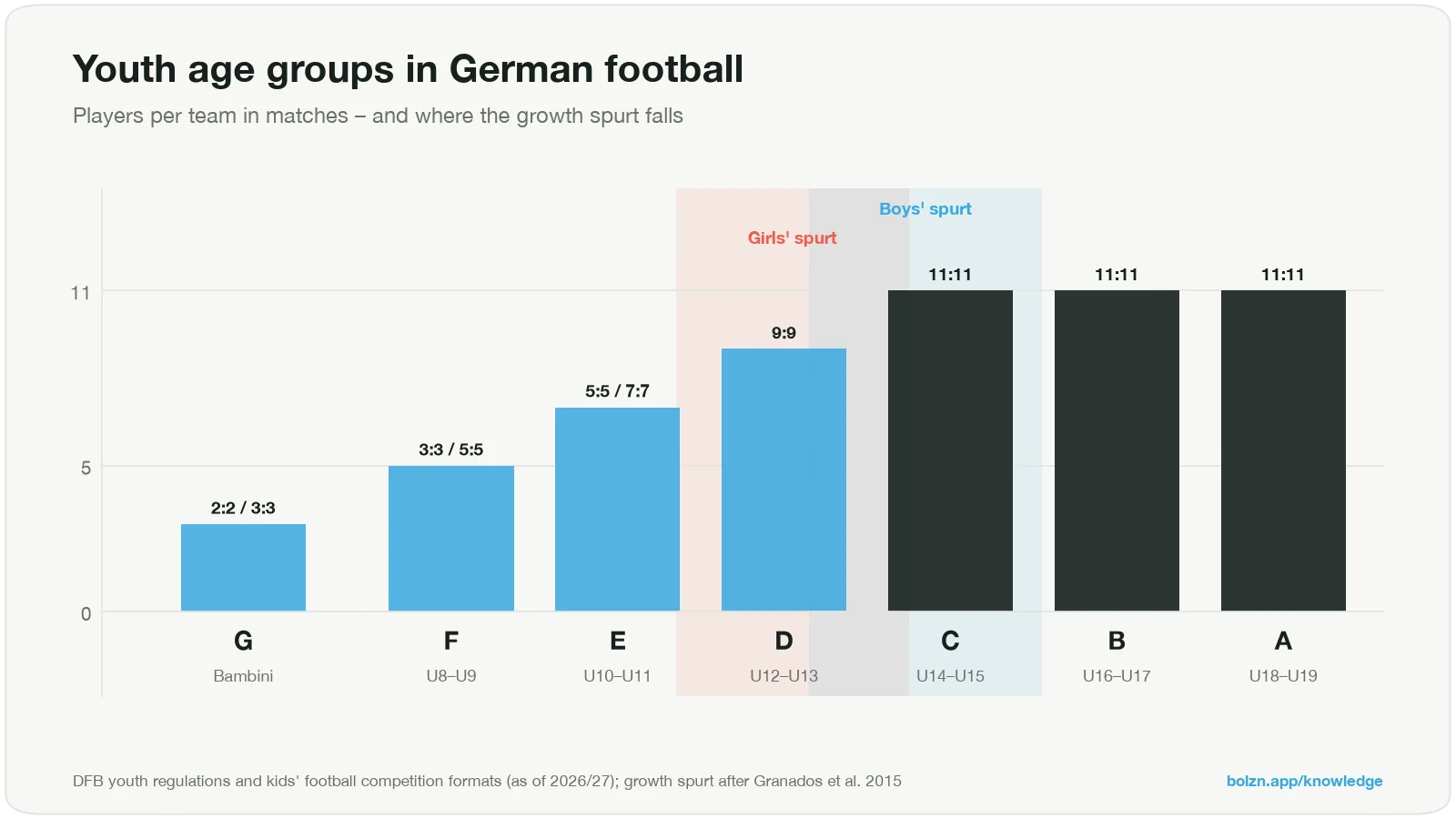
| Class | Also called | Birth years 2026/27 | Match format | Match length |
|---|---|---|---|---|
| G-Jugend | Bambini, U7 | 2020 and younger | 2v2 or 3v3 on four mini goals | at most 7 × 5 or 7 × 7 minutes respectively |
| F-Jugend | U8 / U9 | 2018 / 2019 | 3v3 or 5v5 | up to 7 × 10 minutes |
| E-Jugend | U10 / U11 | 2016 / 2017 | 5v5 or 7v7 with a goalkeeper | up to 2 × 25 minutes, depending on the format |
| D-Jugend | U12 / U13 | 2014 / 2015 | 9v9 (penalty area to penalty area) or 8v8 | 2 × 30 minutes |
| C-Jugend | U14 / U15 | 2012 / 2013 | 11v11 on the full-size pitch | 2 × 35 minutes |
| B-Jugend | U16 / U17 | 2010 / 2011 | 11v11 | 2 × 40 minutes |
| A-Jugend | U18 / U19 | 2008 / 2009 | 11v11 | 2 × 45 minutes |
Details such as pitch size, goal size and ball size are in part regulated differently by the regional associations (Landesverbände). The youth regulations (Jugendordnung) of your regional association are always the binding ones. All pitch dimensions, with diagrams, are in the article Youth football pitch sizes in Germany.
Children's football: the new small-sided formats up to U11
Since the 2024/25 season the Bambini, the U9s (F-Jugend) and the U11s (E-Jugend) have played small-sided games all over Germany. The idea: every child should be on the ball as often as possible, shoot at goal often and make lots of decisions. There are no league tables or championships in these age groups.
- Bambini (U7): 2v2 or 3v3 without a goalkeeper on four mini goals. The pitch is only about 16 × 20 to 25 × 20 metres.
- F-Jugend (U8/U9): 3v3 or 5v5, goalkeeper optional.
- E-Jugend (U10/U11): 5v5 or 7v7, now with a goalkeeper, on a small-sided pitch.
Matches are played with lightweight balls, size 3 (up to F-Jugend) and size 4 (E-Jugend). Heading hardly plays a role in children's football.
The transitions: what changes for the children?
Every move up to the next age group brings bigger pitches, more team-mates and new rules. At the same time the body is changing. That makes some transitions particularly demanding.
From U11 (E-Jugend) to U13 (D-Jugend)
At U13, 9v9 is played for the first time, usually from penalty area to penalty area on half of the full-size pitch. Offside is added, the spaces get bigger and the runs longer. Many girls enter their growth spurt at this age; on average it peaks at around 12 years for them.
From U13 (D-Jugend) to U15 (C-Jugend)
The biggest step: from U15 (C-Jugend) onwards the game is 11v11 on the full-size pitch, with full-size goals and a size 5 ball. Right now, between 13 and 15, most boys go through their strongest growth spurt. In the same team you then have children who are almost fully grown next to children whose growth has not really started yet. The difference in biological age can be up to five years.
For coaches this means: at U15, differences in strength and speed are often not a question of talent but of stage of development. More on this in the article Growth spurt in football.
U17 (B-Jugend) and U19 (A-Jugend)
Most teenagers have their growth spurt behind them. Strength and muscle mass now increase markedly, and the differences due to maturity get smaller. Training moves closer to that of adults, with more athletic and tactical work.
What does the cut-off date mean for the children?
Because the cut-off date is 1 January, a child born in January is almost a year older than a child born in December of the same birth year. For seven-year-olds that is a seventh of their life. Older children are often taller, stronger and faster and are therefore picked more often for representative squads. In the former U17 Bundesliga (2022/23 season) almost half of the players were born in the first quarter of the year, but only about one in ten in the last.
As a coach you can counteract this: do not judge children by their current performance alone, but also by their month of birth and stage of development. Give younger and late-developing children time.
Can a child play in a higher or lower age class?
Many regional associations allow children to play in the next age class up, usually with restrictions (for example only the younger birth year of a class moving up, and not across several classes). Playing down in a younger class, by contrast, is only possible in exceptional cases, for instance in girls' football or for girls playing in boys' teams. The exact rules are in the youth regulations of your regional association.
If you want to “play a child up”, do not look at footballing ability alone. The physical load and the total number of sessions and matches per week count too. How to plan the week sensibly is covered in the article Planning the training week.
Planning training to suit the age group
Every age group needs a different focus: lots of touches and fun for the youngest, technique and small-sided games at U11 and U13, plus athletic work and tactics from U15 onwards. A proven warm-up programme for 7- to 13-year-olds that has been shown to halve injuries is FIFA 11+ Kids.
You will find suitable drills for every age group in the bolzn football drills. With the session planner you can put them together into sessions for your team.
Sources
- DFB (2026). Jugendordnung (youth regulations), § 5 (age classes), § 8 (match length), § 8a (pitch), Appendix IV (children's football).
- DFB (2024). Wettbewerbsformen im Kinderfußball (booklet).
- Granados, A. et al. (2015). Relationship between timing of peak height velocity and pubertal staging. Journal of Clinical Research in Pediatric Endocrinology.
- Heilmann, F., Kuhlig, A. & Stoll, O. (2024). Relative age effects in German youth A and B men's soccer teams. Frontiers in Sports and Active Living.
- DFB (n.d.). Ausbildungskonzeption / Talentförderung: biological age and game formats by stage of development.