Youth football pitch sizes in Germany: DFB dimensions and set-up
Pitch sizes under the German FA (DFB) youth rules from Bambini to U19, plus goal and ball sizes, small-sided rules and how to set up a Funino pitch.
How big is the pitch for each youth age group?
Under the youth regulations of the German FA (DFB-Jugendordnung, Appendix IV), the pitch in Germany grows with age: the Bambini (G-Jugend, U7) play on about 16 × 20 metres, the U9s (F-Jugend) on 25 × 20 to 40 × 25 metres, the U11s (E-Jugend) on 40 × 25 to 55 × 35 metres, the U13s (D-Jugend) from penalty area to penalty area on the full-size pitch, and from U15 (C-Jugend) onwards matches are played on the normal full-size pitch.
| Class | Format | Pitch | Goals |
|---|---|---|---|
| G (Bambini, U7) | 2v2 without a goalkeeper | approx. 16 × 20 m | mini goals, max. 2.0 × 1.2 m |
| G | 3v3 without a goalkeeper | approx. 25 × 20 m | mini goals, max. 2.0 × 1.2 m |
| F (U8/U9) | 3v3 without a goalkeeper | approx. 25 × 20 m | mini goals, max. 2.0 × 1.2 m |
| F | 5v5 with or without a goalkeeper | approx. 40 × 25 m | mini goals or 5 × 2 m, reduced in height |
| E (U10/U11) | 5v5 with or without a goalkeeper | approx. 40 × 25 m | mini goals or 5 × 2 m |
| E | 7v7 with a goalkeeper | approx. 55 × 35 m | 5 × 2 m |
| D (U12/U13) | 9v9 with a goalkeeper | penalty area to penalty area (about 72 × 68 m), at least 50 × 68 m | 5 × 2 m |
| D | 8v8 with a goalkeeper | across the full-size pitch, touchline to touchline | 5 × 2 m |
| C to A | 11v11 | full-size pitch | 7.32 × 2.44 m |
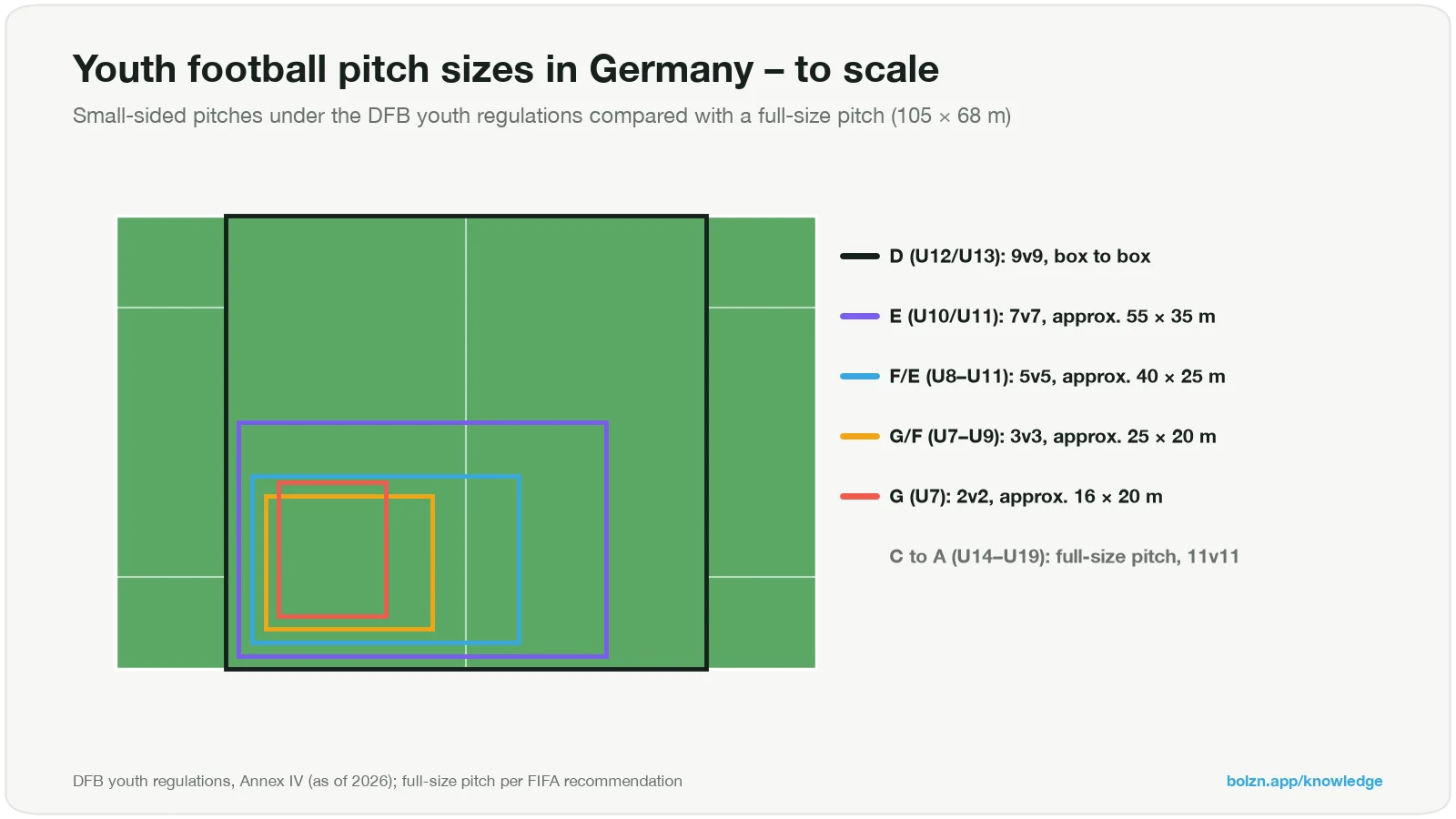
These are approximate dimensions. The DFB words them as recommendations to its regional associations (Landesverbände). The youth regulations of your regional association are the binding ones, and they do differ, for example on ball size at U13 or on 7v7 as an alternative at U13. Which birth years belong to which age class is covered in the article Youth football age groups in Germany.
The full-size pitch
From U15 (C-Jugend) onwards the game is played on the normal pitch. Under the Laws of the Game it may be between 90 and 120 metres long and 45 to 90 metres wide; 105 × 68 metres is recommended. The key dimensions:
- Penalty area: 16.5 m deep, 40.32 m wide
- Goal area: 5.5 m deep, 18.32 m wide
- Penalty mark: 11 m from the goal
- Centre circle: radius 9.15 m
- Goal: 7.32 × 2.44 m
At U13 the full-size pitch is divided: either lengthways between the two penalty areas (9v9; on a 105 × 68 m pitch that is about 72 × 68 m, the youth regulations require at least 50 × 68 m) or across the pitch from touchline to touchline (8v8).
Goal sizes and ball sizes
| Class | Ball | Goals |
|---|---|---|
| G | size 3, 290 g | mini goals up to 2.0 × 1.2 m |
| F | size 3 or 4, 290 g | mini goals or small-sided goals |
| E | size 4, 290 or 350 g | mini goals or 5 × 2 m |
| D | size 4 or 5, 350 g | 5 × 2 m |
| C to A | size 5 | 7.32 × 2.44 m |
Small-sided goals must be secured against tipping over. Goals falling over are among the most dangerous accidents in children's football.
Small-sided rules up to U11
Children's football in Germany is played to simplified rules:
- No offside up to and including U11 (E-Jugend).
- Direct free kicks only; the penalty kick is taken from 8 metres.
- The goal kick may also be taken as a throw from the hands.
- No yellow or red cards; a word of warning instead.
- Unlimited substitutions, including players going off and coming back on repeatedly.
- A foul throw is not penalised up to U9 (F-Jugend). At U11 it may be retaken after an explanation.
How to set up a Funino pitch
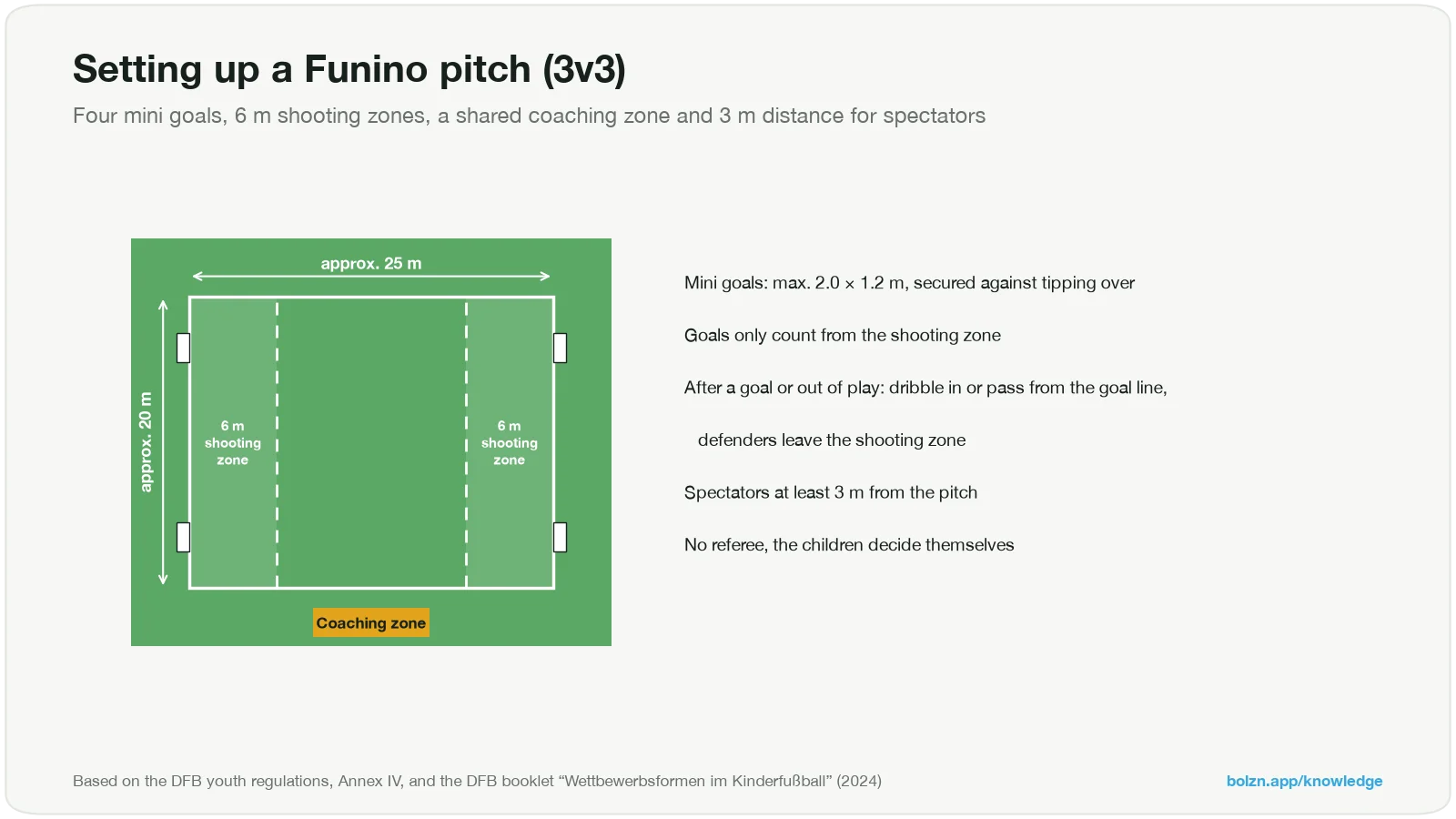
For the new formats with four goals:
- Two mini goals on each goal line, as far apart as possible.
- 6 m shooting zone in front of each goal line (in 3v3): goals only count if the shot is taken from inside this zone. In 2v2 and 4v4, goals count from the halfway line.
- After a goal or when the ball goes out, play restarts with a dribble-in or a pass from the team's own goal line. The defending team has to leave the shooting zone for this.
- No goalkeeper, with rotation players who come on in a fixed order.
- Shared coaching zone for both coaches; spectators stay at least 3 metres away from the pitch.
- Up to U9 no referee: the children make the decisions themselves.
Why these small pitches work so well is explained in the article Small-sided games in children's football.
Festival afternoon: several pitches on one ground
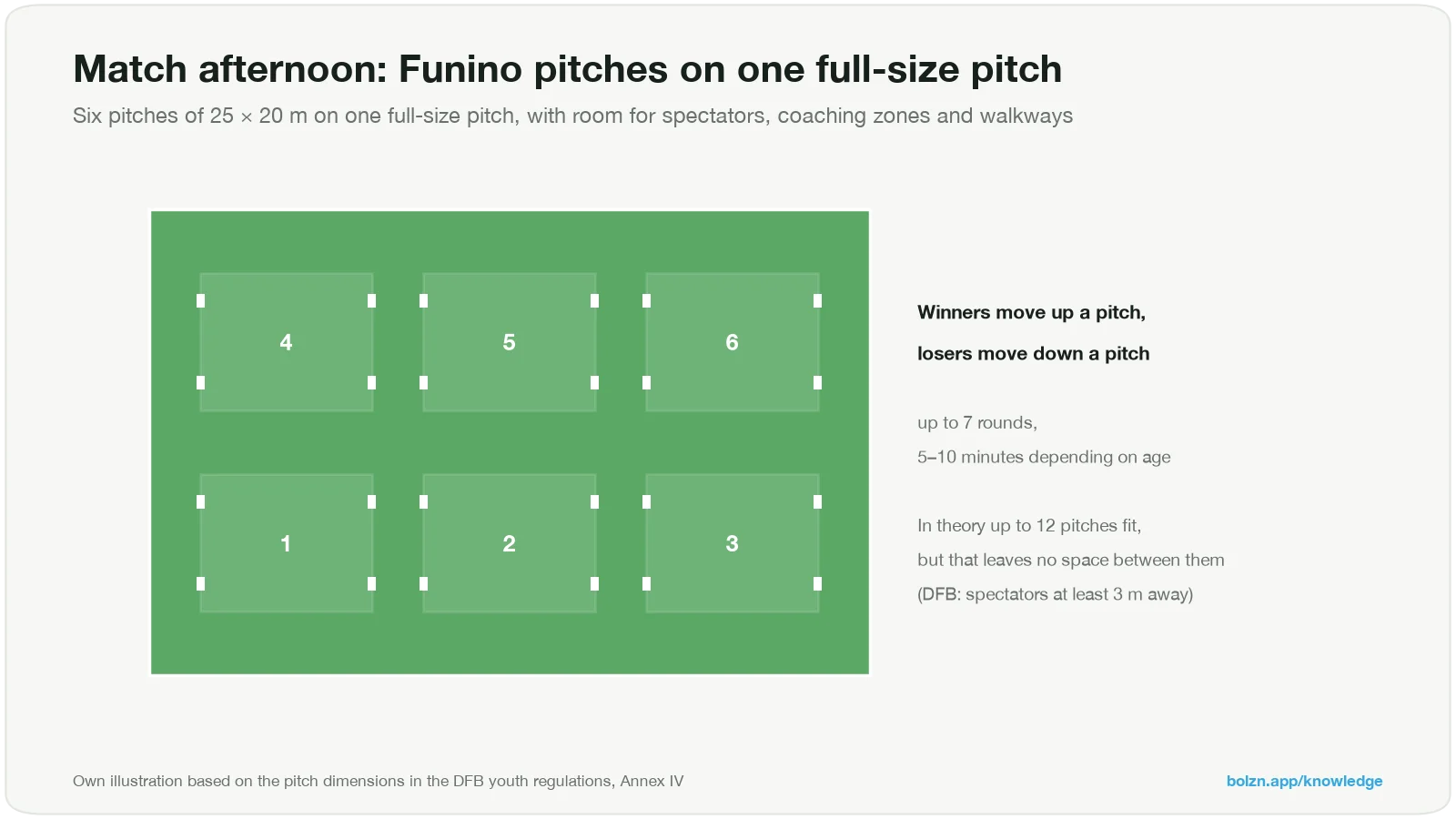
For Bambini, U9s and U11s there is no league with a table. Instead there are festival afternoons (Spielnachmittage) in a tournament format:
- Several small-sided pitches side by side; each team starts on one pitch.
- Up to seven rounds of about 5 to 10 minutes each, depending on age, with short breaks in between.
- After each round the winner moves up one pitch and the loser moves back one pitch. That way teams soon play against opponents of similar strength.
On paper, up to twelve Funino pitches fit on a full-size pitch, but that leaves no room for spectators, coaching zones and walkways. Six to eight pitches is realistic.
Training: adapt pitches to what you need
In training you do not have to stick to match dimensions. Smaller pitches increase the pressure and the number of actions on the ball; bigger ones bring longer runs and more space to dribble. How pitch size and player numbers work is covered in the article Small-sided games on a small pitch. You will find suitable small-sided games for every pitch in the bolzn football drills, and you can draw pitches and sequences on the tactics board.
Sources
- DFB (2026). Jugendordnung (youth regulations), § 8a (pitch size and number of players) and Appendix IV (special provisions for matches on small-sided and reduced-size pitches).
- DFB (2024). Wettbewerbsformen im Kinderfußball (booklet).
- IFAB / DFB: Fußball-Regeln (Laws of the Game), Law 1 (The Field of Play).