Small-sided games in kids' football: why 3v3 works
Why children get twice as many actions on the ball in 3v3, 4v4 and Funino, who benefits most and how to use small-sided games in training.
Why do children play small-sided games?
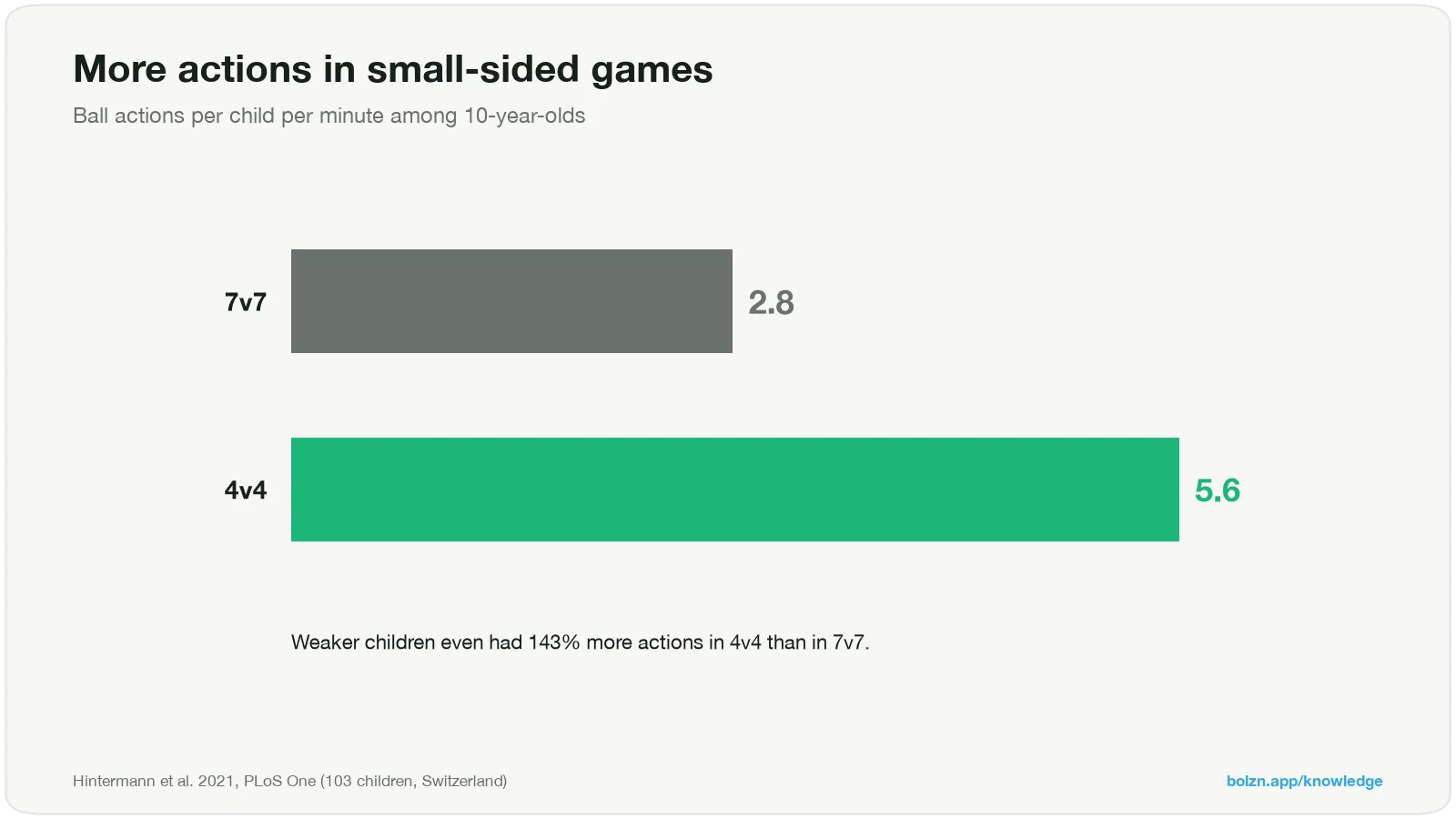
Because children learn football best with the ball at their feet. In small-sided games such as 3v3, 4v4 or Funino every child is on the ball far more often, shoots at goal more often, dribbles more and constantly has to decide for themselves. A Swiss study with 10-year-olds showed: in 4v4 every child had twice as many actions on the ball as in 7v7.
That is why, since the 2024/25 season, all children in Germany up to U11 (E-Jugend) have played small-sided formats, from 2v2 at U7 (Bambini) to 7v7 at U11. The birth years and game formats of each age group are listed in the article Youth age groups in football.
Who benefits most?
The most surprising finding of the study: the weaker children benefit most. In the big game they hardly get the ball because their stronger team-mates take over the game. In 4v4 they had 143 per cent more actions than in 7v7, the dominant children 72 per cent more. So small-sided games are not only more effective but also fairer.
A study with U11 players shows something similar: in Funino 3v3 with four mini goals there were several times as many technical actions as in 7v7, along with more movement.
What is Funino?
Funino is a 3v3 with four mini goals, two on each goal line, usually with a shooting zone in front of the goals. Goals only count if the shot is taken from inside the shooting zone. No goalkeepers, lots of substitutions.
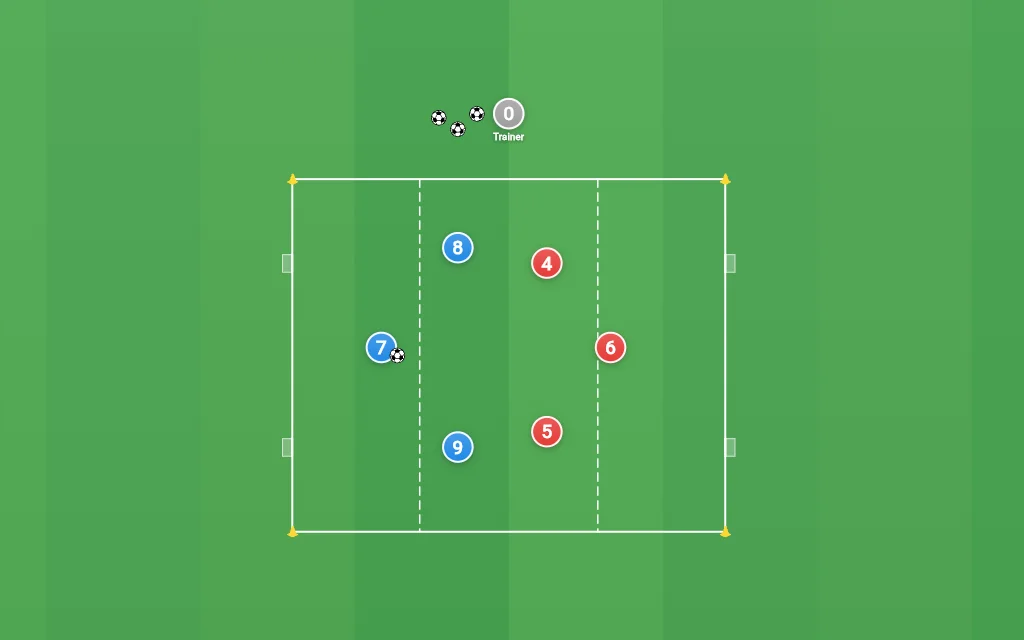
From the bolzn drill library: 3v3 on a Funino pitch with 4 mini goals.
Why it works:
- Four goals force players to lift their head and look for the free goal. That is early training for switching play.
- The shooting zone prevents long shots from the team's own half and rewards dribbling and combination play.
- Three against three is the smallest format that already has width and depth: one child on the ball, one to the side, one in depth.
- No goalkeeper: everyone plays, nobody stands around.
How do I use small-sided games in training?
- Lots of small pitches instead of one big one: with 12 children, two 3v3 pitches are better than one 6v6.
- Short rounds: play for 2 to 4 minutes, have a quick drink, new opponents.
- Rotation: winners move up a pitch, losers move down. That way children play against opponents of a similar level.
- Shout little from the touchline: children should decide for themselves. The coach runs the game and is not a remote control.
- Spare balls at the side of the pitch: if a ball goes out, a new one comes into play straight away.
- Steer with rules: goals after dribbling across the halfway line count double, only low goals count, everyone must have touched the ball once.
How rules, player numbers and pitch size work in general is covered in the article Small-sided games.
What about rondos and positions?
Simple rondos such as 3v1 or 4v1 already work from about age 8, without a touch limit and with free movement (see Rondo in football). Fixed positions as in the positional play of older players, on the other hand, are something children do not need yet. They learn far more in small formats when they are allowed to turn up anywhere on the pitch.
What do critics say?
Some parents and coaches miss league tables, results and the “real” game in small-sided formats. The numbers say otherwise: twice as many actions on the ball, more goals, more moments of success, especially for the weaker children. And there is still competition: every game is won or lost, just in many small games instead of one big one.
You will find more than 80 small-sided games with mini goals and Funino games for all children's age groups in the bolzn football drills.
Sources
- Hintermann, M. et al. (2021). How to improve technical and tactical actions of dominant and non-dominant players in children's football? PLoS One, 16(7), e0254900.
- Akdag, M. et al. (2025). The impact of competition mode and verbal encouragement on physiological, physical, and technical performances in youth football. International Journal of Sports Science & Coaching.
- Capranica, L. et al. (2001). Heart rate and match analysis in pre-pubescent soccer players. Journal of Sports Sciences.
- Katis, A. & Kellis, E. (2009). Effects of small-sided games on physical conditioning and performance in young soccer players. Journal of Sports Science and Medicine, 8, 374–380.
- German FA (DFB) (2024). Wettbewerbsformen im Kinderfußball (booklet); DFB-Trainingsdialog 3 and 4.
- Funino booklets and kids' football materials from the bolzn drill library.