Heading in football: technique, youth guidelines, drills
How to head a football properly, what the FA, U.S. Soccer and the German FA say about heading for children, light balls, a step-by-step progression and drills.
Heading in football: the essentials first
A good header comes from the whole body, not from the head alone. The player watches the ball, braces the trunk and neck and strikes it with the forehead. It is learned with light balls, over short distances and with few repetitions.
With children, less is more. The English FA recommends no heading in training up to and including U11, and deliberate heading in English grassroots matches up to U11 is now being phased out. U.S. Soccer has not allowed heading for players aged 10 and under since 2015. The German FA (DFB) rejects a ban but relies on ultralight and foam balls, few repetitions and small-sided formats in which the ball stays on the ground.
Why heading still matters
In adult football, headers decide many matches: from crosses, corners, free kicks and long throws, and in defence when high balls have to be cleared. Players who can head win aerial duels without endangering themselves or others. Players who never learned it still head the ball in matches, just worse: with their eyes closed, with the top of the head or with a loose neck.
So with youth players, heading practice is mainly about clean technique with low load, not lots of repetitions.
Technique: how do you head a ball correctly?
Standing header
- Watch the ball: track the flight closely, eyes open until contact.
- Load: lean the upper body back from the hips like a drawn bow. Legs slightly bent, feet staggered or level.
- Brace: just before contact, tense the neck and trunk, chin slightly tucked. Head and upper body move as one unit.
- Strike: with the flat part of the forehead, ideally through the middle of the ball. Not with the top of the head, not with the temple.
- Follow through: watch the ball go, upper body swinging towards the target. Mouth closed.
Header with a turn: the player faces the ball and turns the upper body towards the target while snapping forward. The foot on the target side may step back slightly. This is how a cross becomes a header on goal.
Jumping header:
- Two-footed from a standing start when there is no room for a run-up, for example in a direct duel. The arms swing up, the ball is met at the highest point, the landing is soft through the knees.
- One-footed after a short run-up, like a high jump. This gives more height and power. Key point: jump up, not forward, and in time. Whoever gets up first wins the ball.
Most problems, even with experienced players, are not technique faults as such but timing: they misjudge the flight and jump too early or too late.
Common mistakes and corrections
| Mistake | Correction |
|---|---|
| Eyes shut at contact | Practise with light balls from short distances until the fear is gone. "Watch the ball onto your forehead." |
| Ball just bounces off the head | Build the arch and drive the upper body forward actively. |
| Contact with the top of the head | Let the ball come, don't run under it. Forehead faces the target. |
| Loose neck | Tense neck and trunk before contact, chin tucked. |
| Jumping forward instead of up | Take off under the ball, at the highest point of its flight. |
| Jumping too early or too late | Lots of varied throws so players learn to read the flight. |
Heading for children: what the associations recommend
Whether and how much children should head the ball has been debated for years. Long-term effects of frequent heading are still being researched, so associations have set rules as a precaution. These are the three sets of rules mentioned most often:
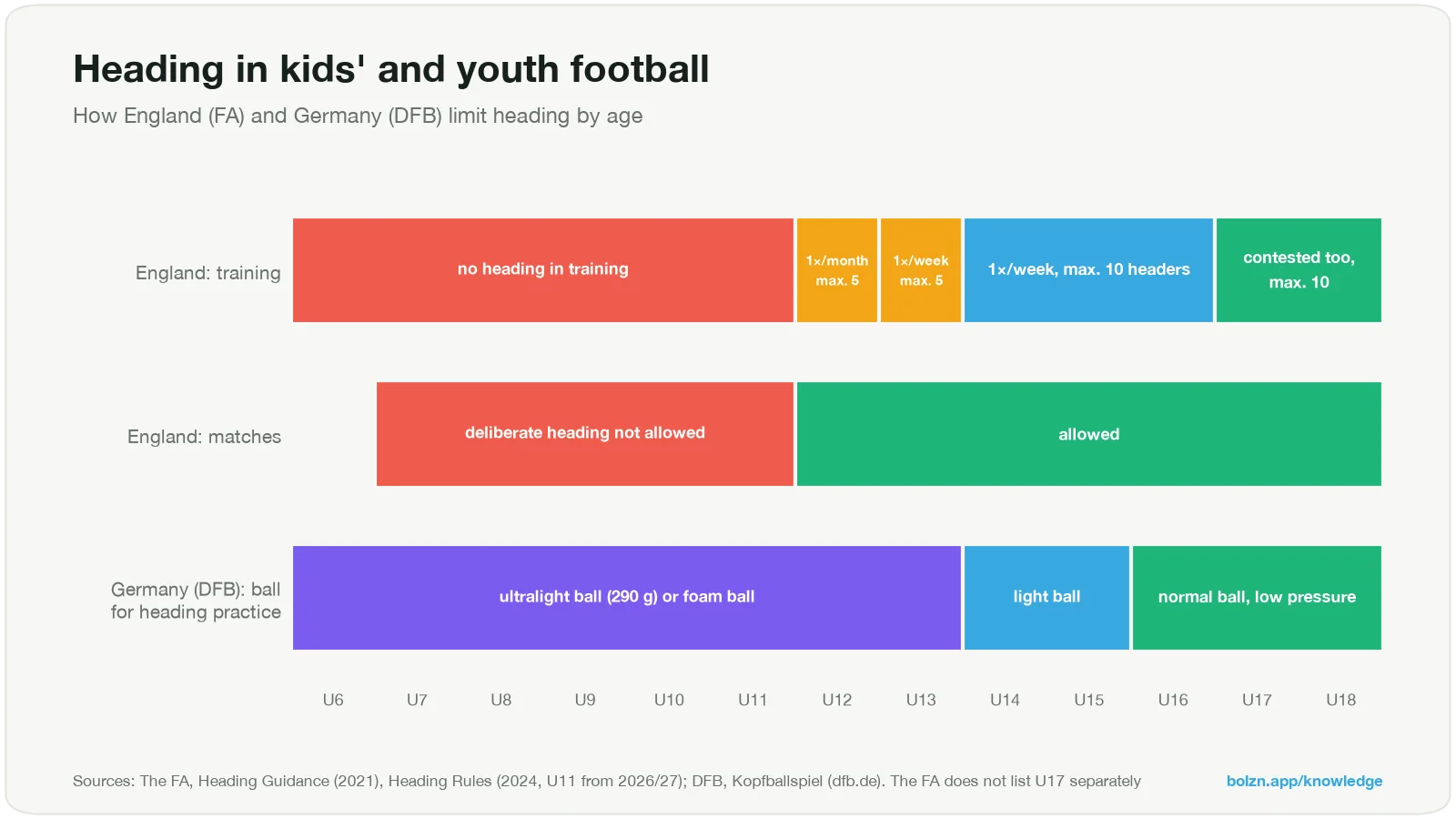
England (The FA), training (guidance from 2020, age table from 2021):
- No heading in training up to U11. Heading should not be introduced in training at this age.
- U12: at most one session a month with at most five headers per player, using light balls, short distances, self-serve and unopposed.
- U13: at most one session a week, still with at most five headers.
- U14 to U16: at most one session a week, at most ten headers per player.
- U18: contested headers are added; the limit of ten headers per session and one heading session per week remains the recommendation. Light balls are still useful for technique work.
England (The FA), matches (decided May 2024): after a trial from 2022, deliberate heading is being phased out of English grassroots youth matches: from 2024/25 at U7 to U9, from 2025/26 also at U10, and from the current 2026/27 season also at U11. A deliberate header gives an indirect free kick. Heading returns in matches at U12. The FA says it will update its guidance as research develops. We could not establish whether the training table has been changed since (as of November 2026).
USA (U.S. Soccer, since 2015): players aged 10 and under do not head the ball in matches or in organised training. From 11 to 13, heading is allowed in matches but limited in training. This is mandatory for the federation's youth national teams and academies and a strong recommendation for all other leagues.
Germany (DFB, as stated on the DFB's heading information page):
- No ban. The DFB considers a training ban the wrong approach, because children still head the ball in matches and in the park, just without learned technique.
- Light balls: in kids' football up to U11, the ultralight size 3 ball (290 g) is used. For heading practice at U10 to U13 the ultralight ball remains, or foam balls and balloons. At U14/U15 light balls, from U16 normal balls at the lowest permitted pressure.
- Few repetitions: build heading sessions up slowly, fewer repetitions over longer distances, no sessions focused on lots of headers. With younger players, throw the ball by hand.
- Weather: drop heading work in wet, cold weather when the ball gets heavy.
- Formats: small pitches, few players and small goals keep the ball on the ground. More in Small-sided games for kids.
- Neck strength: isometric neck exercises belong in training.
As far as we know, the DFB has not published a fixed maximum number of headers per session like the FA does. Check with your own association whether additional rules apply to your team.
Our suggestion for practice: no targeted heading practice up to U11. If you want children to play with high balls, use balloons or soft balls. From U12, introduce the technique in short blocks with light balls and keep numbers low, and only train contested headers from about U16.
Head impacts: recognising concussion
Most head injuries in football are caused not by the ball but by collisions, such as head against head or elbow against head. So heading practice also means teaching players to use their arms legally in aerial duels and to be aware of the opponent.
After a collision or fall, watch for warning signs: dizziness, nausea, headache, confusion, slowed reactions, memory gaps. Then: take the player off immediately, don't bring them back on, and have them checked by a doctor. If in doubt, sit them out. Never play down head injuries, not even in an important match.
A step-by-step progression for heading
This is how heading practice builds up over several sessions, always with a light ball and few repetitions per player:
- Self-serve: throw the ball about half a metre up and head it forward or up again. Goal: eyes open, forehead contact.
- Partner throws: 2 to 4 metres apart, the partner throws softly, the player heads it back into the partner's hands. First standing, then with a lunge step.
- Header to a target: between two cones, into a small goal or onto a partner's chest. Accuracy, not power.
- With a turn: three players in a triangle, one throws, one heads it on sideways to the third.
- Jumping: first two-footed from standing, then one-footed after two or three steps. Meet the ball at its highest point.
- Heading in a game: handball-heading (see below), header on goal from a cross.
- Against opponents: only from about U16, with clear rules for using the arms.
You don't need to run through every stage every year. Players who have the technique only need a few targeted headers in training.
Heading drills
1. Head tennis in pairs (from U12): two players, two small goals 3 to 5 metres apart. The player tosses the ball up and heads it at the partner's goal; the partner catches. Five headers each, then a break. Soft ball, focus on accuracy.
2. Handball-heading (from U12): two teams pass the ball by hand in an area twice the size of the penalty box. Goals only count from a header after a throw. If the ball hits the ground or is intercepted, possession changes. Maximum three steps with the ball. To keep header numbers low: short rounds and a light ball.
3. Throw-in, header, shot (from U14): one player throws in, a second heads it back, then the thrower throws to a third who chests it down and shoots. Rotate after every turn. More on throw-ins in Throw-ins in football.
4. Header from a cross (from U16): a player crosses dead balls from the side of the box, three attackers take the near post, far post and penalty spot. Later a defender joins and heads the balls out and wide. Especially here: few repetitions, breaks, watch for fatigue.
5. Neck strengthening in the warm-up: a partner places a hand lightly on the forehead, back or side of the head; the player pushes against it for five seconds without moving the head. How to fit this into the warm-up is covered in Football warm-up.
How much room a technique focus gets in a session is explained in Planning a training session. For heading: short and regular beats long and rare.
Sources
- The FA (2021). Heading Guidance (age groups U6 to U18), chart on heading frequency in training.
- The FA (2024). New rule introduced to phase out heading in youth football over next three seasons, thefa.com, 17 May 2024.
- U.S. Soccer (2015). Concussion initiative / heading guidelines (no heading for 10 and under, limited from 11 to 13), reported by CBS News, 10 Nov 2015, among others.
- DFB: Kopfballspiel: Alle Infos auf einen Blick (heading: all the facts), dfb.de (ball weights, recommendations, no training ban).
- DFB (2010). Spielend den Kopfball lernen (learning to head through play). DFB info evening 15 for club coaches.
- Bisanz, G. & Gerisch, G. (2012). Fußball: Kondition, Technik, Taktik & Coaching. Meyer & Meyer, chapter on heading.