Throw-ins in football: rules, technique, routines, drills
How to take a throw-in correctly: the law and common foul throws, technique standing and with a run-up, smart throw-in routines and drills for training.
What is a throw-in?
A throw-in restarts play when the ball has wholly crossed the touchline, on the ground or in the air. It is awarded to the team that did not touch the ball last. The ball is thrown with both hands from behind and over the head, from the point where it left the pitch.
The throw-in looks trivial, but it happens dozens of times in every match. Waste it and you give the ball away each time. Use it well and you have a small set piece that can be trained just like a corner.
The throw-in law: what must the thrower do?
Law 15 of the Laws of the Game (IFAB) requires, at the moment of delivery:
- Facing the field of play: the thrower stands and faces the pitch.
- Both feet on the ground, on or behind the line: part of each foot touches the touchline or the ground outside it. A run-up is allowed, but both feet must be down when the ball is released.
- Both hands, from behind and over the head: the ball comes from behind the head and is thrown evenly with both hands.
- From the right spot: where the ball went out.
A few points many players don't know:
- Opponents must stay 2 metres away from the point of the throw. Standing closer or distracting the thrower can earn a caution.
- No goal directly from a throw-in. If the ball goes straight into the opponents' goal, it is a goal kick; into the thrower's own goal, a corner.
- No offside from a throw-in. A player receiving the ball directly from a throw-in cannot be offside, which makes throws near goal interesting.
- No double touch: the thrower may not touch the ball again until another player has. Otherwise the opponents get an indirect free kick.
- No time-wasting: under the current Laws, the referee counts down five seconds if the throw is delayed. If the ball is not in play by then, the throw goes to the opponents.
A foul throw is not retaken; the throw-in goes to the other team.
The most common throw-in mistakes
Most foul throws come from rushing or from trying to throw further than the player can:
- A foot comes off the ground. Typical with a run-up: the back leg swings through and leaves the ground before the ball is released. Fix: just drag the back foot forward, toes scraping the ground.
- The ball doesn't come from behind. The player throws from head height or pushes the ball from in front. Fix: take the ball well behind the head until the elbows are slightly bent.
- One hand does the work. The ball spins off sideways because one hand pushes harder. Fix: both thumbs and index fingers behind the ball, fingers spread like a fan.
- The thrower is on the pitch. Both feet are in front of the line. Fix: a quick look down before throwing.
- Too slow. The team waits until everyone is organised, and so does the opponent. A quick throw to a free team-mate is often the best one.
In German kids' football a foul throw is treated leniently: up to U9 it is not penalised, at U10/U11 it may be retaken after an explanation. In the German small-sided formats on mini goals there are no throw-ins at all; players dribble or pass the ball in. Other countries have their own rules for the youngest age groups, so check your league handbook. Details for Germany are in the article on pitch sizes in youth football.
Technique: the standing throw-in
The standing throw is the basic form and the safest for short, accurate throws:
- Stance: feet shoulder-width apart, side by side or slightly staggered, toes and eyes towards the target.
- Grip: fingers spread around the back and sides of the ball, thumbs and index fingers forming a triangle behind it. Wrists bent back.
- Backswing: take the ball well behind the head, bend knees and ankles slightly, push the hips forward. The whole body arches back like a bow.
- Throw: from this arch the upper body whips forward, legs and trunk extend, the arms bring the ball over the head and push it forward with the palms.
- Follow-through: the body stretches up onto the toes, arms following the ball. Both feet stay on the ground until the ball has left the hands.
The power comes from the legs and trunk, not the arms. Throwing with the arms alone means short throws and foul throws.
Technique: the throw-in with a run-up
For long throws the player takes a few steps of run-up:
- Run-up: ball in both hands in front of the body, a few steps straight towards the line.
- Plant step: in the last two steps the ball goes behind the head. The front foot plants heel first, toes pointing in the direction of the throw.
- Arch: hips forward, upper body back, knees slightly bent.
- Throw: the upper body whips forward, the back leg is drawn up towards the front one, toes dragging along the ground. The arms swing right through.
The run-up adds distance but also mistakes. Only once the standing throw is reliable is it worth practising with a run-up.
Throw-in routines: how to use the throw-in tactically
A throw-in is only as good as the movement around it. If everyone stands still next to their marker, all that's left is a throw into the crowd. Four basic patterns help:
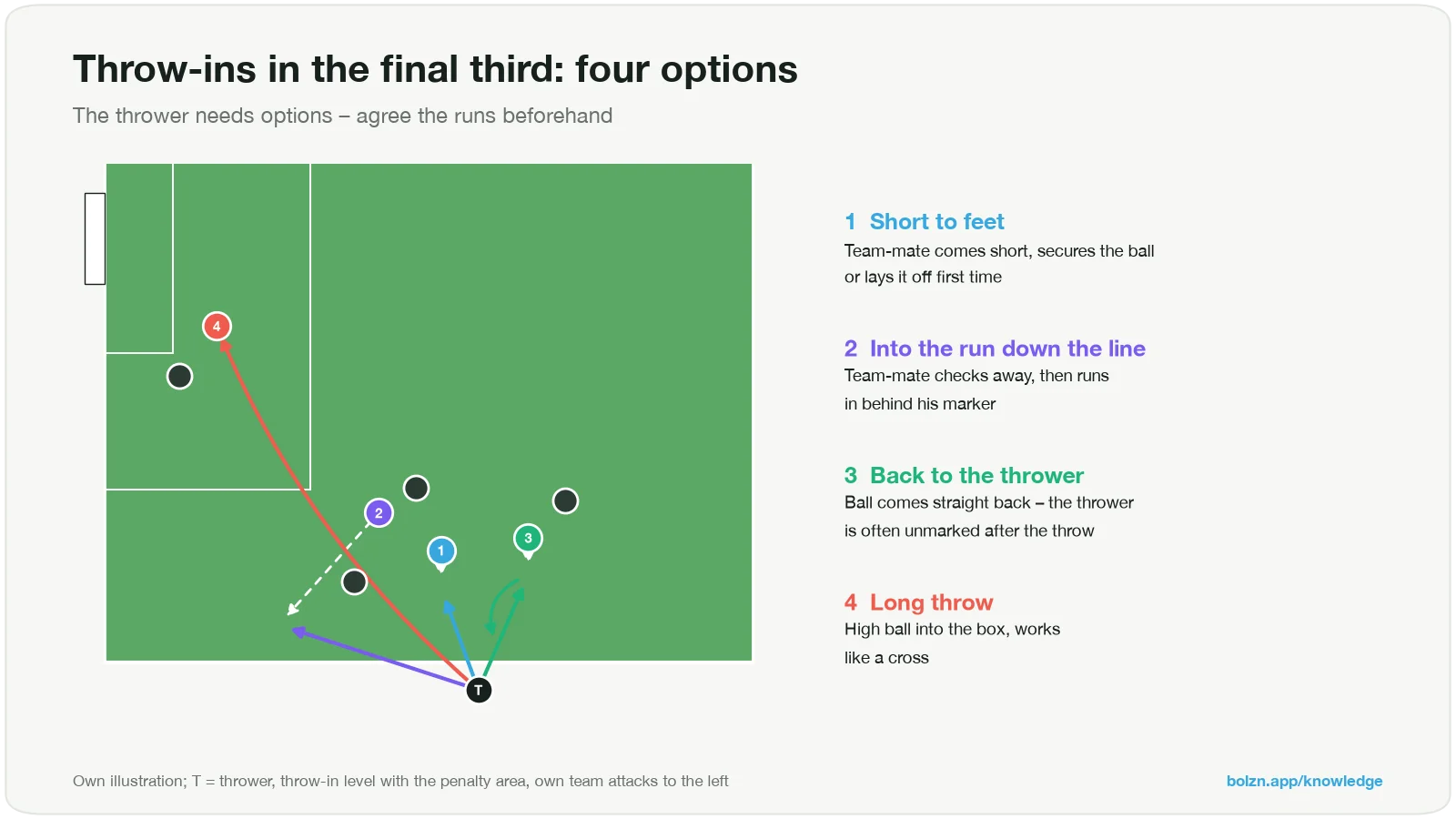
- Short to feet: a team-mate comes towards the ball, receives it low to the feet or on the chest and secures it. The safest option, especially in your own half.
- Into the run down the line: a team-mate pretends to come short, then spins in behind the marker along the line. Because there is no offside from a throw-in, this works even level with the last defender.
- Back to the thrower: the ball goes short and comes straight back. The thrower is often unmarked after the throw because nobody picks him up.
- Long throw: near goal, a long throw works like a cross. A tall player at the near post flicks it on, the others attack the space behind.
More tips:
- Throw quickly while the opponent is still disorganised.
- Move before the throw: team-mates start their movement once the thrower is ready, moving away first and then coming short. That creates space.
- Receive half-turned: whenever possible the receiver turns forward with the first touch.
- When in doubt, forward down the line: losing the ball far from your own goal hurts less than a square throw into the middle.
- Agree on routines: one or two fixed patterns per zone are enough. Then everyone knows who runs where.
How do I train throw-ins?
You don't need to drill throw-ins for hours. A few minutes in suitable drills are enough, because the technique is quick to learn. It's best to build throw-ins into other drills rather than practising them in isolation.
1. Throw and receive in pairs (warm-up): two players, 8 to 10 metres apart. One throws, the other controls and plays it back: with the foot, thigh, chest or head. Swap roles after ten throws. The partner checks the throw is legal. Fits well into a warm-up with the ball.
2. Long-throw contest: who throws furthest with a legal throw? First standing, then with a run-up. Foul throws don't count. Short, motivating and quickly shows who lifts a foot.
3. Throw-in, passing combination and shot: on a pitch of about 30 × 25 metres with a goal and goalkeeper. The thrower throws to a team-mate, who controls and plays it back. The thrower passes to a second player, who lays it first time into the run of a third player, who finishes. Then everyone rotates one position. Variations: receive on the chest or thigh, return first time, add a defender at the reception.
4. Throw-in and header (from about U12): a thrower throws high to a team-mate who heads it back, then to a second player who chests it down and shoots. The throw replaces the cross here because it controls the flight of the ball precisely. Keep the number of headers low with children and youth players, see Heading in football.
5. Train throw-ins in the game: in a final game on a normal pitch, a team scores a point for every throw-in after which it keeps the ball for at least three passes. Or: every time the ball goes out, the throw is taken at the halfway line and the team must play its agreed routine. That turns theory into habit. How to steer a game with rules like these is explained in Small-sided games.
Coaching points: both feet down? Ball from behind? Are team-mates moving before the throw? Has the receiver opened up towards the pitch?
Throw-ins in kids' and youth football
With young children, the throw-in doesn't need to be a big topic. In the formats for the youngest players the ball is dribbled or passed in, so the kids spend more time with the ball at their feet. Once they move to bigger pitches, throw-ins come in. Then a few throws in the warm-up and clear pointers in the game are enough.
From around U12 it pays to practise one or two simple routines, such as coming short followed by a run in behind. From U14 onwards, long throws near goal become a weapon for players with enough core strength.
Many more drills with throw-ins are in the bolzn drill library.
Sources
- IFAB: Laws of the Game, Law 15 (The Throw-in), current version at theifab.com.
- Thiessen, P. (2021). Der Einwurf im Fußball (The throw-in in football). Institute of Sports Science, University of Koblenz-Landau, KNSU (CC BY-SA 4.0).
- Hrubesch, H. (2010). Einwurf-Zuspiele I. DFB training session for U12–U15.
- Annahme von Einwürfen und Passkombination bis zum Torschuss (receiving throw-ins and passing combination to a shot). Drill sheet.
- DFB: Jugendordnung (youth regulations), Annex IV, and Wettbewerbsformen im Kinderfußball (kids' competition formats).