Running drills in football: exercises, set-up and benefits
Running drills (running ABC) in football: the key exercises from fast feet to build-up runs, common mistakes, dosage and variations with the ball.
What are running drills (running ABC)?
Running drills, also known as the running ABC (German: Lauf-ABC), are a collection of running exercises that emphasise individual parts of the running movement: the push-off from the foot, the knee lift, the heel recovery, the arm action. Typical exercises are fast feet, high knees, heel flicks, power skips, side shuffles, carioca and backwards running. In football, running drills usually belong in the warm-up: after the initial jog and before the fast parts of the session.
To be honest: there is no evidence that running drills on their own make sprints faster or prevent injuries. What is proven is that structured warm-up programmes with a running part, such as the FIFA 11+, reduce injuries considerably. Running drills are a good building block within them, because they prepare muscles and joints dynamically, train coordination and prepare for speed.
The most important exercises
| Exercise | Movement | Watch for | Typical mistake |
|---|---|---|---|
| Ankling | very small, quick steps, from the ankle only | knees almost straight, heel does not touch the ground | movement comes from the knee |
| Fast feet (low knees) | small steps with a slight knee lift, high frequency | powerful push-off from the forefoot, arms swing along | landing on the whole foot |
| High knees | lift the knees to about horizontal | upper body upright, foot lands under the body | leaning back, hollow back, knees above horizontal |
| Heel flicks (butt kicks) | pull the heel quickly to the buttocks | thigh stays vertical, on the forefoot | knee drifts forwards |
| Power skips | powerful push-off, knee and opposite arm swing up | land softly, body extends | arms hang |
| Side shuffle | hop sideways, feet do not close completely | hips low, eyes forward | feet knock together |
| Carioca | run sideways, legs cross in front and behind | upper body still, only the hips rotate | upper body rotates too |
| Backwards running | small, quick steps backwards | slightly bent, look over the shoulder | steps too big, leaning back |
| Build-up run (strides) | build up over 30–50 m from an easy jog to 80–90 % | leaning slightly forward at first, then upright | sprinting flat out right from the start |
How do I set up the running drills?
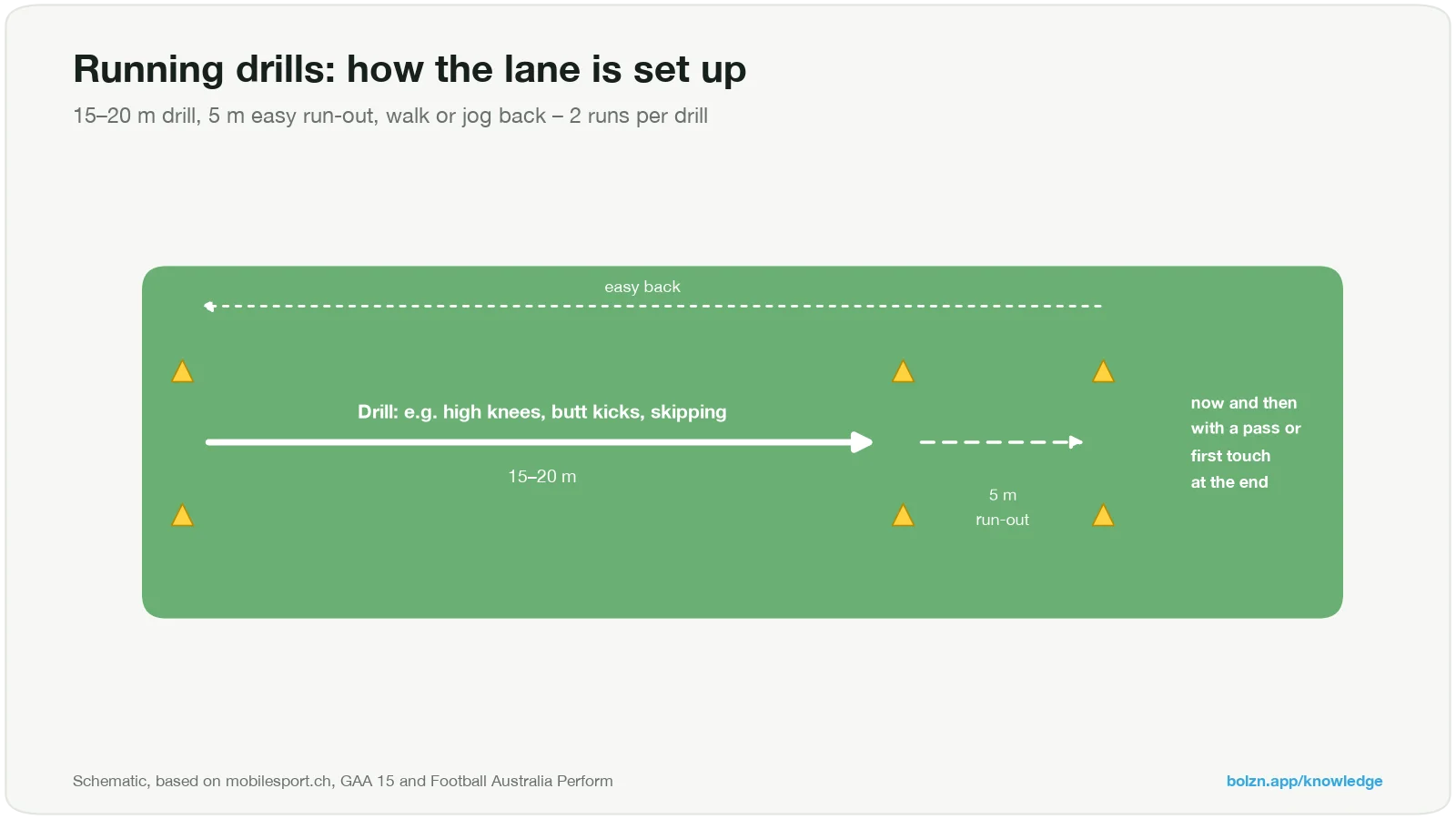
- Distance: 15 to 20 metres per exercise, then ease off over a few metres.
- Back: walking or at an easy jog.
- Runs: 2 per exercise, 6 to 8 exercises in total. That takes about 6 to 8 minutes.
- Order: from slow and small to fast and big, for example ankling, fast feet, heel flicks, high knees, power skips, side shuffles, carioca and build-up runs to finish.
- Quality before quantity: Better a few exercises done cleanly than many done sloppily. Learn new exercises slowly first, at a walk or on the spot.
How running drills fit into a complete warm-up is covered in the article Warming up in football. Before a match, many professional teams use a short block of running drills in two groups, see Pre-match warm-up.
Running drills with the ball
Footballers prefer doing something with the ball. Three proven variations:
- Lane with a dribbling partner: Two lanes, pairs face each other. While one player crosses to the other side doing a running drill, their partner dribbles towards them in the neighbouring lane. They go around each other in the middle, then swap roles.
- Running drills to passing zones: Several short running stations, each ending with a pass. Receive, play it back, move on to the next station. The passes get longer with each round.
- Running drills with a sprint start: At the end of the lane, sprint to the ball on a call and shoot at goal.
This turns a compulsory exercise into part of football training, and the players see the link to their movements in the game.
And the agility ladder?
The agility ladder is popular, but studies with youth footballers found no additional effect on sprinting, agility or dribbling compared with normal training. It does no harm and many enjoy it, but it should not take up much training time. If you use it, build in an action with the ball or a sprint at the end. Cones or poles do the job just as well.
Running drills for children
For children, running drills are above all coordination training. Instead of rigid lines, games work well: animal walks (hare, frog, stork), running on command, tag games with a set way of running. The movements are the same, just wrapped in stories. Correct mistakes sparingly; enjoying movement comes first. You can find good warm-up games for children in the bolzn football drills.
Common mistakes in running drills
- Distances too long: From about 30 metres, technique suffers.
- Too much too soon: Clean first, then fast.
- No explanation: Players do it better when they know what the exercise is for, for example "heel flicks help you pull the leg back quickly in the sprint".
- No finish at speed: Running drills should be followed by build-up runs or short sprints, otherwise the preparation for the fast game is missing.
Sources
- mobilesport.ch (BASPO): Laufschule – Das Lauf-ABC als Grundlage and Running – Good Practice: Lauf-ABC.
- Football Australia: Perform Warm-up; GAA: GAA 15 Warm-Up.
- Warm-up and training sessions from the bolzn drill library (including a German FA (DFB) training session Ü20, SC Freiburg "Lauf-Koordinations-Schulung mit Pass-Zonen", West Ham United Pre-Match Warm-Up).
- Soligard, T. et al. (2008). Comprehensive warm-up programme to prevent injuries in young female footballers. BMJ, 337, a2469.
- Haugen, T. et al. (2019). The training and development of elite sprint performance: an integration of scientific and best practice literature. Sports Medicine – Open.
- Padrón-Cabo, A. et al. (2020, 2021). Studies on agility ladder training in youth footballers (sprint, agility, dribbling).
- Rumpf, M. C. et al. (2012). Effect of different training methods on running sprint times in male youth. Pediatric Exercise Science.