Building out from the back against a press
How goalkeeper, centre-backs and holding midfielders play out against a press, get past the first line of pressure and when the long ball is the better option.
How do I build up against a press?
You build up against a press by making the pitch wide and deep, moving the ball quickly and on the ground through several players and looking for the pass behind the opponent's first line. Every pass that gets past a pressing opponent takes him out of the game. A team that only plays square and backwards invites the press, because a back pass is often the opponent's signal to go.
If building up fails, the long ball is no shame but a solution. What matters is that the team knows when to play short and when to go long.
The shape in build-up
What the build-up looks like depends on your own formation and on how the opponent presses. Some principles apply almost always:
- Centre-backs wide: they split almost as wide as the penalty area, open to the pitch. The opposing striker has long distances to cover and cannot block both.
- Full-backs high and wide: they stand roughly level with the holding midfielders on the touchline. This forces the opponent into long runs when play is switched.
- Holding midfielders behind the first line of pressure: they offer themselves behind the opposing strikers, not in front of them. A pass to a midfielder standing in front of the strikers takes nobody out of the game.
- Height in attack: strikers and wingers stand level with the opponent's back line. That pushes the line back and creates space between the lines.
- Goalkeeper as an extra player: with the goalkeeper, the build-up has a numerical advantage. He has to be comfortable on the ball and always available.
What does the centre-back do on the ball?
The centre-back is often the first to make decisions. Three basic rules:
- Carry the ball when there is space. As long as no opponent comes near, he dribbles forward. This forces an opponent to close him down. That player is then missing elsewhere, or a passing lane opens in the centre.
- Depth before width. First he looks forward: is a pass into the striker, to a winger who has moved inside or to the midfielder behind the first line possible? Only then comes the pass sideways.
- Play against the opponent's shift. When the opponent shifts towards the ball, a pass in the same direction is often too slow. Playing back to the other centre-back, who then has space for a sharp pass forward, can be better than the pass to the closed-down full-back.
Passes that break a line should be firm and on the ground, ideally with the instep. A slow pass gives the opponent time to shift.
How do midfielders and wingers get out of the cover shadow?
A pressing opponent positions himself so that a cover shadow forms behind him, where no pass can arrive. Whoever stands in the shadow cannot receive. Players without the ball therefore have to keep moving:
- The near-side holding midfielder stays high and joins in when the ball goes wide or into the striker.
- The far-side holding midfielder drops away from his opponent and offers himself between the two opposing strikers.
- The winger moves inside into the gap between the opposing winger and holding midfielder. He is only free there for a moment and can only be reached with a firm pass.
- The player on the ball should always have at least two options, a short one and a deep one.
The opposing winger is caught in a dilemma: if he closes the passing lane inside, he is too late on the full-back. If he goes towards the full-back, the pass inside opens. A good build-up looks for exactly this dilemma.
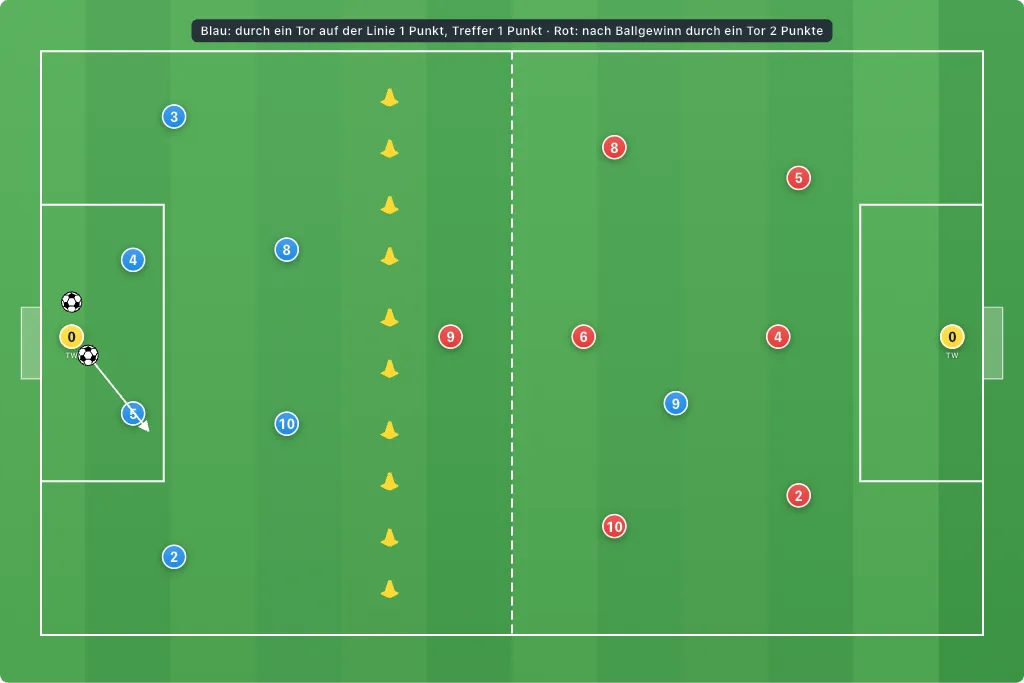
From the bolzn exercise library: five goals in a line – getting through a goal with a pass or a dribble means the first line of pressure is broken.
Pushing up after the pass in behind
A successful pass through the first line is only the start. The receiver often has his back to goal and needs help:
- Every player who has been bypassed pushes up, including the passer. The receiver then has options for a short lay-off that can be played forward again.
- The holding midfielder moves into an open position so he can play a laid-off ball forward at once.
- The full-back pushes up on the wing that has opened up.
- The back line moves up too, so the distances between the lines stay small. If the ball is lost, the team is close enough together to counter-press immediately.
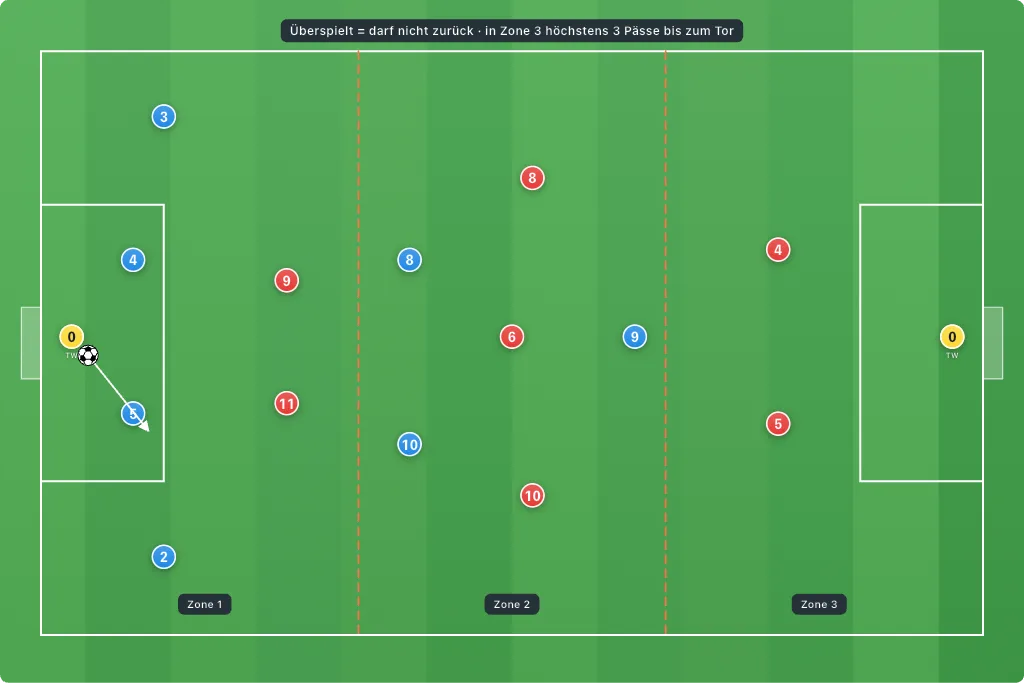
From the bolzn exercise library: build-up through three zones – whoever is bypassed may not go back, in the last zone at most three passes to the shot.
When is the long ball better?
Not every opponent can be played through on the ground, and not every team is technically ready for it. The long ball makes sense when:
- the opponent has blocked all short options and presses high with many players, because then there is a lot of space behind his defence,
- your team has a strong target player who holds up or flicks on high balls,
- the risk of losing the ball at your own box is too high right now, for example on a poor pitch or in the wind.
The key is the second ball: team-mates position themselves around the target player so they can win the cleared or laid-off ball. A long ball without players pushing up is usually just a lost ball.
How do I train the build-up?
- Positional rondos: players stand in the positions of their own formation and practise distances, triangles and the pass behind the first line. More in Positional play.
- Back four against two strikers: the goalkeeper starts, the defence plays forward against two pressing strikers. A point counts when a defender dribbles into a target zone with the ball.
- Build-up against a block: one team builds up from the goalkeeper, the other presses. A pass or dribble through a marked line counts, the opponent counters after winning the ball.
- Zone game with a push-up rule: whoever is bypassed may not go back. This creates an overload in the next zone, and players learn to push up.
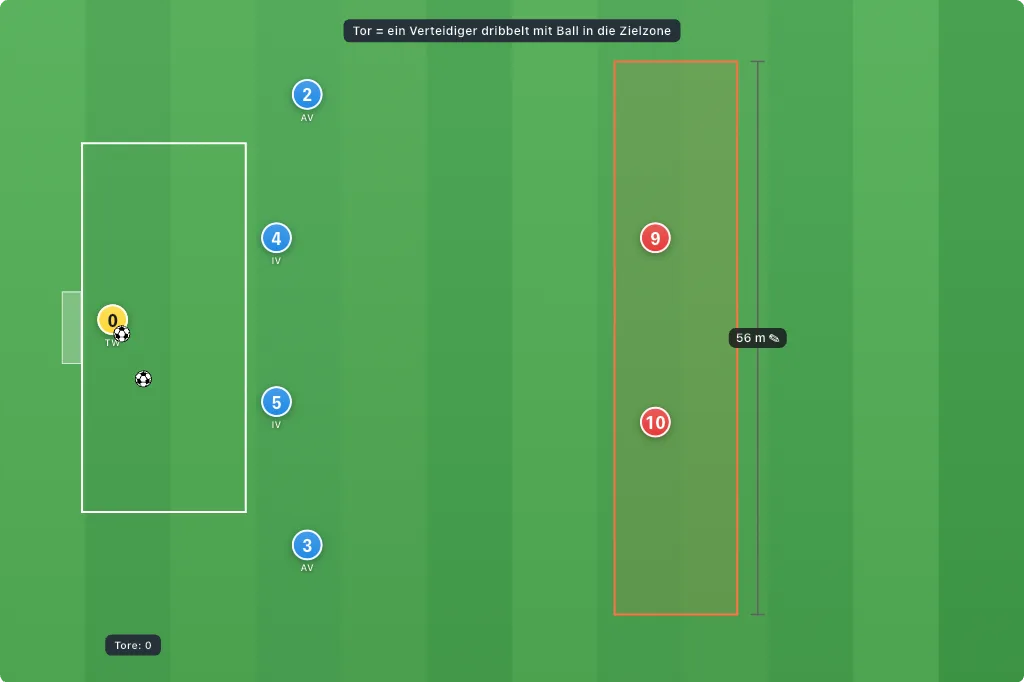
From the bolzn exercise library: the back four plays into the target zone – against two strikers.
Coaching points: open body shape when receiving, a look over the shoulder beforehand, pace on the pass, offer again after every pass. And: mistakes in build-up are part of learning. A team that goes long after every lost ball never learns to build up.
How the opponent presses and what he is waiting for is explained in Pressing in football. Build-up drills for all age groups are in the bolzn football drills.
Sources
- Bund Deutscher Fußball-Lehrer: International Coaches Congress 2013, practical session on build-up play (4-2-3-1 against a midfield press from a 4-4-2).
- Bund Deutscher Fußball-Lehrer: International Coaches Congress 2014, practical session by Wück: passing drills derived from positional play, pushing up.
- Drills from the bolzn exercise library (five goals in a line, build-up through three zones, back four plays into the target zone, long ball to the nine).