Positional play: rondos and games for your own system
Positional play in football: use positional rondos and small-sided games to bring pictures from your own system into training – from 4v2 to 8v8.
What is positional play?
Positional play (Spanish juego de posición) is a playing idea in which the team moves the ball forward through good positions rather than long runs: the players occupy the pitch so that there is always an overload around the ball, triangles and diamonds offer passing options, and passes break the opposition's lines. The idea became well known through Johan Cruyff, Louis van Gaal and Pep Guardiola.
In training, positional play is practised with positional rondos and positional games. Unlike in a normal rondo, the players do not stand anywhere around the edge but in the positions they also play in a match. That way they see in training exactly the pictures they will meet again at the weekend.
From the rondo to the positional rondo
A normal rondo trains ball control, passing and awareness. A positional rondo lays your own formation on top of it:
- Build-up 4v2: goalkeeper, two centre-backs and the number 6 against two pressing strikers. The aim is to beat the press with the pass through the gap to the number 6.
- Midfield 4v2: number 6s and number 8s against two opponents, the aim is the pass in behind to the striker.
- 5v3 with a switch of play: the ball is kept on one side until the other side opens up.
- Positional rondo with a finish: after three to five passes, out to the wing and a 3v2 towards goal.
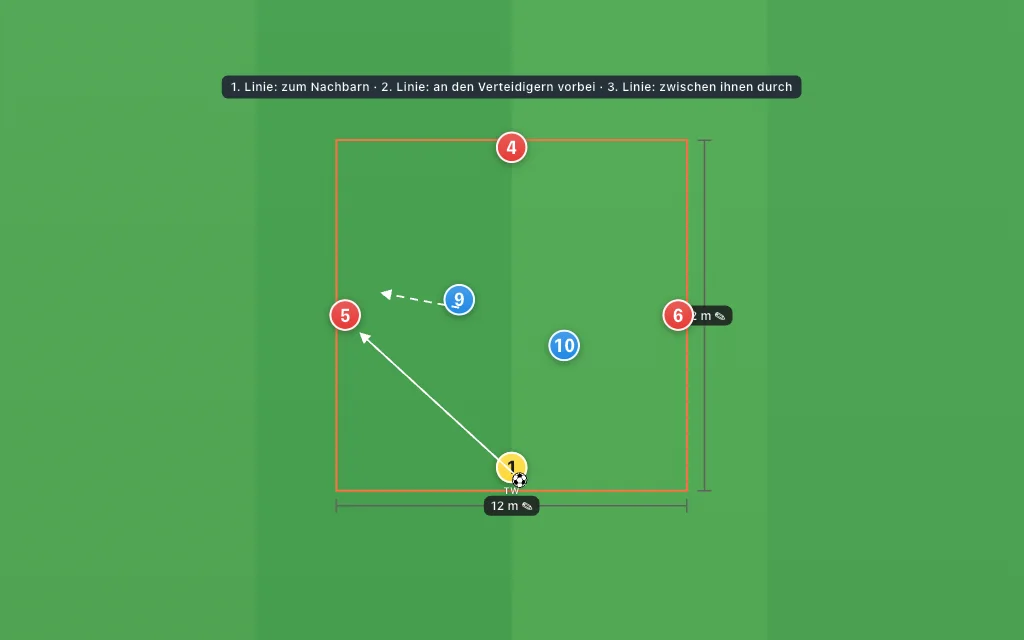
From the bolzn drill library: build-up rondo 4v2 – goalkeeper, centre-backs and number 6 beat the press with the pass through the gap.
The basic principles
- Create an overload around the ball: one player more in the zone of the ball, through positions, floaters or a number 6 dropping out of midfield.
- Occupy and break lines: players stand between the opposition's lines. The pass through the line (in the rondo the “third passing line”) is the most valuable one.
- Width and depth: wide players hold the width, strikers the depth, so that the opponent is stretched.
- Move the opponent, not the ball: possession is not an end in itself. Passes should draw opponents in and open up space behind them. Pep Guardiola is often quoted along these lines: it is not about moving the ball, but about moving the opponent.
- Win the ball back immediately after losing it: because the players are close together, the team can apply pressure straight after losing the ball.
How big does the pitch need to be?
This is where a common mistake lies. Studies show that typical training pitches offer less than 150 m² per player, while in a match it is around 320 m². Only at a match-realistic pitch size do the distances between the players match those in a match.
For positional play this means:
- Rondos and small positional games can be tight. They train technique and decisions under pressure.
- Team-tactical games (7v7 to 11v11) need a big pitch, otherwise the players learn the wrong distances.
How pitch size and player numbers work is covered in detail in the article Small-sided games.
Example: 8v8 positional game
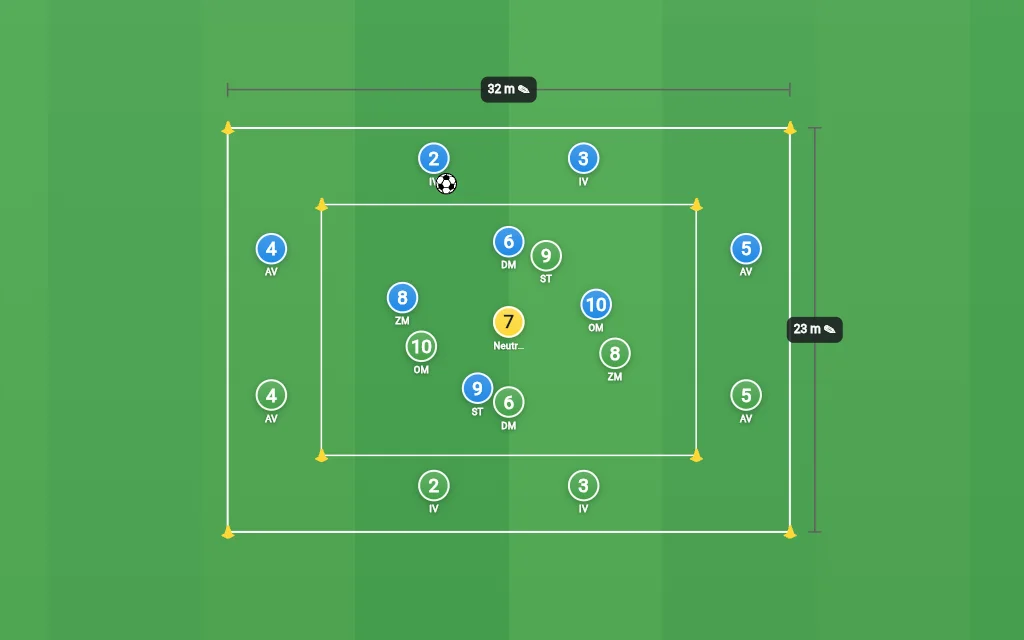
From the bolzn drill library: 8v8 positional game plus a neutral player with wide zones.
In bigger games like this 8v8 the players stand in their basic formation. Wide zones in which only one player is allowed force width. A neutral player creates an overload in possession. This produces situations like those in a match, but more often and with more touches.
Does positional play suit every team?
Not every team wants to keep the ball for long. If you mainly rely on counter-attacks or long balls, you need different games: transition games, games with quick finishes or zone games with runs in behind. The core stays the same, though: the game should show pictures from your own play. For a counter-attacking team those are simply ball wins and quick routes to goal.
For children up to about 12, positional play comes too early. They learn in small formats such as 3v3 and Funino, where they decide freely and do not have to stick to positions (see Small-sided games in kids' football).
Common mistakes
- Possession without a purpose: a hundred passes without breaking a line achieve nothing. Award points for passes through the line.
- Positions too rigid: positions are a guide, not shackles. Players should be allowed to swap spaces as long as the basic formation holds.
- Pitch too small for team tactics: wrong distances, wrong pictures.
- Forgetting to counter-press: whoever loses the ball reacts immediately.
You will find positional rondos and small-sided games for your system in the bolzn football drills, and you can draw up moves in the tactics board and show them to your team.
Sources
- Rondo and positional play booklets from the bolzn drill library (including 4-3-3 Positional Soccer Rondo; positional rondos 1-4-3-3; 8v8 as a stepping stone to the 4-3-3).
- DiBernardo, M.: The Science of Rondo.
- Olthof, S. B. H. et al. (2018). Match-derived relative pitch area changes the physical and team tactical performance of elite soccer players in small-sided soccer games. Journal of Sports Sciences.
- Olthof, S. B. H. et al. (2019). A match-derived relative pitch area facilitates the tactical representativeness of small-sided games for the official soccer match. Journal of Strength and Conditioning Research.
- Nunes, N. A. et al. (2026). Analysing the influence of numerical imbalance on individual tactical behaviour. Journal of Sports Sciences.
- Asian-Clemente, J. A. et al. (2025). Different sizes of position games and official matches in youth professional soccer players. Biology of Sport.