Football formations: 4-4-2, 4-3-3 and 3-5-2 compared
Which formation suits your team? Strengths, weaknesses and player profiles of 4-4-2, 4-3-3, 4-2-3-1 and 3-5-2, and how to coach them in training.
What is a formation?
A formation, or playing system, is a team's basic shape: how many players are in defence, midfield and attack. The numbers are read from back to front, the goalkeeper is usually not counted. 4-4-2 means four defenders, four midfielders and two strikers. Some coaches add the goalkeeper (1-4-4-2), it means the same.
There is no best formation. A formation has to suit the players you have and the way you want to play. On top of that, no formation stays rigid during a game. A 4-3-3 often defends as a 4-5-1, a 3-5-2 as a 5-3-2, and in possession full-backs push up and holding midfielders drop. The numbers describe the starting point, not every situation.
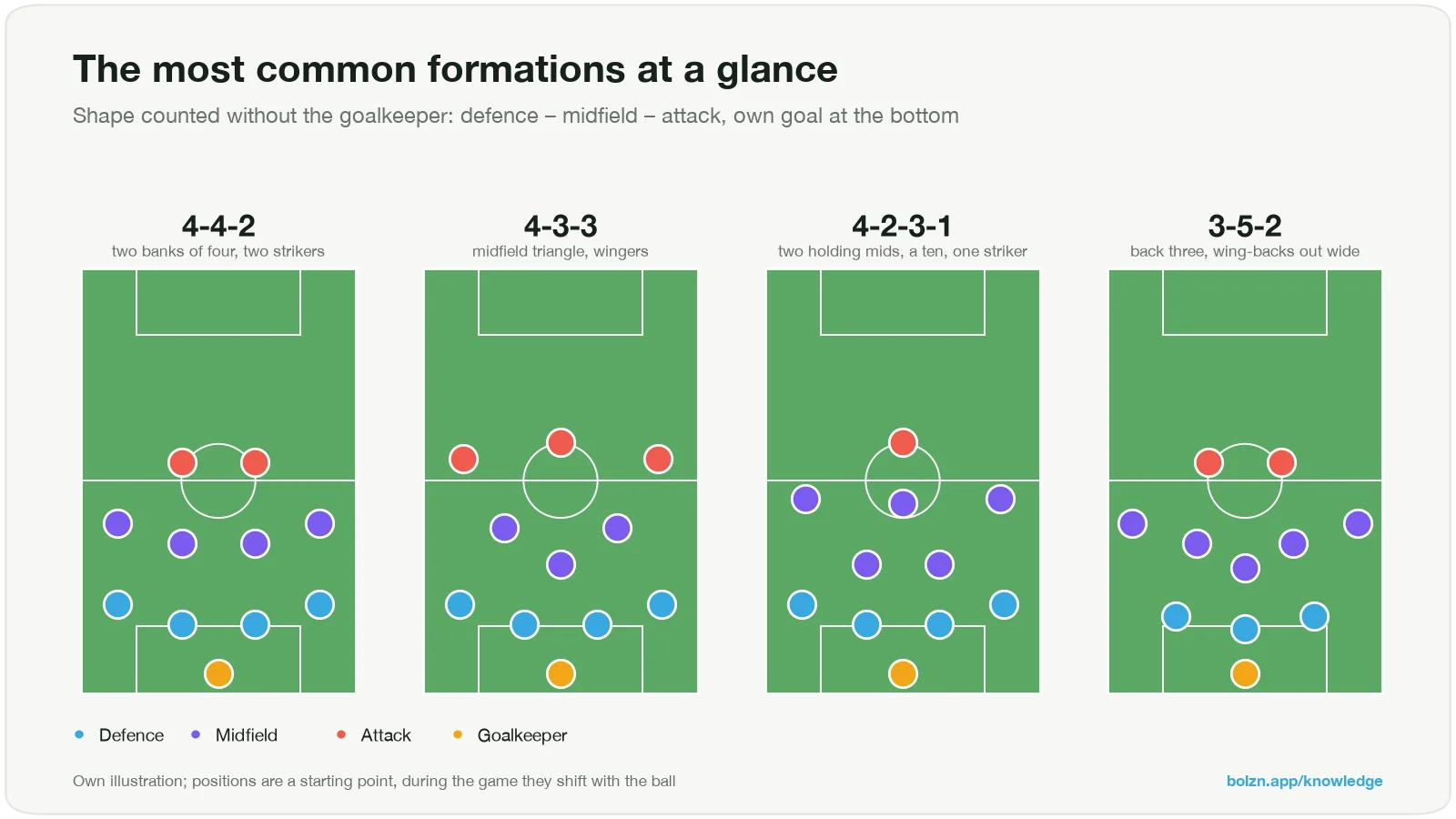
The most common formations compared
| Formation | Strengths | Weaknesses | What it needs |
|---|---|---|---|
| 4-4-2 | Simple, clear roles. Two compact banks of four defend space well. Two strikers can press together | Often two against three in central midfield. Few players between the opponent's lines | Disciplined wide players who track back, and two strikers who complement each other |
| 4-3-3 | Width from two wingers, triangles in midfield, three players for a high press | Wingers who don't track back leave their full-backs exposed. The single holding midfielder can be overrun | Fast, hard-working wingers and a holding midfielder who is good on the ball |
| 4-2-3-1 | Stable thanks to two holding midfielders, the number ten occupies the space between the lines. Easy to switch to 4-4-1-1 or 4-3-3 | The lone striker is often isolated. The number ten has to work without the ball | A striker who can hold the ball up and a creative number ten |
| 3-5-2 | Three centre-backs against two strikers, a strong centre, two strikers | The wing-backs have to run a huge amount. Space opens up behind them. Often drops deep as a 5-3-2 without the ball | Two wing-backs with great endurance and centre-backs who can also build up play |
A Premier League study compared 4-4-2, 4-3-3 and 4-5-1. Overall, players covered similar high-intensity distances in all three formations. Strikers in a 4-3-3, however, did around 30 percent more high-intensity running than in the other formations, and the pass completion rate was highest in the 4-4-2. So a formation mainly changes who has to do how much work.
What should I consider when choosing?
- Players first. If you have two real strikers, a 4-4-2 or 3-5-2 makes sense. If you have fast dribblers out wide, a 4-3-3 fits. A formation you lack the players for makes everyone worse.
- Think with and without the ball. For each formation, consider how it looks in possession and how it looks out of possession. Who presses whom, who fills the gap when a full-back has pushed up?
- Look at the opponent. Against two strikers, a back three gives you an extra player. Against a back three, it pays to press with three players.
- Distances matter more than numbers. Whether 4-4-2 or 4-3-3: a team with big holes between the lines defends badly in any formation. How the defence stays together is explained in Back four: shifting, stepping out and covering.
- Don't change too often. Players need weeks until the patterns are automatic. One fixed formation with small adjustments achieves more than a new one every week.
Formations in youth football
With children, formations are not the main focus. Up to about U11, children should get to know all positions and rotate instead of being fixed to one position early. What matters is that they spread wide and deep and don't all chase the ball.
- 7 v 7 (U10/U11): common shapes are 2-3-1 or 3-2-1. The 2-3-1 gives clear roles: two defenders who shift together, three midfielders for width and one striker who stays high when defending and is available after the ball is won.
- 9 v 9 (U12/U13): lines can already be built here, for example with three defenders, three midfielders and two strikers. Smaller games with the same basic idea also prepare a later 4-3-3.
- 11 v 11: from U14/U15 on the full-size pitch in Germany. Now formations, lines and pressing really matter.
Which pitch sizes and team sizes apply at which age is covered in Pitch sizes in youth football.
How do I coach a formation?
- Explain and show. Players understand a formation faster when they see it. A tactics board with your own positions helps, especially with the question: where do I stand when the ball is on the other side?
- Shadow play: the team stands in its shape without opponents. The coach places the ball in different spots or passes it with a helper, and the team shifts together. Slowly at first, then at match speed.
- Positional rondos: a rondo in which the players stand in the positions of their formation. They learn distances and passing lanes that appear again in the game. More in Positional play.
- Small-sided games in the team shape: 8 v 8 or 9 v 9 with zones in which players have to hold their positions.
- Practise pressing and build-up in the formation. Who presses whom, who covers? How does the team play out from the goalkeeper? See Pressing in football and Building out from the back against a press.
- Freeze the final game. After a mistake, call "Stop!", everyone freezes, and the team sees for itself where the gap is.
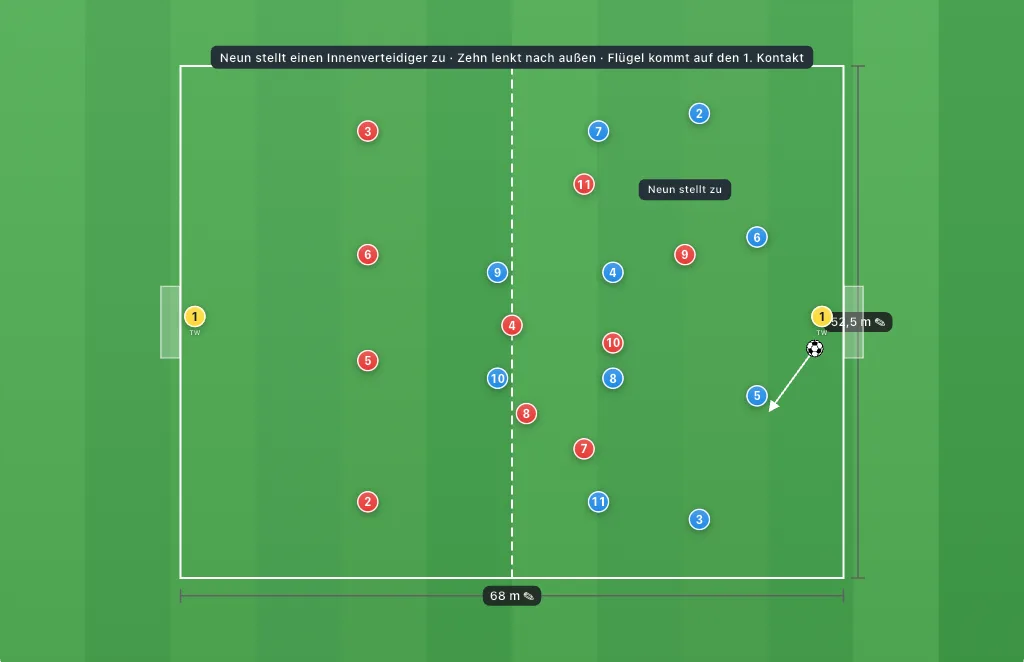
From the bolzn exercise library: pressing in a 1-4-2-3-1 against a 1-4-4-2 – two formations meet.
Small-sided games and drills for every formation are in the bolzn football drills. With the tactics board in the app you can show your team its own shape, in 3D as well.
Sources
- Bradley, P. S. et al. (2011). The effect of playing formation on high-intensity running and technical profiles in English FA Premier League soccer matches. Journal of Sports Sciences, 29(8), 821–830.
- Bund Deutscher Fußball-Lehrer: International Coaches Congress 2013, practical session on build-up play (4-2-3-1 against 4-4-2).
- U9/U10 Systems of Play (7v7), coaching material on the 2-3-1.
- DFB youth regulations: age groups, team sizes and pitch sizes.
- Drills from the bolzn exercise library (positional rondos, 8 v 8 as a step towards 4-3-3, pressing in a 1-4-2-3-1).