Transitions in football: counter-attack and counter-press
What has to happen after winning or losing the ball: transition moments, types of counter-attack, counter-press or drop off, and drills to train it.
What are transitions in football?
Transitions are what a team does in the first seconds after winning or losing the ball. After winning it, the team switches to attack and looks for a quick way to goal before the opponent can organise. After losing it, the team switches to defence: it tries to win the ball back immediately or drops back quickly.
Why this matters so much: in these moments the opponent is briefly disorganised. His players are still positioned as if they had the ball, or as if they had to defend. A study from the Norwegian top division showed that counter-attacks against an unbalanced defence were more effective than slow, elaborate attacks. In the Bundesliga, successful teams won the ball back faster after losing it than the others.
The four phases of play
A football match can be split into four phases that keep alternating. Two of them are transitions:
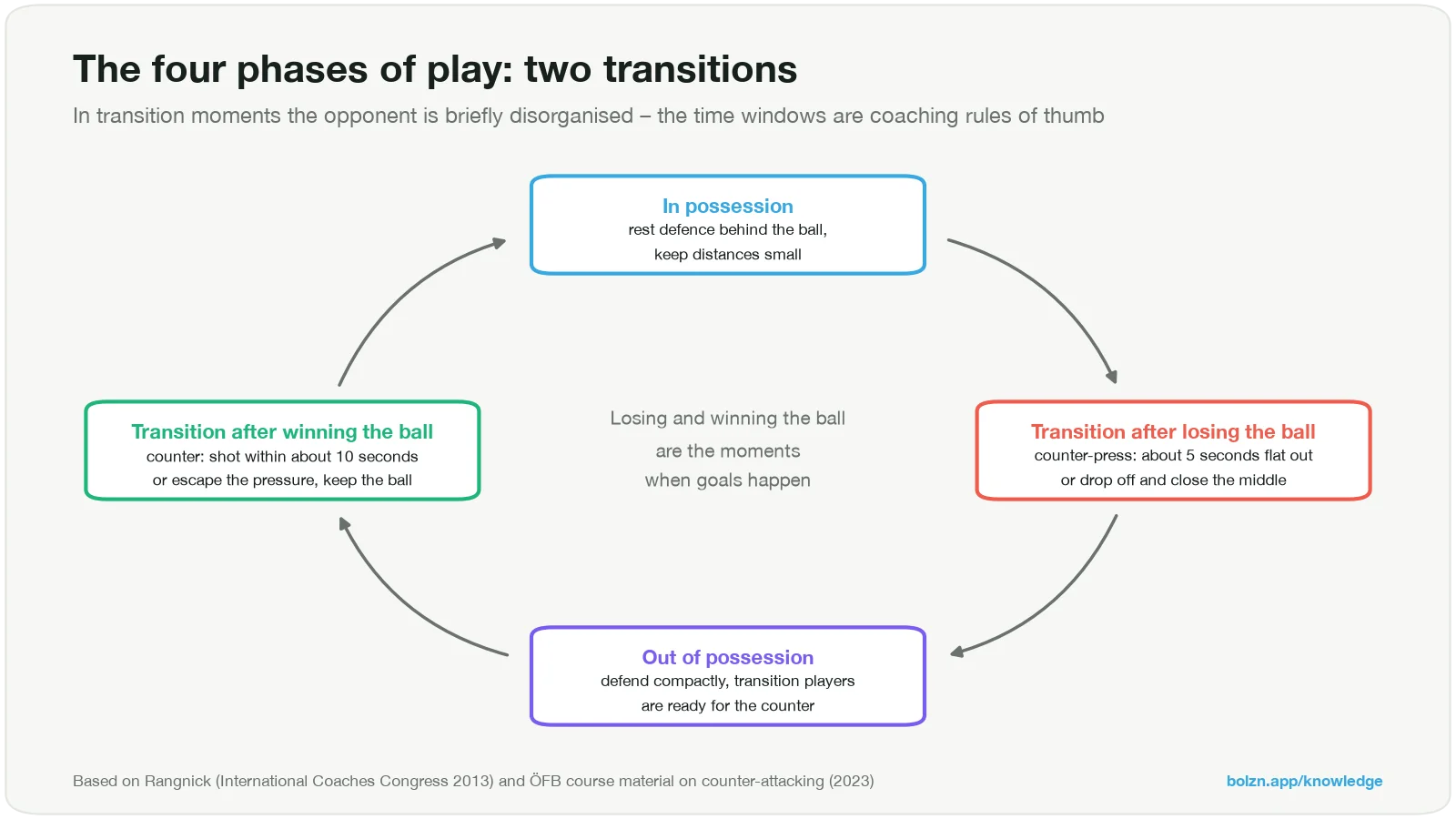
- In possession: build up, combine, attack.
- Transition after losing the ball: counter-press or retreat.
- Out of possession: defend compactly, press, steer the opponent.
- Transition after winning the ball: counter-attack or secure the ball.
The key idea: a transition starts before the ball changes hands. A team with no players behind the ball while attacking cannot counter-press after losing it. A team with nobody in position for the counter while defending cannot counter after winning it.
The time windows: 5 and 10 seconds
Many coaches work with two rules of thumb made popular by Ralf Rangnick:
- About 5 seconds after losing the ball: full effort pays off in this time to win the ball back. Your players are still close to the ball, often outnumbering the opponent, and the opponent is not yet set up for possession. Chasing the ball later costs more energy.
- About 10 seconds after winning the ball: the shot should come in this time. With every extra second, the opponent is better organised again. The Austrian Football Association (ÖFB) speaks of 10 to 15 seconds in which you often still face a disorganised opponent.
These numbers are coaching experience, not laws of nature. But they help in training, because every player knows how long he has to go flat out.
After winning the ball: counter-attack or keep it?
After winning the ball, the player who won it makes the first and most important decision. There are three options:
- Counter-attack: if there is space behind the opponent's defence and the ball winner is not under pressure, the first pass goes forward or diagonally, ideally to the furthest free team-mate. Alternatively, he dribbles at speed into the free space.
- Escape the pressure: if the ball winner is under pressure, for example because the opponent counter-presses straight away, he first has to get free. A pass square, back or to the far side gets the ball out of the tight area. Then the team goes forward.
- Keep the ball: if no counter is possible, the team keeps possession and builds up again. That is a good decision too, for example to catch breath after a long defensive phase.
Tools for a good counter-attack:
- quick passes in behind, vertical or diagonal
- runs into the space behind the defence
- a target player who holds the ball up or lays it off, and combinations via the third man
- running with the ball at speed when there is space ahead
- many players pushing up quickly so there is an overload up front
Types of counter-attack: where is the ball won?
Where the ball is won changes the counter-attack. The ÖFB distinguishes three types:
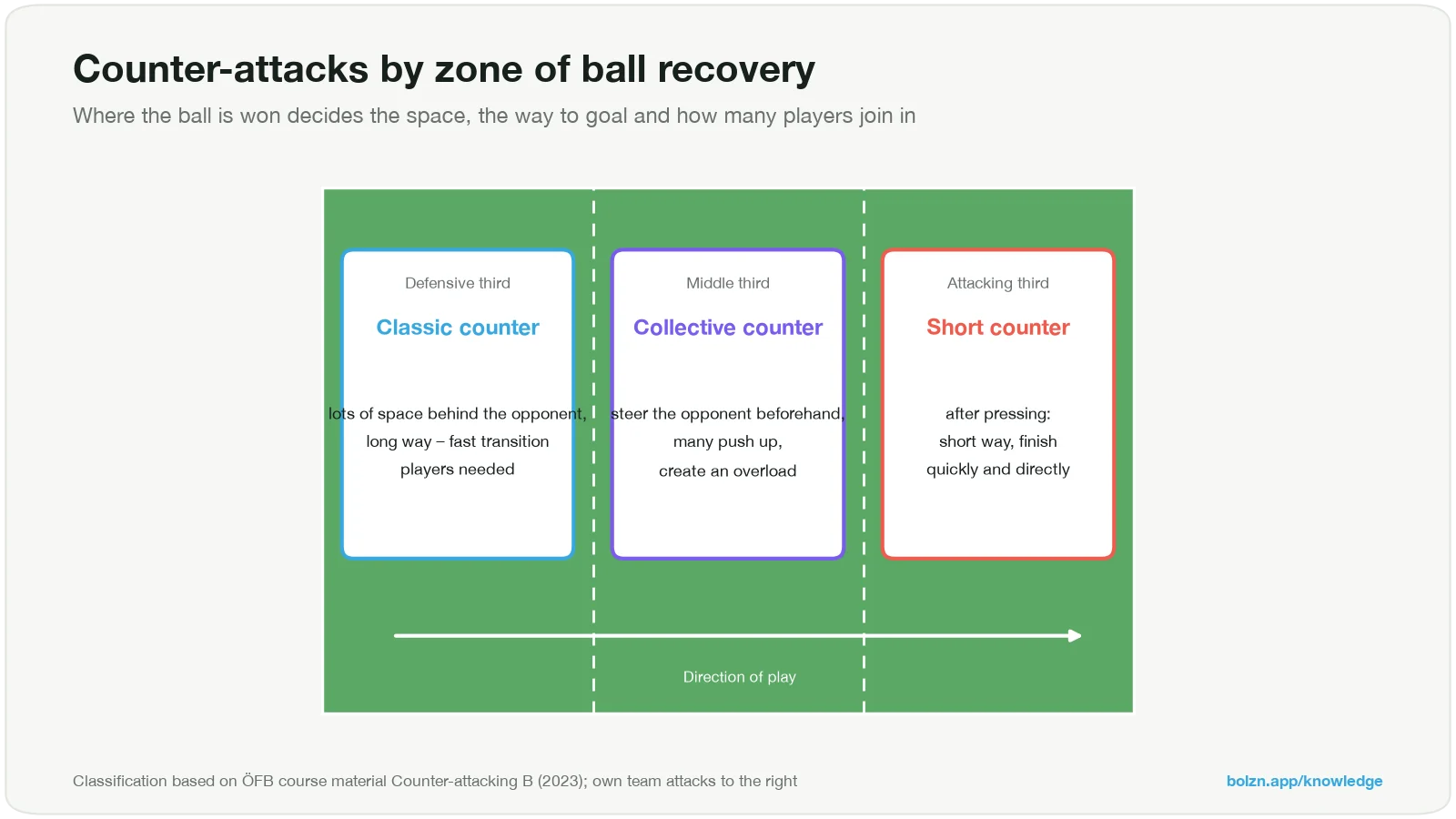
- Ball won in the defensive third, the "classic counter": the team defends deep and organised, with many players behind the ball. After winning it, there is a lot of space behind the opponent, but the way to goal is long. Fast transition players are needed.
- Ball won in the middle third, the "collective counter": the team deliberately steers the opponent beforehand to where it wants to win the ball, for example inside. After winning it, many players push up and the wide players run in behind.
- Ball won in the attacking third: usually after pressing high. The way to goal is short, now quick and direct solutions count.
Good counter-attacking chances also come after opposition set pieces, such as corners, when many opponents are in your box.
After losing the ball: counter-press or drop off?
After losing the ball there are also two ways:
- Counter-pressing: the players near the ball attack immediately, the rest push up. This works when enough players are close to the ball and the opponent has not had time to escape. How to close down and block passing lanes is explained in Pressing in football.
- Dropping off: if the opponent is already free or too few of your players are nearby, the team retreats quickly. It only blocks the direct way to goal, buys time and gets as many players as possible behind the ball. Only once it outnumbers the opponent again does it attack the ball.
The top rule in both cases: no counter-attack in behind the defence. Players have to recognise in a split second which way fits. They only learn that through many repetitions in small-sided games.
Rest defence and transition players: be in position beforehand
Good transitions are prepared:
- Rest defence while attacking: a few players stay behind the ball, usually centre-backs and a holding midfielder. They stop the quick counter and are the first counter-pressers when the ball is lost.
- Small distances: only if the team stays close together are there enough players near the ball after losing it. How a line stays compact is explained in Back four: shifting, stepping out and covering.
- Transition players while defending: some players already position themselves while defending so they can run in behind as soon as the ball is won, ideally without a direct opponent. Often these are the strikers and the far-side wide players.
- Pushing up: players not directly involved in the counter still move up. That keeps the team compact, even if the counter fails.
How do I train transitions?
Players learn transitions by playing, not by listening. Proven principles for drills:
- Overloads and neutral players: in games with neutrals, the defending team is outnumbered. It only gets the ball by attacking immediately and together. After winning the ball it should counter straight away.
- Time limits: a goal only counts if it is scored within 10 seconds of winning the ball. Winning the ball back within 5 seconds of losing it earns a bonus. Some professional clubs use a big countdown clock on the training pitch.
- Rules that force play forward: no back pass after winning the ball, at most three passes to the shot, or a long, narrow pitch, for example 4 v 4 on 50 × 34 metres.
- Changing direction: whoever wins the ball immediately attacks another goal or zone. Three-team games where the winning team stays on work especially well.
- Signals: during an action the coach calls a colour or plays in a new ball, and the roles switch at once.
- Always both directions: whoever counter-attacks must switch back immediately after losing the ball. So let both transition moments happen in every drill.
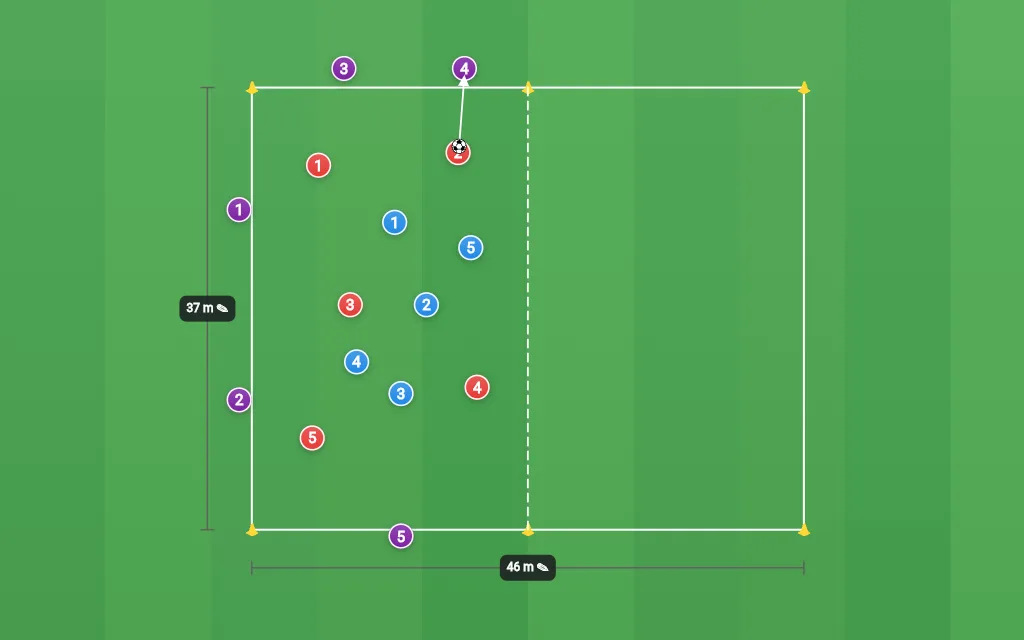
From the bolzn exercise library: transition game with three teams in two zones – whoever wins the ball plays it wide and switches zones.
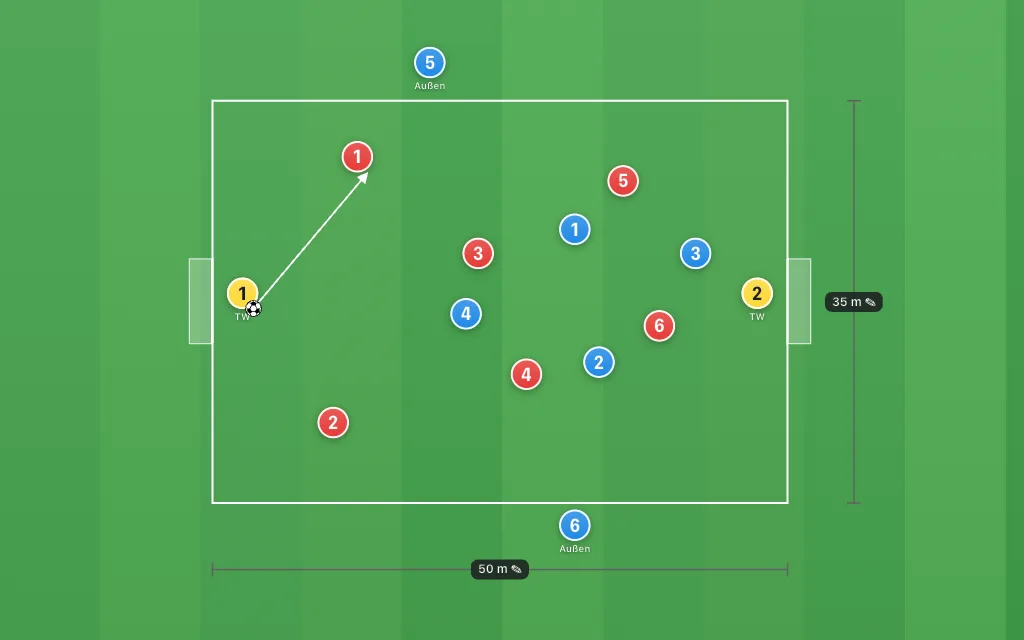
From the bolzn exercise library: 6 v 4 plus 2 – the overload attacks, the underload counters with two wide players.
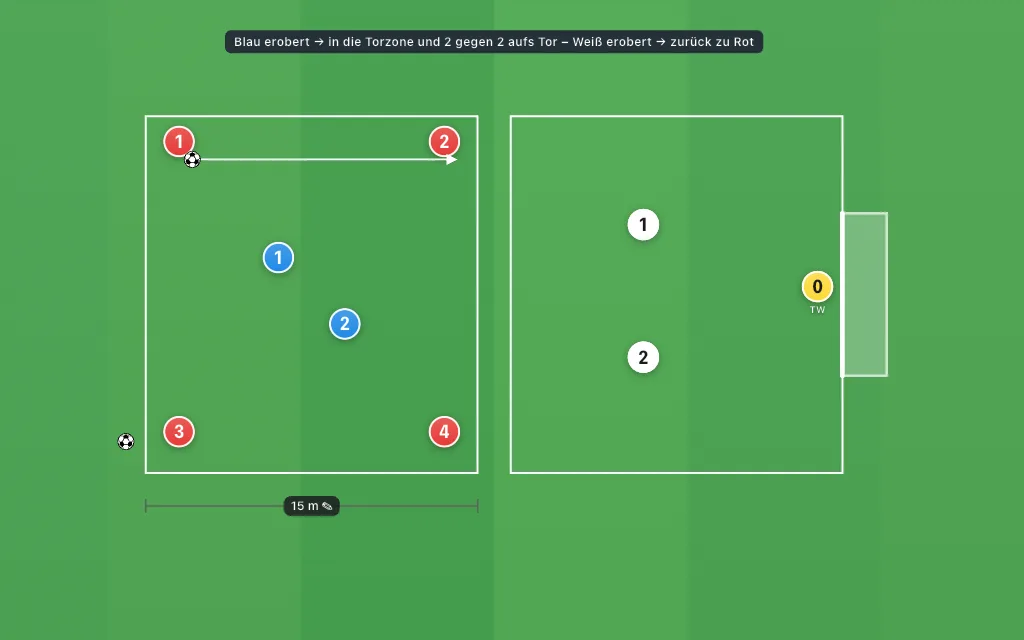
From the bolzn exercise library: 4 v 2 with a breakout – after winning the ball, out into the goal zone.
Coaching points: what is the first action after winning the ball? Who offers depth? Who stays back? And after losing it: do we press, or do we drop? Stop briefly and let the players answer themselves.
Transitions in children's football
Children switch quickly by nature, they want to go for goal straight after winning the ball. They don't need a tactics board but small-sided games with lots of turnovers: 2 v 2, 3 v 3 or 4 v 4 on several goals, where play goes the other way immediately after every ball won. More in Small-sided games for kids.
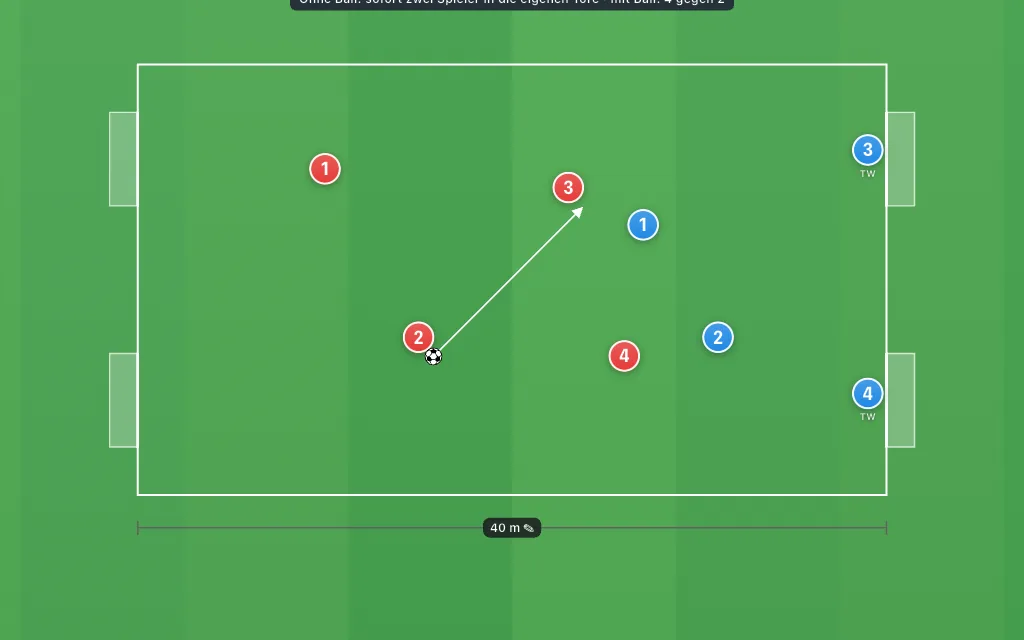
From the bolzn exercise library: two keepers without the ball – whoever loses the ball sends two players into goal at once (for ages 10 to 14).
Well over 100 transition drills for all age groups are in the bolzn football drills.
Sources
- Austrian Football Association ÖFB (2023): UEFA B and UEFA C licence course material, counter-attacking.
- Rangnick, R.: Fast transitions – from defence to attack and from attack to defence. Bund Deutscher Fußball-Lehrer, International Coaches Congress 2013.
- Tenga, A., Holme, I., Ronglan, L. T. & Bahr, R. (2010). Effect of playing tactics on goal scoring in Norwegian professional soccer. Journal of Sports Sciences, 28(3), 237–244.
- Vogelbein, M., Nopp, S. & Hökelmann, A. (2014). Defensive transition in soccer: are prompt possession regains a measure of success? Journal of Sports Sciences.
- Coaching Transition Play, Vol. 2: Maurizio Sarri, transition from defence to attack in the low zone (analysis of Napoli 2016/17).
- 25 Transitional Practices (coaching collection, Guardiola-style games).
- Drills from the bolzn exercise library (transition game with three teams, 6 v 4 plus 2, 4 v 2 with a breakout, two keepers without the ball).