Football nutrition: what to eat before a match
What footballers and kids should eat and drink before, during and after a match: timings for 11am and 3pm kick-offs, a tournament bag and common myths.
What to eat before a football match?
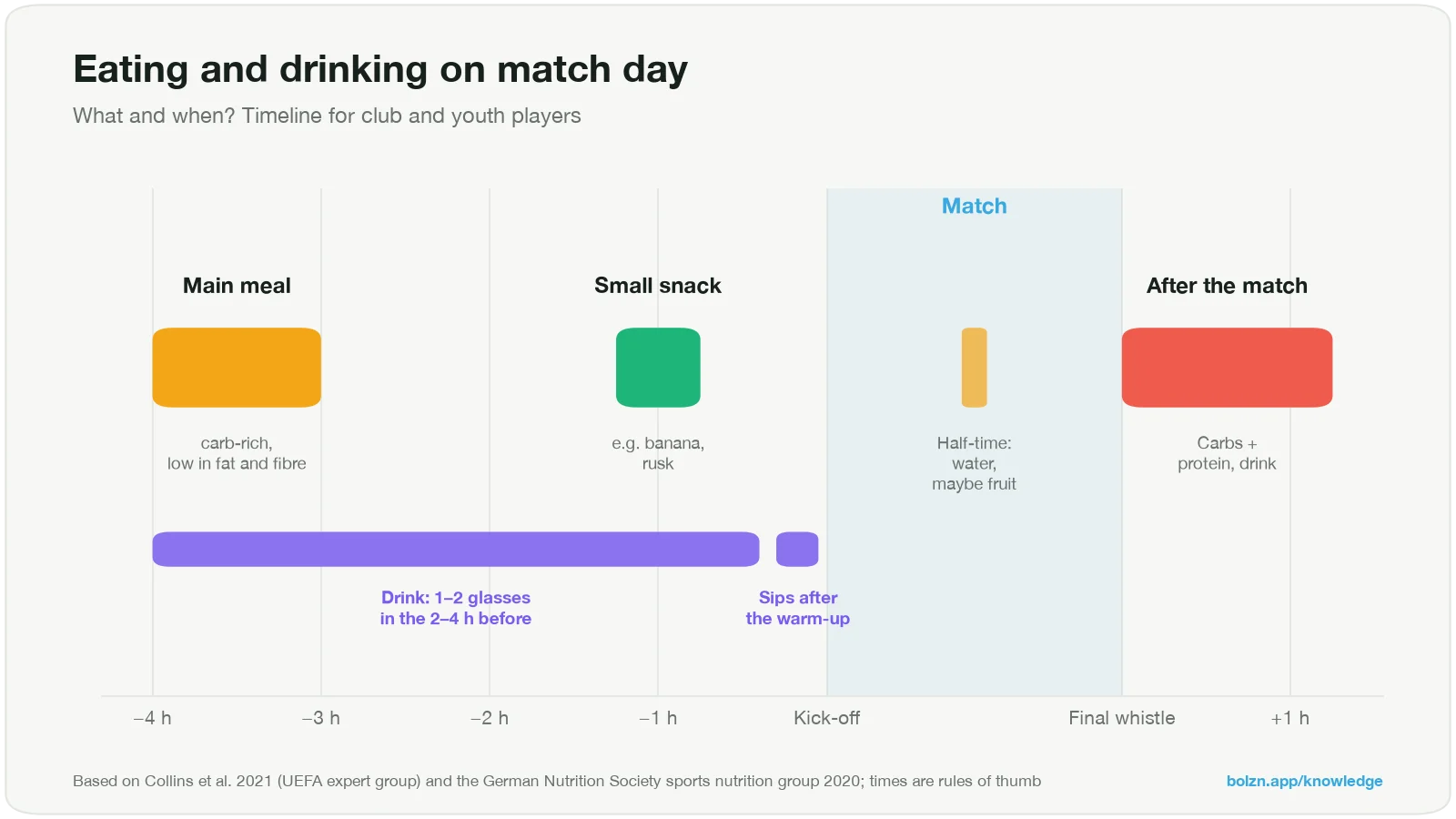
The short answer: a normal, carbohydrate-rich meal that sits well, three to four hours before kick-off. Shortly before, at most a small snack such as a banana. Plus enough to drink through the day. That is all a club player needs, and the same applies to kids in smaller portions.
Carbohydrates (pasta, rice, potatoes, bread, oats, fruit) are the main fuel for sprints, duels and changes of direction. That is why the UEFA expert group recommends professionals a carbohydrate-rich meal three to four hours before the match. It also stresses that the meal should be easy to digest and make the player feel good. Feeling comfortable comes before rigid gram targets.
What sits well and what does not?
Good before a match:
- pasta or rice with tomato sauce and some lean meat, fish or egg
- potatoes with quark or cottage cheese
- bread or rolls with honey, jam, cheese or turkey
- porridge or muesli with milk or yoghurt and a banana
- rice pudding, pancakes
Better avoided shortly before a match:
- fatty food: chips, fried sausages, pizza, burgers, creamy sauces
- lots of fibre: a big raw salad, beans and lentils, large amounts of wholegrain
- very spicy food and fizzy drinks
- large amounts just before kick-off, whatever it is
Fat, fibre and big portions stay in the stomach for a long time. That is healthy on normal days but uncomfortable during a match. Wholegrain toast at breakfast is fine if kick-off is a few hours away.
Important: don't try anything new on match day. What the stomach tolerates differs a lot. A new dish or a bar the child has never eaten belongs in training, not in the cup game.
When to eat carbs before a football match?
| What | When | Example |
|---|---|---|
| Main meal | 3 to 4 hours before kick-off | pasta with tomato sauce, sandwiches, muesli |
| Small snack (if hungry) | about 1 hour before | banana, rusks, rice cake, half a roll with honey |
| Fluids | through the day, plus 1 to 2 glasses in the 2 to 4 hours before | water, diluted juice |
| After the warm-up | a few sips | water |
The times are rules of thumb. Some players are fine eating two hours before, others need four. Try it out in training and friendlies.
Example: kick-off at 11am or 3pm
| Time | Kick-off 11am | Kick-off 3pm |
|---|---|---|
| Morning | 7:30 to 8:00: breakfast with bread, muesli or porridge, plus a glass of milk or diluted juice | 8:00 to 9:00: normal breakfast |
| Mid-morning | 9:45 to 10:00: banana or rusks, a few sips of water | 10:00: fruit or yoghurt if hungry |
| Midday | 12:30: lunch after the match | 11:00 to 12:00: main meal, e.g. pasta or rice |
| Afternoon | 13:45 to 14:00: small snack if hungry | |
| After the final whistle | drink, chocolate milk or fruit, then lunch | drink, snack, normal dinner |
Breakfast matters most before morning matches. Overnight, the carbohydrate stores in the liver drop by about half. Anyone who steps onto the pitch at 10am without breakfast starts with a half-empty tank. In a study with professional youth players, players dribbled faster after a larger breakfast a little over two hours before the match. For kids who can barely eat in the morning: a small portion, a glass of chocolate milk or a banana is better than nothing.
Eating the night before a football match: is a pasta party needed?
The evening before, a normal dinner with a decent portion of carbohydrates is enough: pasta, rice, potatoes or bread, with some protein and vegetables. A special carb-loading routine, eating huge amounts of pasta over several days, is not necessary for amateurs or kids.
The UEFA expert group does advise professionals to eat 6 to 8 grams of carbohydrate per kilogram of body weight on the day before a match. But these are values for professionals who train hard almost daily and often play twice a week. According to the same expert group, there are hardly any studies on carb-loading in young players. A normal Friday dinner where half the plate is pasta, rice or potatoes prepares a player well. A team pasta party is great for team spirit, but it is not a must.
What matters more is what does not happen that evening: a late, greasy meal, too little sleep, too little to drink. With an early match the next morning, the day before is the best chance to drink enough.
Drinking before, during and after the match
For club players and kids, water is almost always the right drink. Diluted fruit juice is a good alternative as long as it is mostly water: a match-day brochure from the health insurer AOK Baden-Württemberg and the football associations of that region recommends one part juice to three parts water.
- Before the match: The sports nutrition working group of the German Nutrition Society (DGE) recommends 5 to 10 millilitres per kilogram of body weight in the two to four hours before exercise. For a 70 kg player that is 350 to 700 millilitres, for a 30 kg child 150 to 300 millilitres, so one or two glasses. Urine should be pale yellow.
- During the match: drink at half-time and during breaks in play. The UEFA expert group's guide is that fluid loss should not exceed 2 to 3 per cent of body weight. Drinking too much is not good either.
- After the match: Weighing before and after the match shows how much fluid was lost. The DGE working group advises about 1.5 litres per kilogram lost when rehydration needs to be quick. Otherwise, normal meals with enough water are sufficient.
In hot weather everything counts double: bottles always at the side of the pitch, use drinks breaks, actively remind kids. The UEFA expert group cites studies showing that young players often arrive at training and tournaments already short of fluid. Kids easily forget to drink during a game.
For comparison: for an ordinary day, the DGE gives reference values for drinks of 970 millilitres for 7 to 9-year-olds, 1,330 millilitres for 13 and 14-year-olds and 1,530 millilitres for 15 to 18-year-olds. With lots of exercise and heat the need is higher.
Sports drinks are not normally needed for a child's club match. The DGE working group considers carbohydrate and salt in drinks useful only for longer, intense exercise. Sports Dietitians Australia mainly recommend clean, cool water in sufficient amounts for young athletes.
What to eat at half-time?
For most club matches, water or diluted juice is enough at half-time. Anyone who is hungry or feels their energy fading can eat a few pieces of banana, apple or orange. Professionals take 30 to 60 grams of carbohydrate after the warm-up and again at half-time, for example as sports drinks or gels. In amateur football, a cup of diluted juice and a piece of fruit is the simple version. In children's football with short playing times, water is enough.
Tournament day: what goes in the bag?
At youth tournaments with four, five or six games in a day, food and drink matter even more because there is little time between matches. A big meal does not fit between two games with a 30-minute break. Small portions spread over the day work better.
What goes in the tournament bag:
- a large water bottle with the child's name on it, better two, with water or diluted juice (1 part juice, 3 parts water)
- sandwiches or filled rolls, several for a long day
- fruit and vegetables in handy pieces: banana, apple, grapes, cucumber, peppers
- small snacks: rice cakes, rusks, pretzels, nuts or dried fruit (nuts only if nobody in the team has an allergy)
- for afterwards: chocolate milk or a yoghurt drink in a cool bag
Less suitable: sweets as the main food, crisps, chips and sausages between two games. After the last match, the sausage is of course allowed.
For coaches and team managers it helps to coordinate food within the team: who brings fruit, who brings the water, who brings the rolls? The bolzn app has bring lists for this, where everyone signs up themselves. That way you don't end up with three cakes and no water at the side of the pitch.
Eating after the match and training
After the match the body needs carbohydrates and protein, ideally within the first hour: chocolate milk, a banana, a cheese roll, followed by a normal meal. The details, including sleep, fluids and the beer after the match, are in the article Recovery after a football match.
Nutrition for young footballers and teenagers
Kids need more energy than many people think
A child who is growing and training several times a week needs a lot of energy. In youth players of English professional clubs, resting energy expenditure alone rose by about 400 kilocalories per day between the ages of 12 and 16. U18 players at these academies used around 3,600 kilocalories a day on average, more than some adult professionals. These are elite youth players, but the direction is the same at club level: a teenage player in a growth spurt is very hungry, and that is a good thing.
Reviews suggest that young footballers in particular often eat too little, especially too few carbohydrates (North et al. 2022, Martinho et al. 2025). According to the UEFA expert group, the gap is largest on match days and heavy training days.
In practice that means: regular main meals, small meals in between, a packed snack for school and something to eat before afternoon training. A player who goes straight from school to training and has not eaten since lunch runs out of energy quickly.
Normal food instead of powder
Young players need a little more protein than adults who do no sport. The UEFA expert group considers up to 1.6 grams per kilogram of body weight appropriate for youth players and adds that this is easy to reach with normal food, without supplements. Milk, yoghurt, quark, cheese, eggs, meat, fish, pulses and bread provide enough. A glass of milk also brings about 300 milligrams of calcium, which growing bones need.
Protein shakes, powders and supplements are not necessary for children and teenagers. That is not a lone opinion:
- The UEFA expert group advises a "food first" approach for youth players and notes that parents and coaches sometimes give children supplements based on wrong beliefs.
- Sports Dietitians Australia state in their position on adolescent athletes that nutrient needs should be met by everyday foods rather than supplements.
- The Liechtenstein Olympic Committee and the Liechtenstein football association write in their guide for clubs and parents: supplements are not needed, and performance-enhancing products such as creatine or caffeine have no place in youth sport.
- The International Olympic Committee warns, even for adults, that some products are contaminated and can lead to a positive doping test without the athlete knowing.
Iron is a special case: girls after their first period in particular have high needs. But iron tablets only if a doctor has confirmed a deficiency.
Energy drinks and caffeine
Energy drinks have no place in children's and youth football, neither before the match nor at half-time. A 250 ml can contains about 80 milligrams of caffeine. The European Food Safety Authority (EFSA) considers a maximum of 3 milligrams of caffeine per kilogram of body weight per day safe for children and teenagers. For a child weighing 25 kg that is 75 milligrams, less than one can.
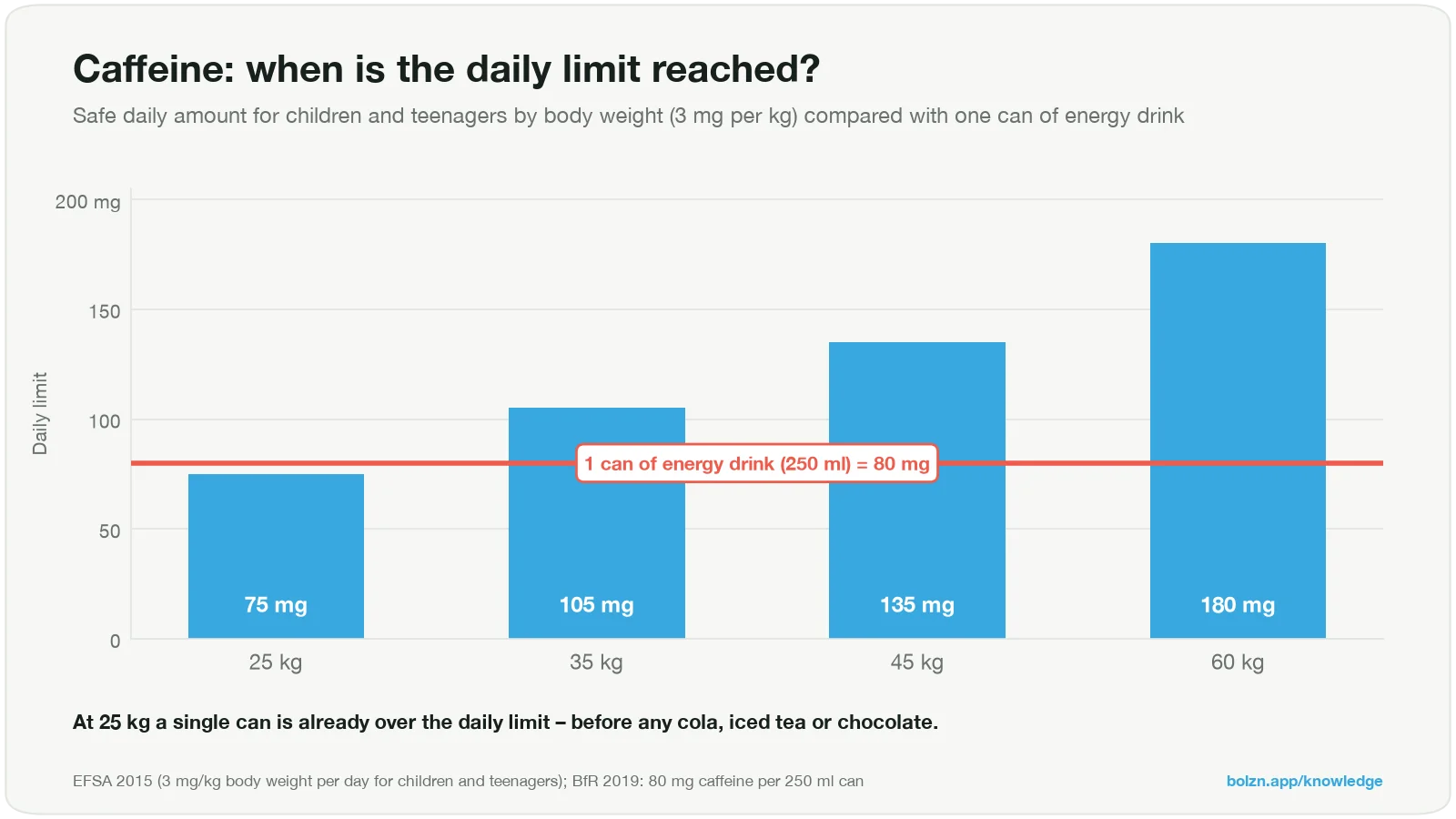
The German Federal Institute for Risk Assessment (BfR) warns that many teenagers drink a litre or more on certain occasions and that strenuous exercise may intensify the unwanted effects on the heart and circulation. Cola, iced tea and coffee contain caffeine too.
When kids eat too little
Some teenagers deliberately eat little to be lighter, faster or more "lean". Others simply don't manage to eat enough between school, training and travel. If too little energy is taken in over a longer period, this is called Relative Energy Deficiency in Sport (RED-S). It can affect digestion, the immune system, hormones, bone development and performance, and raises the risk of an eating disorder.
This does not only affect girls. In 2023 the International Olympic Committee updated its consensus statement with new data on male athletes, and the UEFA expert group names young players of both sexes.
As a coach: never comment on children's weight or figure, give no diet tips, don't weigh them in front of the team. If you notice that a child is losing a lot of weight, eating noticeably little or is constantly exhausted, have a calm talk with the parents. Weeks of exhaustion can have other causes too, see Recognising overtraining.
Note: This article does not replace advice from a dietitian. With allergies, intolerances, diabetes, marked underweight or a suspected eating disorder, the child should see a paediatrician or a qualified nutrition professional.
Football nutrition myths
"Before a match you need a huge plate of pasta." No. A normal, carbohydrate-rich meal is enough. Too much shortly before the match sits heavily in the stomach.
"You play best on an empty stomach." A big, greasy meal shortly before does feel heavy, that is true. But eating nothing at all is the worse choice, especially in the morning. Most players tolerate a banana an hour before kick-off well.
"At half-time, only drink, never eat." Too strict. Half-time is the most important chance to drink, and a few pieces of fruit are fine too. Professionals even take carbohydrates on purpose during the break. Just no big meal.
"Losing just 2 per cent of fluid costs 10 per cent of performance." This figure appears in some textbooks, but it is not supported in that form. How much fluid loss slows a player down varies from person to person. What remains true: drinking well pays off, especially in the heat.
"Isotonic sports drinks are better than water." Not for a normal club match. Water or diluted juice is enough.
"Teenagers need protein shakes to build muscle." No. The slightly higher protein need is easy to meet with normal food.
"The pros eat it, so it must be good for my child." The professional recommendations (grams per kilogram, gels, caffeine) are made for adults who train almost every day. Kids mainly need regular, normal meals.
Frequently asked questions
What should you eat for breakfast on match day?
Something carbohydrate-rich that the child knows: bread or rolls with honey, jam or cheese, muesli, porridge, with milk, chocolate milk or diluted juice. For a morning match, have breakfast three hours before.
Is chocolate before a match bad?
A piece of chocolate does no harm. But it is not a good main fuel because it contains a lot of fat. A banana or a roll with honey is better.
What is the best drink for kids playing football?
Water, or diluted fruit juice. No fizzy soft drinks, no energy drinks.
How long before training should a child eat?
A proper meal about two to three hours before, a small snack up to about an hour before. Kids coming straight from school should eat something on the way.
How a good warm-up before the match looks and how to plan the week until the next game (Planning the training week) are covered in separate articles. Drills for your next session are in the bolzn football drills.
Sources
- Collins, J. et al. (2021). UEFA expert group statement on nutrition in elite football. British Journal of Sports Medicine, 55(8), 416–442.
- Mosler, S., Braun, H., Carlsohn, A. et al. (2020). Position of the working group sports nutrition of the German Nutrition Society (DGE): fluid replacement in sports. Deutsche Zeitschrift für Sportmedizin, 71, 178–184.
- German Nutrition Society (DGE): reference values for water intake (dge.de).
- Desbrow, B. et al. (2014). Sports Dietitians Australia position statement: sports nutrition for the adolescent athlete. International Journal of Sport Nutrition and Exercise Metabolism, 24(5), 570–584.
- Maughan, R. J. et al. (2018). IOC consensus statement: dietary supplements and the high-performance athlete. British Journal of Sports Medicine, 52(7), 439–455.
- Mountjoy, M. et al. (2023). 2023 International Olympic Committee's (IOC) consensus statement on Relative Energy Deficiency in Sport (REDs). British Journal of Sports Medicine, 57(17), 1073–1097.
- North, M. et al. (2022). Nutritional considerations in high performance youth soccer: a systematic review. Journal of Science in Sport and Exercise.
- Martinho, D. V. et al. (2025). Nutrition as a missing piece in the development of youth male soccer players: a scoping review. Biology of Sport, 43, 291–317.
- EFSA (2015). Scientific opinion on the safety of caffeine; BfR (2019). Opinion No. 018/2019 on energy drinks and children and adolescents.
- AOK Baden-Württemberg with the football associations of Baden, Südbaden and Württemberg (2020). Für kleine Kicker und große Talente (match-day nutrition brochure for youth football).
- Liechtenstein Olympic Committee & Liechtenstein Football Association. Kinder im Sport stark machen: Ernährung (guide for clubs, associations and parents).