Running in football: distance covered, sprints and training
How far professionals and amateurs run per match, how fast footballers sprint and from what age running without the ball makes sense – with figures by age.
How far does a footballer run per match?
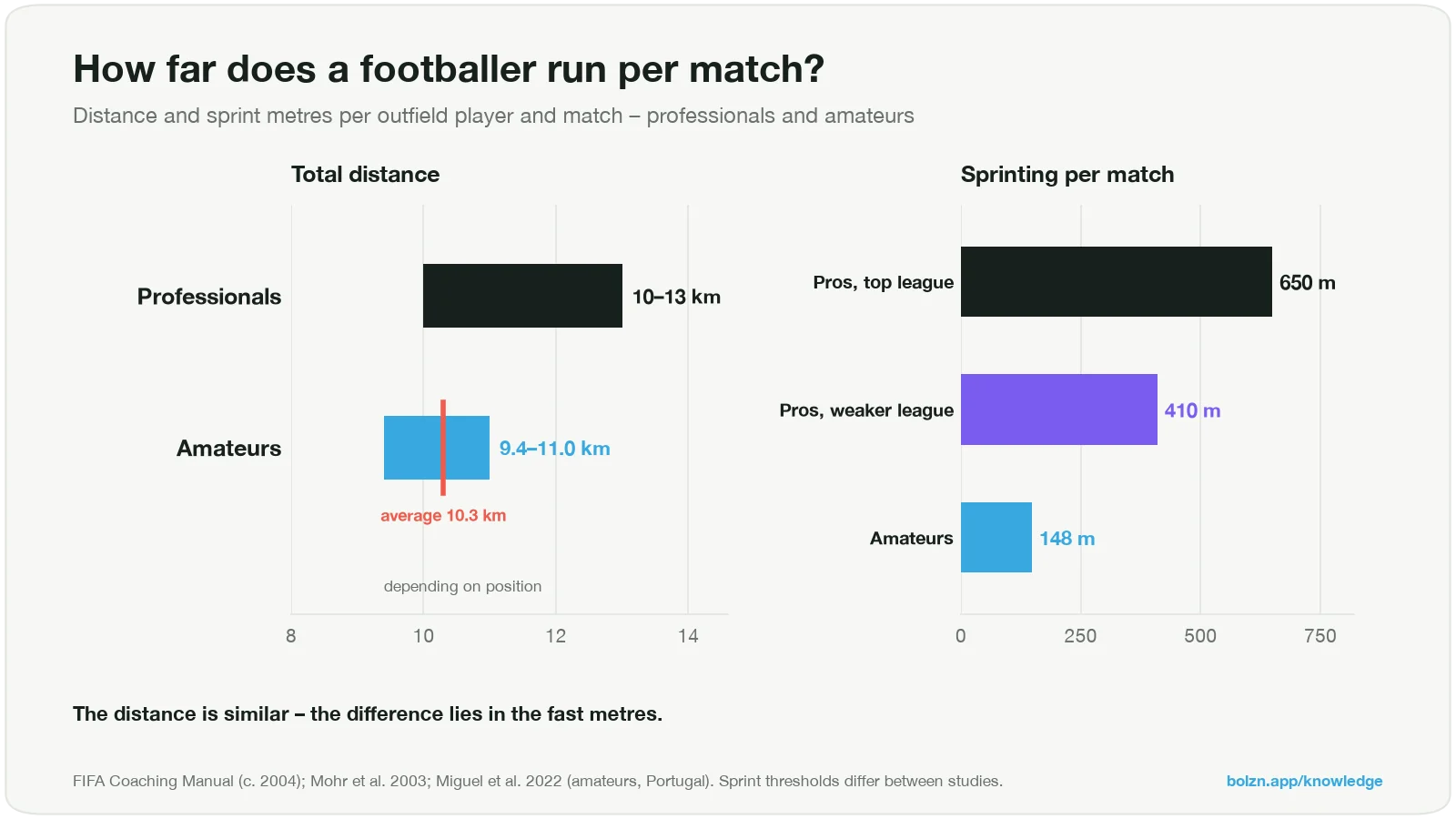
A professional runs about 10 to 13 kilometres per match, depending on position. Amateurs cover almost the same distance: in a study of a Portuguese amateur team the average was 10.3 kilometres. The big difference is not the kilometres but the speed. Professionals cover many times more metres at sprint speed.
So football is an endurance sport, but not a steady run. A player walks, jogs, sprints, brakes, turns and sprints again. If you want to train for that, you have to train exactly this switching. How to do it, and from what age running without the ball makes sense at all, is explained below.
Professionals and amateurs compared
FIFA's coaching manual gives these figures per match for professionals:
| Position | Distance per match |
|---|---|
| Centre-backs | 8–10 km |
| Full-backs and wide midfielders | 9–12 km |
| Central midfield | 11–13 km |
| Forwards | 9–10 km |
Of this, 5 to 6 kilometres are walking and easy jogging. On top come 600 to 1,200 metres of sprinting, spread over 50 to 70 sprints, and 300 to 400 metres of running backwards. The figures date from around 2004 and are best read as a rough guide.
Whole teams in the Bundesliga run about 111 to 118 kilometres per match, substitutes included. That was the range in the 2021/22 season, from VfL Wolfsburg to Arminia Bielefeld.
There are fewer measurements for amateurs. The Portuguese team in the study played at regional level. Centre-backs ran 9.4 kilometres on average, central midfielders 11.0. But the players covered only 148 metres per match at sprint speed above 25 km/h. Studies set the sprint threshold differently, so these metre figures show the direction, not an exact gap.
Speed also separates the leagues among professionals. In one study, players in a top league ran 28 percent more at high intensity and sprinted 58 percent more (650 instead of 410 metres) than professionals in a weaker league. It is not quite that simple, though: in England, players in the second and third tiers actually ran more at high intensity than in the Premier League, while their technical numbers were lower. The kilometres alone say little. What counts is how often a player can be fast and how quickly he recovers.
How fast do professional footballers sprint?
The Bundesliga record is 37.16 km/h, set by Jean-Mattéo Bahoya of Eintracht Frankfurt in the 2024/25 season. The Bundesliga has recorded these values since 2011/12. Some media reports have quoted a higher value, but it does not appear in the official ranking.
For comparison: in his 100 m world record (9.58 seconds, Berlin 2009), Usain Bolt reached a peak of 12.32 metres per second. That is about 44 km/h. So the fastest footballers are roughly 7 km/h slower than the fastest sprinter in the world. But they have to produce their speed after 80 minutes too, often after a short burst and with the ball.
In a match, footballers rarely reach their top speed, because most sprints are short. That is why acceleration over the first few metres matters more in football than top speed after 60 metres.
Sprint times by age: normal and elite
How fast is a child for their age? Two benchmarks help:
- The German Sports Badge (Deutsches Sportabzeichen) shows what ordinary sporty children and adults achieve. Bronze is well within reach for anyone who does sport regularly. Gold is already a good performance.
- The qualifying standards for the German youth athletics championships show the top end. Anyone who runs them is among the fastest in their age group in Germany.
A typical club sprinter is somewhere in between.
| Age (boys) | Distance | Sports Badge bronze | Sports Badge gold | German championship standard |
|---|---|---|---|---|
| 6–7 | 30 m | 7.7 s | 6.0 s | – |
| 8–9 | 30 m | 7.2 s | 5.7 s | – |
| 10–11 | 50 m | 10.3 s | 8.4 s | – |
| 12–13 | 50 m | 9.7 s | 8.1 s | – |
| 14–15 | 100 m | 17.0 s | 14.1 s | 11.80 s (U16) |
| 16–17 | 100 m | 16.3 s | 13.5 s | 11.30 s (U18) |
| 18–19 | 100 m | 16.0 s | 13.2 s | 11.05 s (U20) |
| 20–24 | 100 m | 15.8 s | 13.0 s | 10.90 s (U23) |
For girls, the 100 m championship standards are 12.75 seconds (U16), 12.40 seconds (U18 and U20) and 12.10 seconds (U23). The Sports Badge is often hand-timed, championships are timed electronically. Hand times usually come out a little faster.
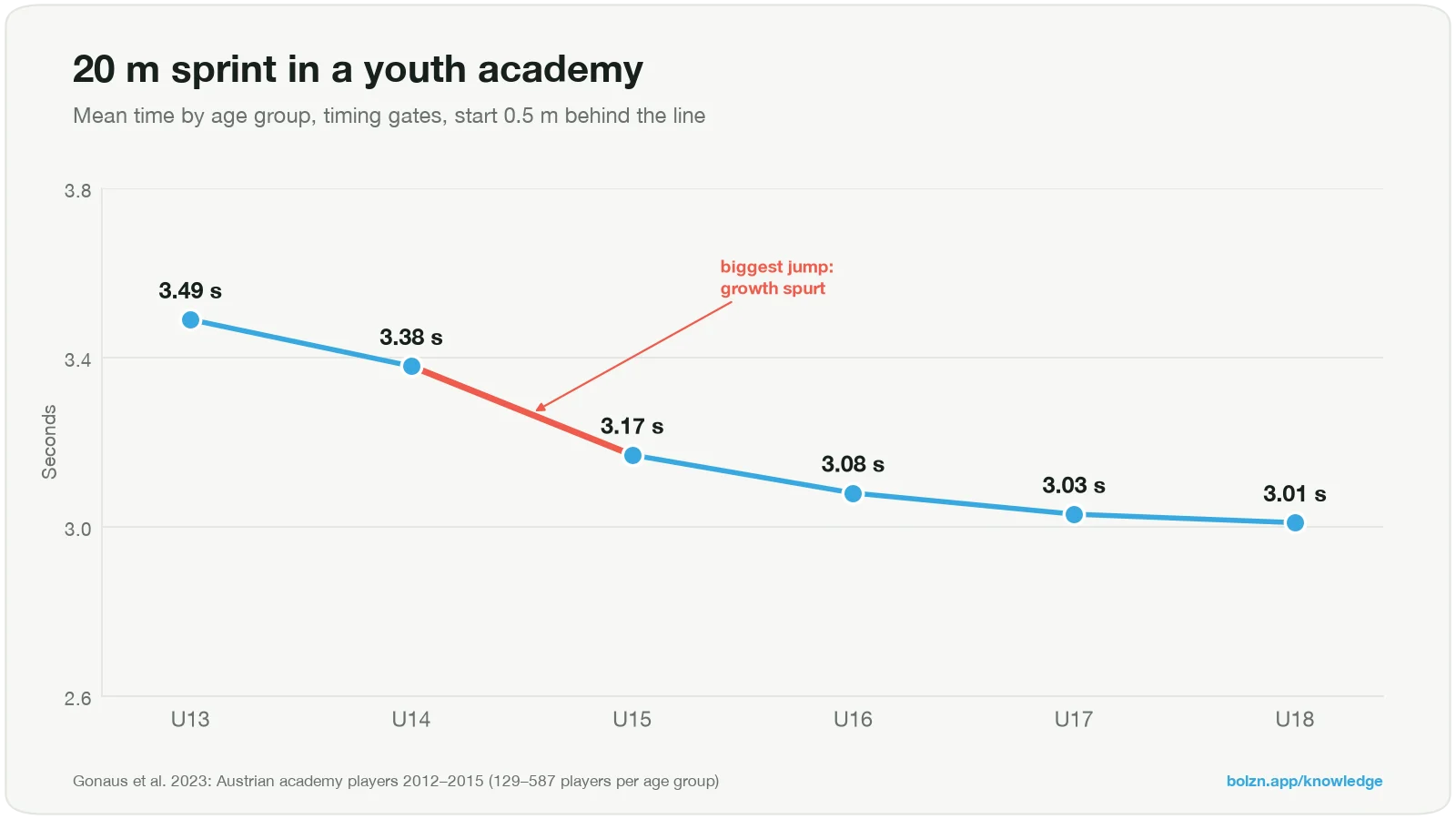
In football, shorter distances are measured. In Austrian youth academies, players needed 3.49 seconds on average for 20 metres in the U13 and 3.01 seconds in the U18. The biggest jump comes between U14 and U15, exactly when most boys go through their growth spurt (see Growth spurt in football). Two players born in the same year can therefore be far apart without one being less talented.
Why football endurance is different from a steady run
A 45-minute run at the same pace has little to do with a football match. In a match, these alternate:
- Walking and jogging as active recovery, which makes up most of the distance.
- Fast runs over 20 to 50 metres, for example when counter-pressing or overlapping.
- Sprints and short bursts over a few metres, usually with a change of direction.
- Braking, turning, jumping and duels, which cost a lot of energy but add little distance.
Between two intense actions there are often only 15 to 30 seconds of recovery. Good football endurance therefore means recovering quickly in these short breaks and running the next sprint at full speed again. The basis for this is good aerobic endurance. On top of it sits the ability to manage many intense actions in a row.
A Norwegian study with U19 players shows how much this matters: after eight weeks of twice-weekly 4 × 4 minute interval runs at 90 to 95 percent of maximum heart rate, the players ran 20 percent more in matches, sprinted twice as often and had 24 percent more involvements with the ball.
How do I train endurance in football?
With the ball: small-sided games
Small-sided games are the best endurance training because they contain exactly the mix of bursts, braking and recovery. The fewer players and the smaller the pitch, the harder it gets. In a study with U15 academy players, 2 v 2 was the most intense format. 3 v 3 and 4 v 4 suit longer bouts. How to set pitch size, player numbers and rest is covered in Small-sided games.
Without the ball: intervals
Running without the ball is easier to dose. Everyone runs at their own pace and nobody can hide. Proven formats:
- Long intervals: 4 × 4 minutes at a brisk pace with 3 minutes of jogging in between, or 4 × 1,000 metres. Good for the base in pre-season.
- Medium intervals: 8 × 60 seconds fast, 60 seconds easy.
- Short intervals: 15 seconds fast, 15 seconds walking, 8 to 12 repetitions. Closest to the match, especially with a change of direction after 20 or 40 metres.
- Fartlek: in the woods or on the pitch, easy and fast sections alternate freely.
Steady runs: only as a base
Easy steady runs of 20 to 40 minutes make sense in the summer and winter break, after injuries and for players who get little game time. They build the base that intervals build on. In football, though, they are just one building block. In UEFA's futsal coaching manual they appear only at the start of pre-season, followed by fartlek, sprints and jump training.
Don't forget sprints
Endurance training does not make you faster. Sprints need a rested body and long breaks. They belong at the start of a session, not at the end. When to place them in the week is explained in Planning a training week. Clean running technique is practised with running drills.
From what age does running without the ball make sense?
Children have more endurance than many people think. In a French study, ten-year-old boys tired about as little in a short all-out test as well-trained adult endurance athletes and recovered faster than untrained men. So children do not have to build endurance through hard running. They just need to use it regularly, and play is the best way to do that.
| Age group | What fits |
|---|---|
| Up to U11 | No running without the ball. Tag games, relays, small-sided games. Children run by themselves when they play. |
| U12/U13 | Small-sided games remain the main thing. Add running games and runs with the ball. Every child runs at their own pace. |
| U14/U15 | First intervals without the ball, short and varied, plus small-sided games. Take the growth spurt into account. |
| U16 to seniors | Intervals and, in pre-season, steady runs too. The higher the level, the more targeted. |
This split follows FIFA's coaching manual: basic endurance through play and exercises with the ball, regular small-sided games from 12 to 13, intervals introduced gradually from 14 to 15. There is no strict ban. For the German Sports Badge, even six-year-olds run 10 to 20 minutes without stopping. But children who only run laps instead of playing lose time on the ball and often their enthusiasm too.
Important for U14/U15: in the same age group there are children before, during and after their growth spurt. The same targets for everyone overload some and underload others. FIFA's manual already advises that 12- to 15-year-olds should run at their own pace, not at the pace of the fittest.
Running without the misery: making running training fun
Running has a bad reputation because it is often used as punishment. It doesn't have to be that way:
- Never as punishment. Making players run laps after a defeat teaches them that running is something bad.
- Targets instead of laps. "Can every group manage 8 × 60 seconds?" motivates more than "five more laps".
- Groups by pace. Players of similar speed run together. Nobody trails behind alone.
- With competition. Relays, chase runs, team runs against the clock.
- With the ball where possible. Dribbling over 40 metres, pass into the run, finish.
- Short and clear. Better 12 minutes of focused intervals than 40 minutes of slow jogging.
- Variety. Pitch, woods, hills, stairs. A different format every week.
- Explain why. Players who know they want one more sprint in the 85th minute run more willingly.
Grassroots or elite: do players need extra running?
In grassroots football with two sessions a week, what happens in training with the ball plus the match at the weekend is usually enough during the season. Small-sided games improve endurance about as well as running. A review of 17 studies with 10- to 19-year-old football and basketball players found no difference in maximal oxygen uptake between small-sided games and interval running. Only in the Yo-Yo test, where you run shuttles again and again, were the runners slightly better.
In grassroots football, extra running pays off mainly:
- in the summer and winter break, so the base is not lost,
- for players with little game time, to make up for the missing match,
- after injuries, as a bridge back into team training.
At elite level that is not enough. Load is planned and measured, and targeted intervals, sprints and strength training belong in every week. Anyone playing at a higher level above all needs the ability to repeat many fast actions. You only get that if you train it.
How much is too much? If performance drops despite training, players sleep badly and are always tired, recovery is missing. How to spot it is covered in Recognising overtraining.
Running tasks for the break with bolzn
In the summer or winter break, players usually run on their own. In the bolzn app you create a task collection for this, for example a preparation plan with a time period. It holds three kinds of tasks:
- Run, either as a steady run or as intervals in sets, such as 8 × 60 seconds or 4 × 1,000 metres, with an optional pace target,
- Workout with repetitions and a video link,
- Checklist with individual items.
Players see their tasks under My Tasks, tap Report done and can leave you a short note. In the collection you see who is already done. More on the training planning page.
Common mistakes
- Only steady runs. They build the base but make players neither faster nor fit for many sprints in a row.
- Running as punishment. Afterwards nobody enjoys running.
- Everyone at the same pace. The slow ones are overloaded, the fast ones underloaded.
- Sprints at the end of the session. Tired legs don't sprint fast, and the injury risk goes up.
- Making children run laps. For children, any game is worth more than any lap.
- Confusing distance with quality. A player who runs 12 kilometres but never sprints has not automatically done more.
Sources
- FIFA (c. 2004). Coaching Manual, chapter 8 (Physical preparation, pp. 1–15) and chapter 10 (The player of tomorrow, pp. 12–16).
- Mohr, M., Krustrup, P. & Bangsbo, J. (2003). Match performance of high-standard soccer players with special reference to development of fatigue. Journal of Sports Sciences, 21(7), 519–528.
- Bradley, P. S. et al. (2013). Match performance and physical capacity of players in the top three competitive standards of English professional soccer. Human Movement Science, 32(4), 808–821.
- Miguel, M. et al. (2022). External match load in amateur soccer: the influence of match location and championship phase. Healthcare, 10(4), 594.
- Sportschau (2022). Bundesliga 2021/22, team running statistics.
- Bundesliga (2026). The fastest Bundesliga players of all time. bundesliga.com.
- Štuhec, S. et al. (2023). Multicomponent velocity measurement for linear sprinting: Usain Bolt's 100 m world-record analysis. Bioengineering, 10(11), 1254.
- DOSB (2025). Deutsches Sportabzeichen, performance catalogue (score cards for men and male youth, as of 1 January 2025).
- DLV (2026). Entry conditions of the German championships U16/U20 and U18/U23, qualifying standards.
- Gonaus, C., Müller, E., Stöggl, T. & Birklbauer, J. (2023). Determining the effect of one decade on fitness of elite Austrian youth soccer players using propensity score matching. Frontiers in Sports and Active Living, 5, 1186199.
- Helgerud, J., Engen, L. C., Wisløff, U. & Hoff, J. (2001). Aerobic endurance training improves soccer performance. Medicine and Science in Sports and Exercise, 33(11), 1925–1931.
- Brandes, M. & Müller, L. (2010). Small-sided games 2 v 2 to 4 v 4 in youth academy football. In: dvs sports games symposium Münster, abstracts, p. 11.
- Birat, A. et al. (2018). Metabolic and fatigue profiles are comparable between prepubertal children and well-trained adult endurance athletes. Frontiers in Physiology, 9, 387.
- Zhang, F. et al. (2026). Comparative effects of high-intensity interval training and small-sided games on physical fitness in male adolescent team-sport athletes: a systematic review and meta-analysis. BMC Sports Science, Medicine and Rehabilitation.
- UEFA (2019). Futsal coaching manual (German edition), season plan pp. 36–37.