Shooting drills in football: techniques, mistakes, practice
How to coach shooting: inside foot, laces, inside and outside of the laces with common mistakes, placement before power, high-repetition drills and free kicks.
Shooting practice: what really matters
A good shot is placed first and powerful second. To score, players need the right technique for the situation: the inside of the foot for short, safe finishes, the laces for hard shots from distance, the inside of the laces for curling shots into the far corner and the outside of the laces for surprising shots without a big backswing.
Shooting is trained with lots of repetitions in small groups, short waiting times and situations like those in a match: under time pressure, after a pass, against a defender. Long queues in front of one goal and unchallenged shots after a twenty-metre run-up achieve little.
The four shooting techniques at a glance
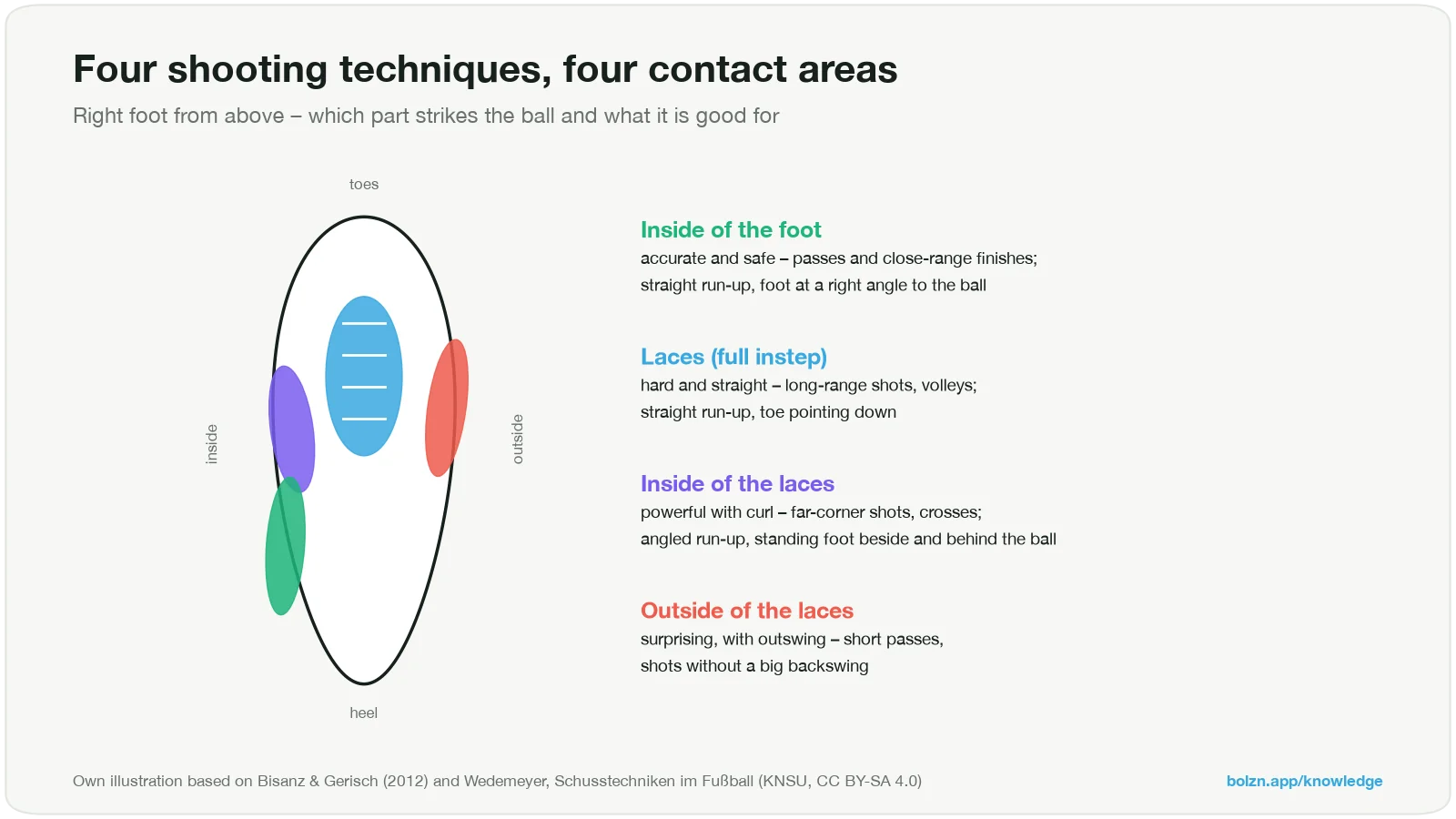
All four techniques share the same basics: the standing foot sets the direction, the ankle of the kicking foot is locked. Master that and you're halfway there.
Inside-foot shot: the safe finish
Use it for: passes and close-range shots when accuracy matters more than pace. The inside of the foot is the largest contact surface, which makes it the safest way to score.
How it works:
- Straight run-up to the ball.
- Standing foot about one foot's width beside the ball, toes pointing at the target, knee slightly bent.
- Kicking leg turned out at the hip, toes pulled up, ankle locked.
- Strike the ball with the whole inside of the foot, which is at a right angle to the direction of the shot.
Common mistakes:
| Mistake | Correction |
|---|---|
| Ball misses the target | Standing foot points at the target. |
| Ball is too slow | Pull the toes up, lock the ankle. |
| Ball skews off although the standing foot is right | Strike with the whole inside of the foot, at a right angle to the ball. |
Laces shot: the power shot
Use it for: long-range shots, volleys, half-volleys – anything that should be hard and straight. The laces shot can be struck at full speed without breaking stride.
How it works:
- Straight run-up to the ball.
- Standing foot about one foot's width beside the ball, toes pointing in the direction of the shot, knee slightly bent.
- Upper body slightly over the ball to keep the shot low.
- Kicking foot extended, toes pointing down, ankle locked. Strike with the laces.
- The leg swings through from the knee.
Common mistakes:
| Mistake | Correction |
|---|---|
| Ball flies over the bar | Upper body over the ball, standing foot beside the ball, not behind it. |
| Ball goes wide | Standing foot points at the target. |
| Standing foot too far from or too close to the ball | Plant it about one foot's width beside the ball. |
| No power, ball comes off the foot | Extend the foot, lock the ankle, toes down. |
Many children are afraid of stubbing their toes with the laces and toe-poke instead. Volleying the ball out of the hands to a partner helps: the ball is already at laces height.
Inside-of-the-laces shot: the curler
Use it for: powerful shots with curl, for example into the far corner, crosses, free kicks over the wall, long passes.
How it works:
- Angled run-up to the direction of the shot.
- Standing foot beside and behind the ball, about two to three foot-widths away, knee a little more bent.
- Kicking leg slightly turned out, foot extended and locked. Strike with the inside of the laces.
- The position of the upper body controls the height: further over the standing leg means lower.
Common mistakes:
| Mistake | Correction |
|---|---|
| Ball flies too high | Lean back less, upper body more over the standing leg. |
| Hip and knee twisted, shot inaccurate | Approach at an angle, not straight. |
| No pace on the ball | Extend the foot, lock the ankle. |
Outside-of-the-laces shot: the surprise
Use it for: short, quick passes and shots without a big backswing, balls with outswing. Often hard for the goalkeeper to read.
How it works:
- Straight or slightly angled run-up.
- Standing foot one to two foot-widths beside or slightly behind the ball.
- Kicking leg slightly turned in at hip, knee and foot, foot extended and locked.
- Strike with the outside of the laces, upper body slightly over the standing leg.
Common mistake: the ankle is loose and the ball slides off the foot. Correction: extend the foot, lock the ankle.
Placement before power
A shot doesn't have to be the hardest one; it has to go where the goalkeeper isn't. A few simple rules for players:
- Aim first, then strike. A low, placed shot into the corner is harder to save than a hard shot straight at the keeper.
- Low before high. Low shots force the keeper to go down, skid unpredictably on wet grass and more often fall to a team-mate as a rebound.
- Far post from wide positions. If the shot misses, a team-mate at the far post can still tap it in.
- Look up just before shooting. Where is the keeper? If he's far off his line, a chip is an option.
- Follow in. After every shot, the shooter follows up until the ball is safely with the keeper or in the net.
Why placement matters so much is clear from the goalkeeper's side in Goalkeeper positioning: a good keeper narrows the angle, and what's left are the corners.
How do I coach shooting?
The German FA (DFB) set out a few simple principles for club coaches that have proven themselves:
- Many repetitions, short waits. Split the squad into small groups and use several goals. If players queue for two minutes after every shot, they barely get ten shots in a session.
- Train what the game demands. In a match nobody shoots from the edge of the box after a long, unchallenged run-up. Shots after a pass, after a dribble, under time pressure and against a defender are closer to the real thing.
- Varied, but not hectic. The same drill every time is boring; switching too quickly prevents learning. A small variation of the basic drill is often enough.
- Build up systematically. From easy to hard, from simple to complex, first unopposed, then with defenders.
- Correct in detail. One technical point per player at a time, straight after the action and phrased positively: "toes down" rather than "not so weak".
- Combine drills and games. Drills groove the technique; small-sided games teach players when to use which technique.
A portable goal or two or three mini goals open up lots of set-ups. More on structuring a session with a focus topic in Planning a training session.
Shooting drills
1. Two goals on the diagonal (basic set-up): two goals with keepers about 40 metres apart, offset diagonally. Two groups, every player with a ball, a line 15 metres in front of each goal. Players dribble to the line and shoot, collect their ball and join the other group. Variations: a feint before the shot, push the ball ahead and chase it, weaker foot only, a slalom before the shot, a pass from behind and a first-time finish.
2. Two goals facing each other with a ball swap: goals 35 to 40 metres apart, a cone in the middle for each group. Two players start at the same time, swap balls in the middle with a pass, control and shoot. Variations: first-time shot, a lofted pass to the partner, or the keeper catches a ball and rolls it into the shooter's run.
3. Double action: the player shoots from a dribble on goal 1, turns immediately, receives a second pass and finishes on goal 2. Trains quick switching to the next action.
4. 2v2 on two goals: pitch about 35 metres long, two goals with keepers, a group waiting in pairs at each end line. Two pairs play against each other; after a shot or the ball going out, the next pair comes on straight away. Lots of finishes under pressure. With a third coach, a small technique group for players struggling with the laces can run alongside.
5. Shooting contests: who can hit the goal from 6, 8, 10 metres without the ball touching the ground? Penalty king: everyone gets five shots, first inside foot only, then inside of the laces only, then outside of the laces. Or two groups dribble through parallel cone slaloms and shoot at two goals side by side: which group scores more after five rounds?
6. Final tournament: 5v5 on small pitches, everyone plays everyone, four to five minutes per game. On one pitch one team attacks two big goals with keepers, the other two mini goals, swapping at half-time. More ideas in Small-sided games.
Coaching points: does the standing foot point at the target? Is the ankle locked? Does the shooter look up before shooting? Is the shot low and into the corner? Does he follow in?
Free kicks: direct, indirect, the wall
Free kicks are shots with an announcement. The main rules (Law 13):
- Direct free kick: the ball may go straight into the goal. The referee points an arm in the direction of attack.
- Indirect free kick: another player must touch the ball first. The referee raises an arm. If the ball goes straight in, it's a goal kick.
- The wall: opponents must be at least 9.15 metres (10 yards) from the ball. If three or more form a wall, attackers must stay at least one metre away from it.
- The ball must be stationary, and the kicker may not touch it again until another player has.
Technique: to bend the ball over the wall, use the inside of the laces: approach at an angle and strike the lower side of the ball so it rises and dips. Players who prefer power use the laces and aim for the keeper's corner or under a jumping wall. Free kicks are a topic for teenagers and adults. In German kids' football up to U11 there are only direct free kicks, and walls hardly matter.
Keep expectations realistic: even Europe's best free-kick takers rarely score directly. According to an analysis of free-kick goals since 2013 published by the German magazine kicker, Lionel Messi scored 32 from 348 attempts, roughly one in eleven. The most successful takers on the list had conversion rates between about 5 and 14 percent. For grassroots football this means: a free kick from 25 metres is often more valuable as a cross or a rehearsed routine than as a direct shot.
Simple free-kick routines:
- Through the legs: two players over the ball, one with his back to goal. The taker plays the ball through his legs; he turns and shoots.
- Chip over the wall: a player peels off the side of the wall or runs in behind it, and the taker chips the ball into his run. Only works with enough distance to goal.
- Square pass and shot: the ball goes short to the side, out of the wall's cover, and a second player shoots first time.
Free kicks are best practised at the end of a session, in small groups and with a target, such as a zone in the goal or a wall made of dummies or poles.
Shooting in kids' football
Children want to score goals, and they should, often. The most effective shooting school for kids is small-sided games on mini goals: 2v2, 3v3 or funino with a shooting zone. Every child gets a shot almost every minute. How that works is explained in Small-sided games for kids.
Add shooting contests in which every child gets lots of attempts. Technique is introduced playfully: "Who can score with the inside of the foot only?", "Who can do it with the other foot?". From around U12, when children pick up movements particularly quickly, it's worth practising all four techniques systematically. And always: both feet. Players who shoot with their weaker foot early on have twice as many options later.
Many more shooting drills for all age groups are in the bolzn drill library.
Sources
- DFB (2003). Torschusstraining: Tipps für die Vereinstrainer (shooting practice: tips for club coaches). DFB info evening 1, DFB talent development programme.
- Wedemeyer, N. Schusstechniken im Fußball (shooting techniques in football). Institute of Sports Science, University of Koblenz-Landau, KNSU (CC BY-SA 4.0).
- Bisanz, G. & Gerisch, G. (2012). Fußball: Kondition, Technik, Taktik & Coaching. Meyer & Meyer, chapter on passing and shooting.
- Messerschmidt, L. & Minardi, F. Freistöße und Treffsicherheit (free kicks and accuracy). Fußball-Mathe (citing kicker: "Meister der ruhigen Kugel – die besten Freistoßschützen seit 2013").
- IFAB: Laws of the Game, Law 13 (Free Kicks).