1v1 defending in football: jockeying, 1v2 and passing shadows
How to defend 1v1 and 1v2: distance, the ball-goal line, showing the attacker outside, passing shadows and passing on runners, with drills.
How do you defend 1v1 in football?
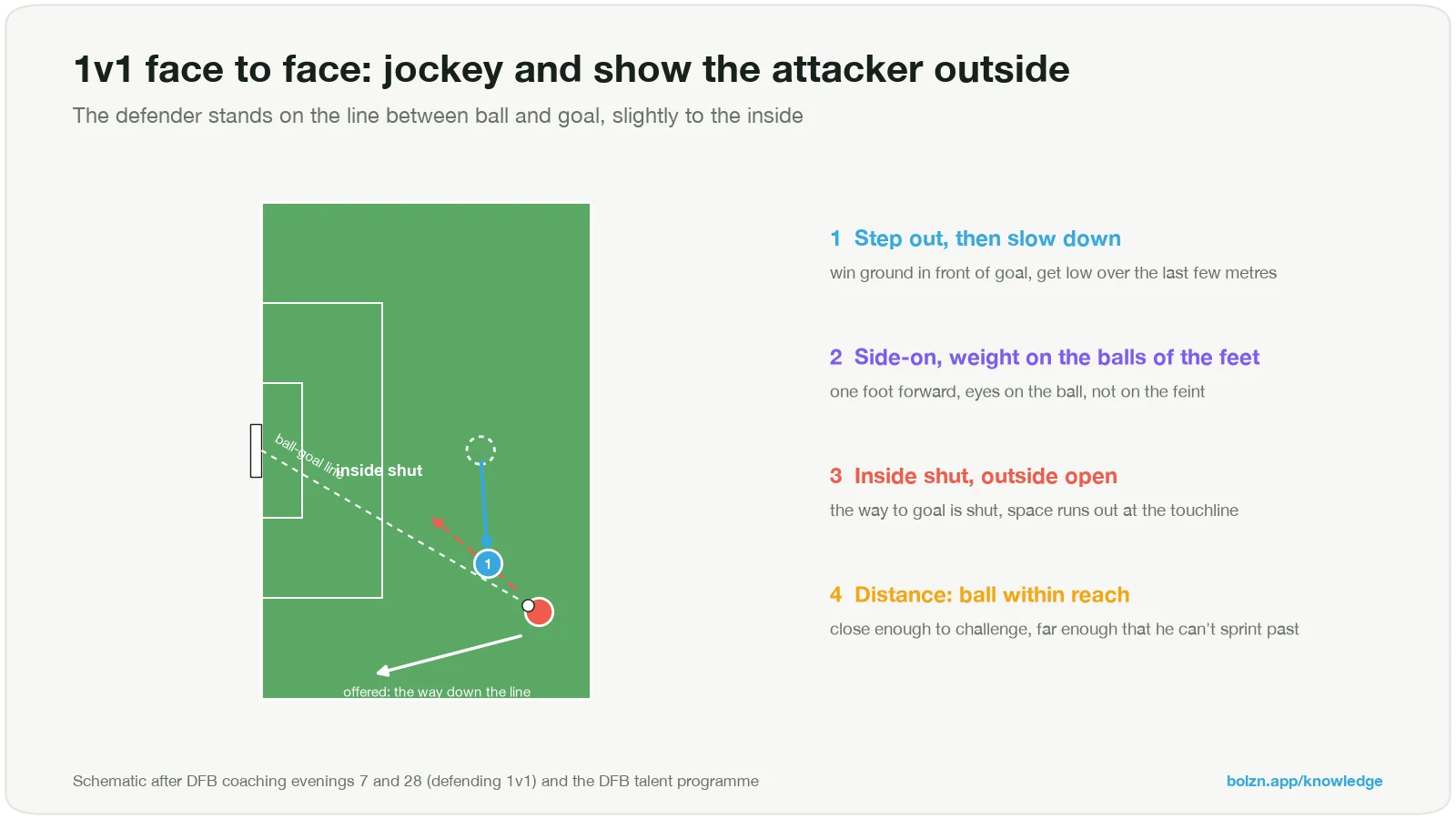
You defend a 1v1 well when you stand between the ball and your goal, side-on with your weight on the balls of your feet, keep your distance and show the attacker one side, usually the outside. You are not trying to win the ball straight away. First you stop him getting past you towards goal. You only tackle when he offers you the ball: a heavy touch, a look down at the ball, or a team-mate arriving to cover you.
When you are outnumbered, one against two, the same idea counts even more: buying time matters more than winning the ball. You delay, block the dangerous pass in behind and wait for help.
German FA (DFB) coaching material splits defending 1v1 into three basic situations, each with its own rules: face to face, attacker with his back to goal and 1v2.
The basic stance: distance, ball-goal line, on your toes
When an attacker dribbles straight at you, work through this order:
- Step out. Close him down quickly while he is still far away.
- Slow down. Over the last few metres get slower and lower: knees bent, centre of gravity low, on the balls of your feet.
- Stand side-on. One foot forward, not square like a wall. That way you can turn and run with the attacker immediately.
- Watch the ball. Legs, shoulders and head can fake a move, the ball cannot.
- Hold the distance. Back off, move with him, keep the gap the same. This is what English coaches call jockeying.
The right distance depends on the attacker's speed. The DFB booklets give roughly 2 metres on the wing at short range, and 3 to 8 metres on the wing or 5 to 8 metres centrally against an attacker coming at speed from far away. A rule without numbers is easier for players: the gap is right when he can't run past you but you can still reach the ball.
Straight or curved approach?
The sources seem to disagree here. The DFB 1v1 booklets say: go towards the dribbler in an almost straight line. Pressing courses say: close down with a curved run. Both are right, depending on the situation. Against a dribbler with no one to pass to, close the gap the shortest way. If the player on the ball has a team-mate to pass to, curve your run and block that pass with it. How this works in a press is covered in Pressing in football.
When do I tackle and when do I wait?
Good moments to win the ball:
- The attacker knocks the ball too far ahead.
- He looks down at the ball.
- He is pushed to the touchline and has no space left.
- A team-mate is covering you and will take over if you get beaten.
Again there are two schools of thought. Classic 1v1 material stresses backing off and waiting. Newer courses on group defending show exactly that waiting stance, 1 to 2 metres off the ball, as a mistake, because the opponent can pass in peace. The way to square it: on your own or outnumbered, you wait; with cover or with numbers, you go through and press.
Which way do I show the attacker?
On your own, show him outside. On the wing, block the way inside and offer the line; the touchline then works as an extra defender. In the middle there is no outside. There you show him his weaker foot or the side where your team-mate is.
With a partner, show him towards the partner. If a team-mate is ready next to you, you can even force the attacker inside, straight into a 2v1 with him. The player in front decides the direction, and the partner has to know it.
Defending an attacker with his back to goal
When your opponent receives with his back to goal, stand about an arm's length behind him, slightly to the side, on the side the ball is coming from and closer to your own goal than he is. Only from there can you still intercept the pass. If you can't get to the ball safely, be patient. Your moment is the turn: as he turns with the ball he is slow for an instant and the ball is briefly free. If you stand right on his back, he spins round you.
1v2: how do you defend when outnumbered?
Alone against two attackers you will rarely win the ball. Your goal is time. Every second you delay brings a team-mate back.
- Stand in the triangle of ball, second attacker and centre of goal. Don't get too close to either of them, or the player on the ball slips the other one in behind you.
- Keep the ball in front of you. Back off without inviting him to dribble past.
- Block the pass in behind. The through ball behind you is the most dangerous one. Position yourself so it lies in your passing shadow.
- Allow the square pass. A pass across in front of you costs the attackers time, and you shift across with it.
- Only engage when help arrives. As soon as a team-mate is back and picks up the second attacker, put full pressure on the ball.
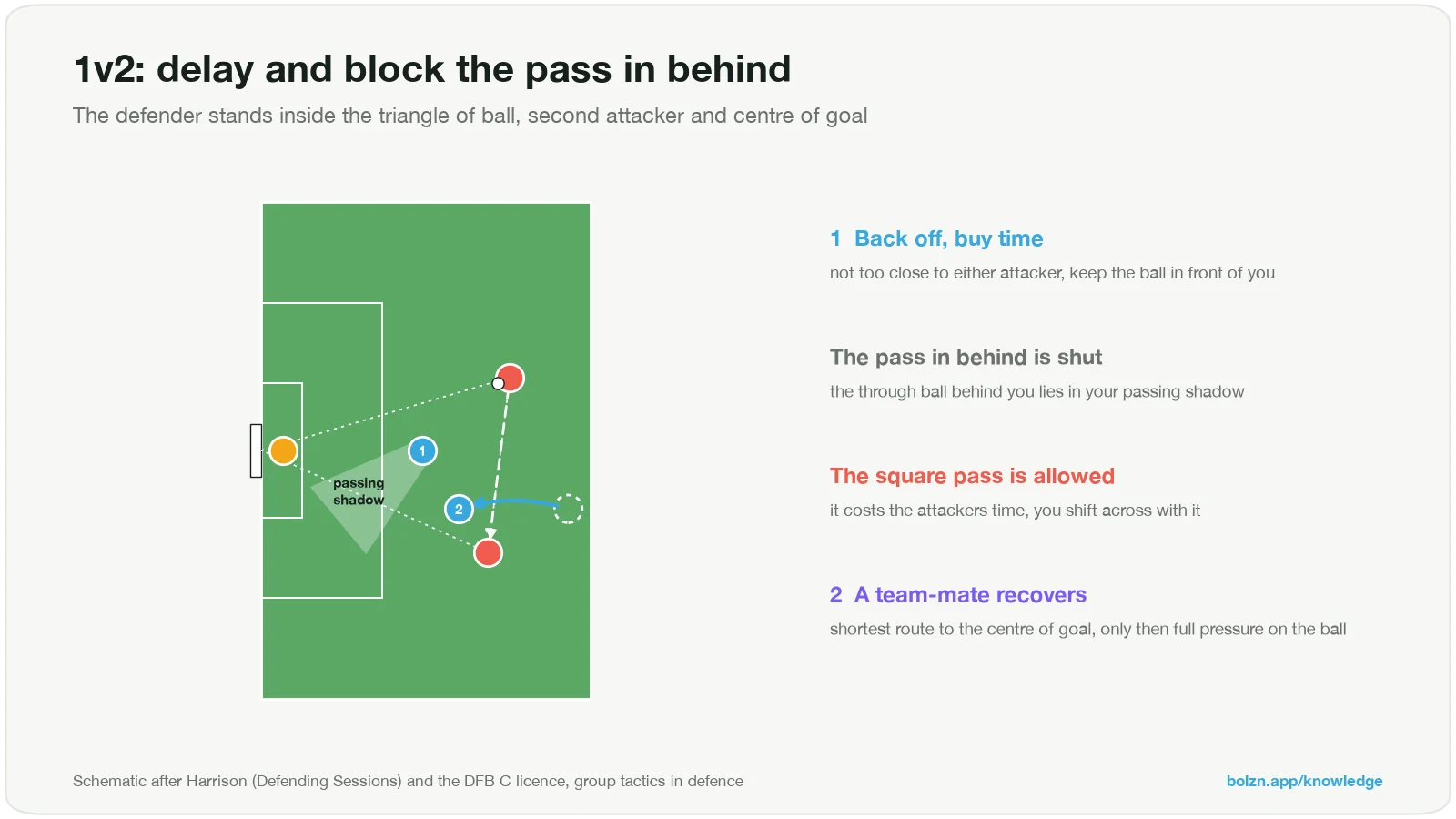
The recovering team-mate takes the shortest route to the centre of goal, not to the ball. He calls out as he arrives so the front defender knows he can now press. The goalkeeper helps by standing further off his line to sweep up balls in behind. What he does if an attacker does get through is explained in Goalkeeper 1v1.
In a 2v3 the same applies to the group. The two defenders stand slightly staggered, never quite level, and block the pass in behind. Typical mistakes listed in DFB material: engaging too early, standing too far apart so nobody covers, or too close together so every passing lane is open. Just outside your own box this changes: there the other defenders line up level with the one engaging, so the attacker running in behind is offside.
Passing shadow: how do I block passing lanes?
The passing shadow (or cover shadow) is the area behind you as seen from the ball. A ground pass into it hits you. An opponent standing in your shadow is out of the game without you marking him directly.
How to use it as an outfield player:
- Stand on the line between the ball and the dangerous team-mate, not just between you and your man.
- Keep checking the ball. The shadow moves with every touch, so you have to slide with it.
- Better staggered in pairs. Two slightly offset defenders cast one big shadow together.
Good attackers know this and move out of your shadow. How they do it is covered in Getting free in football.
Shadow or man-mark?
None of our sources states a general rule outright. From the coaching material you can derive that the zone decides:
- On the ball, in front of the ball and in midfield: block passing lanes and work with your shadow. That is how you defend when outnumbered.
- With equal numbers the others mark their opponents tightly in their zones.
- In your own penalty box: man-marking. On a cross, mark the man, not the space, because there one touch is enough for the striker to score.
How the curved run and the cover shadow work when pressing is explained in detail in Pressing in football.
Passing on and picking up: who takes whom?
When attackers play square, cross over or overlap, the responsible defender changes. Less is documented than you might expect:
- Nearest player goes. After a pass, the defender closest to the new ball carrier engages. The others shift across and cover.
- Pressure near the ball, pick up runners away from it. The player at the ball presses. The player further away picks up the runner coming from deep, for example the opposing holding midfielder arriving at the edge of the box. Pick him up too late and he is free.
- Don't cross your runs. If two defenders go to the same opponent, a hole opens up behind them.
- Don't get sucked towards the ball. Whoever runs at a ball he can't reach leaves his own man free.
No booklet prescribes fixed calls for passing on. As a suggestion from practice: the player taking over calls "Got him!", the player handing over calls "Yours!". The main thing is that everyone uses the same words. More on calls in a back line in Back four: shifting, stepping out, covering.
Common mistakes when defending 1v1
- Arriving too fast: without slowing down, one feint is enough.
- Standing square: a defender planted like a wall can't run with the attacker.
- Watching the feint instead of the ball.
- Diving in too early, especially when outnumbered.
- Standing too far off: the attacker can pass or shoot in peace.
- Leaving the inside open instead of showing him outside.
- Getting sucked towards the ball: two go to the ball, the free opponent scores.
What to teach at which age
In the youngest age groups (roughly up to U10) children mainly play freely, and overloads and underloads happen naturally. From about 11, 1v1 defending becomes a regular topic: closing down, showing outside, patience. The DFB talent programme names 11 to 12 as the latest age for this individual tactical work. Around U13 to U15 comes defending in pairs, threes and when outnumbered, from U17 the whole team. Defending against a player with his back to goal is not a must for children, though strong U12 players can learn it.
1v1 defending drills: how do I train it?
Build it up from the single duel to defending outnumbered as a group. All of these are in the bolzn drill library.
- 1v1 from an open stance: a server out wide plays the attacker into his run, the defender starts from the middle. He has to step out, slow down and jockey before the attacker gets up to speed. If he wins the ball, he counters through a cone gate.
- Two crossing duels on four mini goals: each player defends his own mini goal while a second duel runs across it. After winning the ball you counter on a different goal.
- The ball switches pitches: 3v2 in two boxes. When the ball is played into the neighbouring box, the defending pair responsible for it sprints in and the other pair leaves. The two defend outnumbered with pressure on the ball and on the space: one engages, one blocks the passing lane.
- Defending passes into the strikers: two centre-backs against two strikers and a late runner. One steps out, the other drops and covers, and the runner from deep has to be picked up. Ideal for "pressure near the ball, pick up away from it", from about 13.
"1v2 defending" and "2v3 defending outnumbered" from the library also fit. Coaching points for every drill: where is the ball-goal line? Which side are you showing? When are you allowed to tackle? After winning the ball, switch straight away; more in Transitions in football.
Sources
- DFB (German FA): coaching evenings 7 (training 1v1 defending), 8 (defending in pairs), 28 and 30 (1v1 basics, face to face and against a player with his back to goal).
- DFB: talent development programme, tactical training (individual and group tactics in defence).
- DFB: C licence grassroots, group tactics in attack and defence (course material).
- fussballtraining FOKUS: seeking and winning duels.
- Harrison, W.: Defending Sessions (1v2, the recovering defender's route).
- Kerr, P. & Flynn, P.: Coaching Defensive Play (Gaelic football), being drawn to the ball.
- Association of German Football Coaches (BDFL): International Coaches' Congress 2011 (Hyballa, defensive transition), 2014 (Rasiejewski, defending crosses) and 2015 (Beierlorzer, group defending).
- Drills from the bolzn library (1v1 from an open stance, Two crossing duels, The ball switches pitches, Defending passes into the strikers, 1v2 defending).