Off-the-ball movement in football: runs, overlaps, timing
Overlapping runs, underlaps, crossover runs, runs in behind and the third man: how players lose their marker and when exactly to make the run.
What is off-the-ball movement?
Off-the-ball movement means a player without the ball moves so that the team-mate on the ball can find him safely. Three things make it work. He has to get away from his marker and out of the defender's cover shadow, he has to stand open to the play, and he has to go at the right moment. The third point is the hardest. Go too early and you are marked again by the time the pass arrives. Go too late and the ball comes when the advantage has gone.
A good run helps even when the runner never gets the ball: it drags a defender with it and opens space for someone else.
What types of movement are there?
German FA (DFB) coaching material splits getting free into three basic forms:
- Coming short: the player moves towards the ball carrier and gets away from his marker on the way. The rule of thumb: first away from the ball, then towards it.
- Running in behind: the player first shows short, drags the defender with him, then runs into the space behind. The rule of thumb: first towards the ball, then away from it.
- Moving across: the player stays at the same height and only slides sideways into the gap between two opponents, offering himself in the gap.
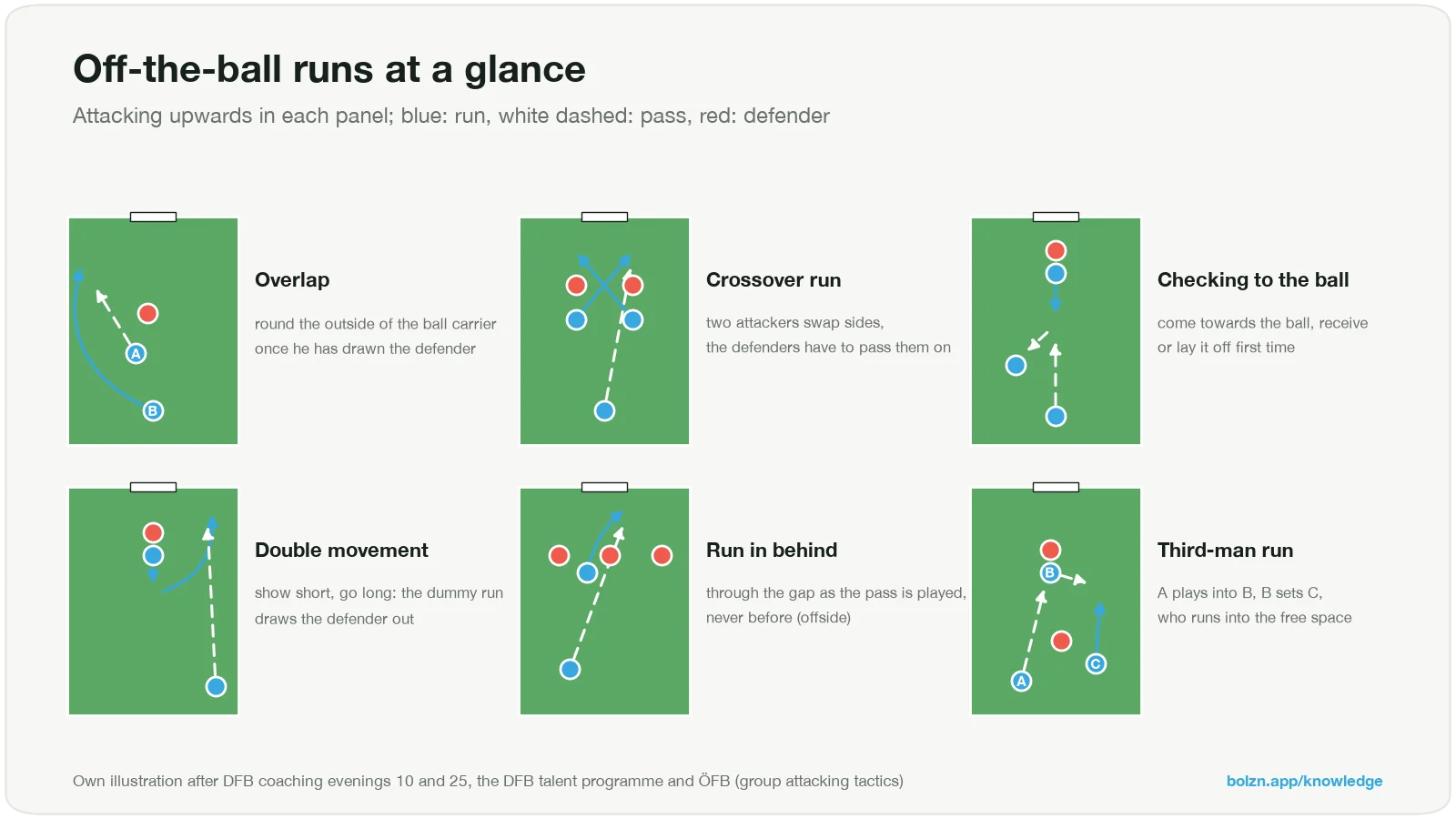
The well-known runs off the ball all grow out of these three. The graphic sums them up.
The runs one by one: what, why and who
Overlap. A team-mate runs round the back of the ball carrier, passes him on the outside and gets the ball into his path. The aim is an overload on the wing, usually followed by a cross or a dribble into the box. The classic case is the full-back overlapping his winger. The Austrian FA (ÖFB) notes that overlaps increasingly happen in the half-space too, between the wing and the centre.
Underlap. The team-mate does not go round the outside but runs past the ball carrier on the inside, towards the box. None of the federation material we worked through covers this run. From practice: it pays off when the winger is holding the width on the touchline and the opponent defends the outside well. Then the gap between full-back and centre-back is the more dangerous space.
Crossover run. Two attackers run across each other and swap sides. The defenders have to decide: follow or pass the runner on. The sources show it mainly with two strikers just before a finish, and as a positional switch from staggered midfield positions.
Checking to the ball. The striker or a midfielder comes towards the ball, receives or lays it off first time. He should not run straight at the ball carrier but offer himself at an angle. Then the passing lane stays open and he can take the ball facing forward.
Double movement. The dummy run before the real run. The player makes a first move, the defender has to follow for a few steps, then comes a sharp change of direction and a short burst. It works both ways: show short and go long, or fake long and come short. Neither pattern is better. It depends on which way the defender follows.
Run in behind. The player runs into the space behind the defence, often diagonally through the gap between two defenders. For the ÖFB, the pass in behind is the first option in attack whenever it is on. The limit is the offside line: the run starts as the pass is played.
Third man run. A plays into B, B lays it off first time to C, who is already running into free space. This is useful when the direct lane from A to C is closed. The first pass draws the defender to B, and C receives facing goal. Xavi is often quoted as saying the third man cannot be defended. How this looks in possession training is covered in Positional play.
How do I lose my marker?
The technique is the same for every run:
- Scan first. A quick look over the shoulder before the ball arrives shows where opponents and team-mates are. Anyone who only looks at the first touch is too late.
- Move against the run. First the wrong way, then a change of pace the right way. The change of pace is also the signal to the ball carrier: I am free now.
- Start from behind the defender. A player in his marker's blind side cannot be seen by him. That is the best place to start from, sideways or at an angle, never straight at him.
- Get out of the cover shadow. If an opponent stands on the line between ball and you, no pass can come. Two or three steps to the side are often enough. How holding midfielders and wide players get out of the shadow against a press is explained in Building out against a press.
- Open body shape. Half turned to the ball, half to the pitch. That way the first touch can take the ball forward.
When do I make the run? Timing
DFB material offers a simple rule. The player on the ball must be able to do three things: see the movement, have the ball under control and play the pass straight away. As long as one of these is missing, the run is wasted. If the ball carrier has an opponent on his back or has not controlled the ball yet, the team-mate runs into nothing and is marked again afterwards.
That leads to practical rules:
- Not too early. Whoever fills the free space too early gets picked up by opponents moving across and takes options away from the ball carrier. That is why the full-back only drifts wide just before the pass.
- Not too late. If the pass comes late, the opponent has reorganised and the advantage is gone.
- Go with the pass. On a run in behind, the player goes the moment the pass is played, not before. Otherwise he is offside.
- The ball carrier buys time. He can hold the ball briefly or dribble more slowly so his team-mates can make their runs.
- The free player decides. The ÖFB puts it like this: the player without the ball sets the direction and the moment of the pass. The ball carrier plays where the runner shows.
One point from practice that the sources do not spell out: a good moment is also when the defender is watching the ball. Then he cannot see the runner behind him.
Timing the overlap
Timing matters most on the overlap. The ball carrier dribbles diagonally at the full-back and slows down just before reaching him. Only once he has committed the defender does the team-mate start from inside, round behind his back and towards the touchline. The pass comes as soon as the overlapping player reappears in the ball carrier's field of view.
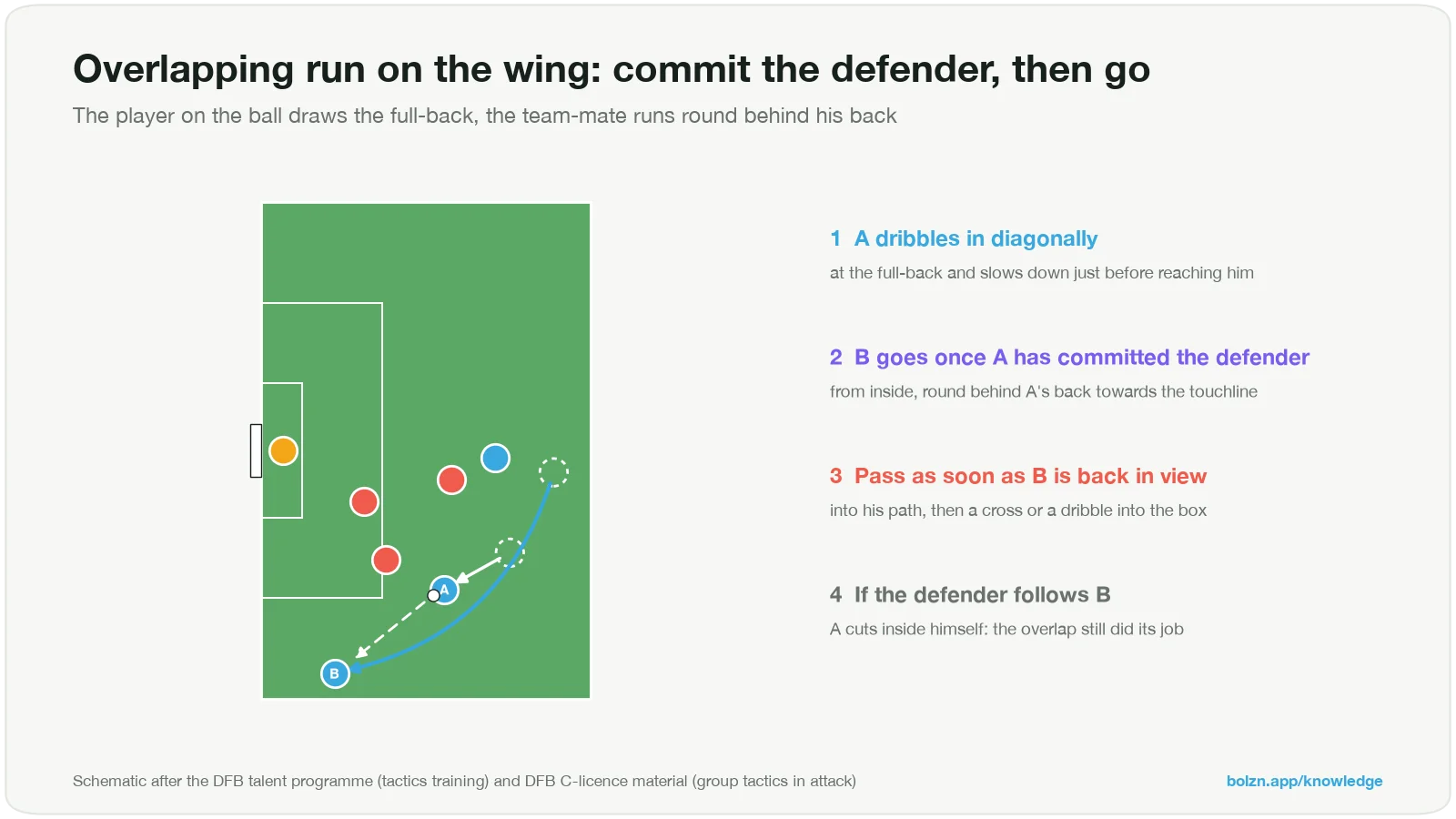
If the team-mate goes too early, the defender simply runs with him and the ball carrier is alone again. If the defender follows the runner anyway, that is not a failure: there is space inside now and the ball carrier cuts in himself. Whether to overlap tight or on a curve is taught both ways. From practice: tight is the shorter route, on a curve the runner arrives with more speed and a better angle for the pass. Allow both and see what works in the game.
When should a player not make the run?
Not every run is a good one. Two situations where a player is better off staying where he is:
- When nobody is left behind. If the full-back overlaps, someone else has to cover his position, usually the holding midfielder or the centre-back on that side. Without cover, losing the ball leads straight to a counter. More on this in the rest defence section of Transitions in football.
- When someone is already running into that space. Two players in the same space take room from each other and only pull in another defender. DFB material therefore asks the players off the ball to coordinate their runs.
Talking helps: calls for the runner
The coaching material hardly names fixed calls; what it does stress is eye contact with the ball carrier. From practice, short calls work well, for example "Overlap!" on the overlap, "Time!" when the ball carrier is not under pressure and "Turn!" when he can turn. The word matters less than everyone using the same one.
Common mistakes in off-the-ball movement
- Staying in the cover shadow. The player feels free but cannot be reached.
- Running straight at the ball carrier. That makes the space tight.
- Closed body shape. With his back to the play, the player can only pass backwards.
- Going too early. The runner has already stopped when the pass comes and is marked again.
- Standing too close to the defender. Right next to him, there is no distance to gain.
- Trying to solve everything first time. Young players in particular often want to play everything with one touch instead of holding the ball and giving the runner time.
At what age should I coach runs?
- U9 to U11: getting free through small-sided games, without run theory. Whoever is free shouts and shows. The DFB coaching evenings on getting free are aimed at players from about 11.
- U12 and U13: according to the DFB talent programme, offering and getting free at the right moment is now the topic. Double movement, checking to the ball, simple overlaps.
- U14 and U15: all combination forms one after another over a longer period: overlaps, crossover runs, third man, runs in behind with offside.
- U17 and seniors: runs taken from your own system, always thinking about cover and rest defence.
Whether to rehearse runs as fixed patterns or leave them free is seen differently. Some textbooks drill set sequences, the ÖFB advises keeping run training in measured doses and not being too strict. For your team that means: everyone should know the patterns, but in the game the player decides which one fits.
How do I coach off-the-ball movement?
Build it up, from getting free without pressure to the game:
- Getting free with a double movement: a player first moves away, then comes short, receives, turns and plays to the other side. Then the same for strikers: strikers getting free by checking to the ball and laying off, showing short and going long, or a move against the run at the six-yard box, each time with a finish. Coaching: scan, change of pace, open body shape.
- Overlap against one defender: pass, run round the outside, return pass and finish. Step up with wide 1v1 through a pole gate: the winger reads the defender and decides whether to cut inside through the pole gate, go round the outside and cross, or play a one-two. Coaching: dribble at the defender and commit him first, then the overlap goes.
- Overlap or third man: 3v2 in the wide channel. The attackers combine across a line, either with an overlap or via the third man, then it carries on 2v2 in the box. A good match for this is goal only via the third man: 4v4 in a hexagon on two mini goals, a goal only counts after a third-man combination. The wide players have to get out of the cover shadow to make it happen. What the outnumbered defenders should do in these drills is covered in Defending 1v1.
- Run into the target zone: a game with two neutral players. In front of the target zone is a line that counts as the offside line. Teams score with a pass into the zone for a team-mate who only starts his run as the pass is played. Anyone in the zone too early is offside and the ball goes to the opponent. This trains the timing of the run in behind under game conditions.
Coaching questions for every drill: Could the ball carrier see you? Did you have time to look around? Did you go with the pass or before it? Who was covering? Rondos for offering in tight spaces are covered in Rondo in football, and more small-sided games in the bolzn football drills.
Sources
- DFB: Info evening 10 "Offering and getting free" (2008) and info evening 25 "Making passes possible: offering and getting free".
- DFB: Talent development programme, tactics training (individual and group tactics, overlapping, handing over the ball, age stages).
- DFB: C-licence grassroots coaching, youth profile, group tactics in attack and defence (course material).
- ÖFB: Group attacking tactics, quick facts for training (2021).
- Association of German Football Coaches (BDFL): International Coaches' Congress 2014 (Wück, build-up under pressure) and 2015 (Sorg, group attacking behaviour).
- Gürke, S.: Tactics in football – attack and defence, KNSU (2015).
- Drills from the bolzn exercise library (getting free with a double movement, strikers getting free, overlap against one defender, wide 1v1 through a pole gate, overlap or third man, goal only via the third man, run into the target zone).